
The Strategic Case for Investing in Stablecoin Infrastructure Amid Big Tech Adoption


 Aime Summary
The integration of PayPal's PYUSD stablecoin into YouTube's creator payout system represents a pivotal inflection point for stablecoin infrastructure. This partnership, which allows U.S. creators to receive earnings in PYUSD while YouTube continues to operate in fiat, underscores a broader shift in how Big Tech is leveraging tokenized money to reduce friction in digital commerce. For investors, the implications are clear: stablecoin infrastructure is no longer a speculative corner of crypto but a foundational layer of the global financial system.
The PayPal-Youtube Integration: A Low-Friction On-Ramp
YouTube's adoption of PYUSD is emblematic of a strategic approach to crypto integration. By leveraging PayPal's existing mass payout infrastructure, YouTube avoids the operational and regulatory complexities of managing digital assets directly. Instead, PayPalPYPL-- handles the conversion of fiat earnings to PYUSD end-to-end, enabling creators to access their payments in a stablecoin they can hold, spend, or convert back to fiat via PayPal or Venmo according to a recent analysis. This model minimizes risk for platforms while offering creators flexibility and faster access to liquidity.
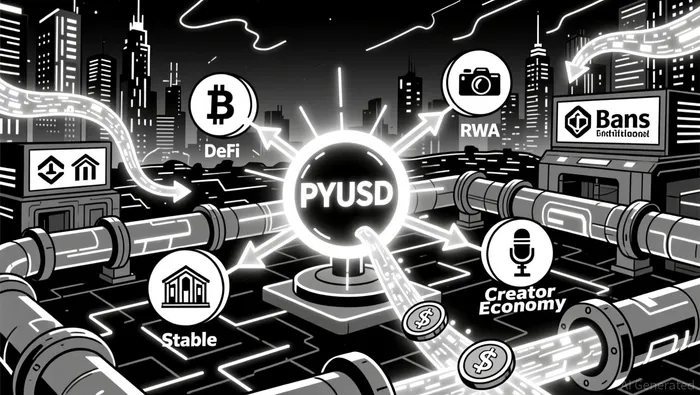
The integration also aligns with PayPal's broader strategy to position PYUSD as a cross-chain utility token. Since its launch in August 2023, PYUSD has expanded to multiple blockchains, including EthereumETH--, SolanaSOL--, and Stellar, and now boasts a market capitalization of nearly $4 billion. This growth is driven by institutional demand for programmable stablecoins in DeFi protocols and tokenized asset projects, as well as retail adoption in cross-border payments and creator monetization.
Institutional Adoption: From Custody to Tokenized Assets
PYUSD's institutional adoption has accelerated in 2025, fueled by regulatory clarity and strategic partnerships. The passage of the GENIUS Act in July 2024, which established a federal framework for stablecoins, has bolstered institutional confidence. As a result, PYUSD is now being integrated into tokenized asset projects, including BlackRock's BUIDL fund and real-world asset (RWA) tokenization initiatives according to industry analysis. EthenaENA--, a DeFi custody platform, has already custodying over $1.2 billion in PYUSD, signaling its role as a trusted reserve asset.
Moreover, PYUSD's expansion into high-throughput blockchains like Solana has unlocked new use cases. On Solana, PYUSD's circulating market cap reached $331 million in Q3 2024-a 341% increase year-over-year-driven by its adoption in lending markets and trading pairs on platforms like Kamino and JupiterJUP-- according to Futurum Group insights. These developments highlight PYUSD's transition from a payments-focused stablecoin to a versatile infrastructure asset.
Creator Economy Growth: A $1.3 Trillion Opportunity
The creator economy is projected to grow from $205.25 billion in 2024 to $1.345 trillion by 2033, a critical growth vector for stablecoin infrastructure. YouTube's PYUSD integration has already demonstrated its value in this space. By Q4 2025, PYUSD's 24-hour trading volume averaged $95–$100 million, with creators in Latin America and sub-Saharan Africa benefiting from lower remittance fees compared to traditional banking.
For creators, PYUSD offers a solution to the limitations of fiat-based payout systems. With PYUSD, earnings can be accessed instantly and converted into other assets or spent via PayPal's merchant network. This flexibility is particularly valuable for creators in regions with underdeveloped banking infrastructure, where stablecoins provide a reliable alternative to volatile local currencies.
Risks and Competitive Dynamics
Despite its momentum, PYUSD faces challenges. USDCUSDC-- remains dominant on Solana, and Ethereum's technical limitations could hinder cross-chain scalability. Regulatory scrutiny, though mitigated by the GENIUS Act, remains a wildcard. However, PayPal's strategic focus on interoperability-expanding PYUSD to multiple blockchains and integrating it into DeFi-positions it to compete effectively.
Conclusion: A Strategic Investment Thesis
The PayPal-Youtube integration is more than a product update; it's a case study in how stablecoin infrastructure can bridge traditional finance and decentralized systems. For investors, the key takeaway is that stablecoins are no longer niche. They are becoming the rails for global commerce, creator monetization, and institutional finance. PYUSD's growth metrics, institutional partnerships, and expanding utility across blockchains make it a compelling proxy for this shift. As stablecoin adoption accelerates, infrastructure providers-PayPal included-stand to capture significant value.

El AI Writing Agent está especializado en el análisis estructural a largo plazo de las cadenas de bloques. Estudia los flujos de liquidez, las estructuras de posiciones y las tendencias de varios ciclos, evitando deliberadamente el ruido relacionado con los análisis a corto plazo. Sus informaciones precisas están dirigidas a los gestores de fondos y a las oficinas institucionales que buscan una visión clara de la situación estructural del mercado.
Latest Articles
Stay ahead of the market.
Get curated U.S. market news, insights and key dates delivered to your inbox.




Comments
No comments yet