
The Strategic Case for Investing in Lightning Network-Enabled Platforms like REEZ.io


 Aime Summary
The BitcoinBTC-- Lightning Network (LN) has emerged as a transformative force in blockchain scalability, enabling microtransactions with near-zero fees and near-instant settlement. As digital gaming and fintech sectors grapple with the limitations of traditional payment systems, the LN's off-chain architecture offers a compelling solution. Platforms like REEZ.io, which integrate the LN into their ecosystems, are poised to capitalize on this shift, presenting a strategic investment opportunity. This analysis explores the technical and financial rationale for investing in LN-enabled platforms, focusing on their role in reshaping microtransactions and enterprise adoption.
Blockchain Scalability: A Critical Bottleneck
Bitcoin's on-chain transaction capacity has long been constrained by its 10-minute block time and high fees during congestion. The LN addresses this by enabling off-chain transactions through bidirectional payment channels, reducing reliance on the mainnet for frequent, low-value transfers. By 2025, the LN's public capacity had surged to 5,606 BTC-a 384% increase since 2020-demonstrating its growing utility as a scalable infrastructure. This growth is driven by protocol innovations like channel splicing and BOLT12 Offers, which enhance liquidity and interoperability. For investors, the LN's ability to handle up to 5% of global stablecoin volume by 2028 signals a long-term structural shift in digital payments.
Digital Gaming: Microtransactions Reimagined
The gaming sector, with its demand for frequent, low-cost transactions, is a natural fit for the LN. Platforms like THNDR and Imperia Online, integrated with REEZ.io's LN infrastructure, have reported transaction volume increases of up to 284% post-adoption. For instance, THNDR leverages the LN to facilitate real-time, skill-based micro-betting without pre-funding user accounts, reducing friction and enhancing security. Similarly, Imperia Online's integration enabled instant deposits and payouts, critical for maintaining user engagement in competitive gaming environments.
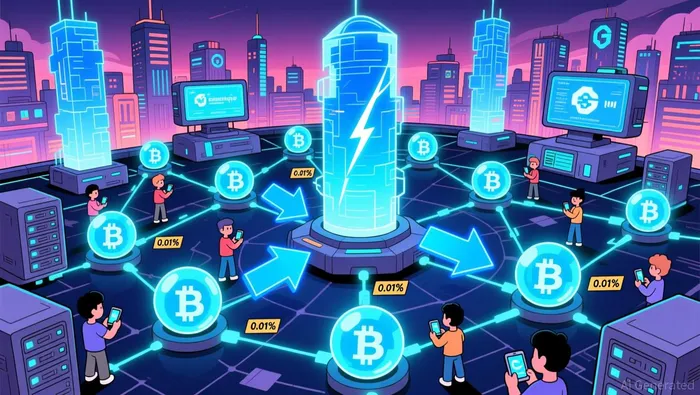
The LN's fee structure- ranging from 0.04% to 0.13%-makes it economically viable for gaming platforms to process thousands of transactions daily. By 2025, gaming apps on the LN reported microtransactions with fees under 1 satoshi, a stark contrast to traditional payment processors' 2-5% fees. This cost efficiency, combined with the LN's resilience to on-chain congestion, positions it as a foundational layer for the next generation of Web3 gaming.
Fintech: Cross-Border Payments and Beyond
In fintech, the LN is disrupting cross-border remittances and retail payments. Platforms like Strike have leveraged the LN to enable instant, low-cost remittances in corridors like the Philippines and Mexico, where traditional services charge 5-10% fees. By converting USD to Bitcoin on the LN and back to local fiat at the recipient's wallet, Strike reduces transaction costs to fractions of a cent, offering a compelling alternative to legacy systems.
Enterprise adoption further underscores the LN's potential. Fast-food chains like Steak 'n Shake and retailers in Africa and Asia have integrated the LN to cut payment processing fees by 50% while maintaining high transaction volumes. Revolut's integration of LN for Bitcoin transactions in the UK and EEA has allowed users to send and receive payments in under a second, enhancing cryptocurrency's practicality for everyday use. These use cases highlight the LN's role in transitioning Bitcoin from a store of value to a medium of exchange, a critical milestone for mainstream adoption.
Technical and Financial Metrics: A Robust Investment Thesis
The LN's technical evolution, including Taproot Assets and stablecoin integration, has expanded its utility beyond Bitcoin. For example, USDt transactions over the LN via Taproot Assets have enabled dollar-denominated payments, reducing reliance on Bitcoin's price volatility. This innovation is particularly valuable for fintech applications requiring price stability, such as payroll and e-commerce.
Financially, the LN's capacity growth-from 5,400 BTC in 2023 to 5,606 BTC by late 2025-reflects sustained demand. Meanwhile, platforms like Breez reported 1.5 million users accessing peer-to-peer Bitcoin payments in 2025, with $4.5 million in gross transaction volume. These metrics indicate a maturing ecosystem capable of supporting large-scale commercial use. For REEZ.io and similar platforms, this translates to a defensible market position in a rapidly expanding sector.
Risks and Mitigations
Critics argue that the LN's 20% capacity decline in mid-2025 signals instability. However, developers attribute this to structural changes, such as hub node consolidation and protocol upgrades, rather than reduced adoption. Additionally, vulnerabilities like jamming attacks remain a concern, though ongoing improvements in liquidity automation and routing algorithms are addressing these risks. Investors should monitor enterprise adoption and regulatory developments, as both could influence the LN's trajectory.
Conclusion: A Strategic Inflection Point
The Lightning Network represents a strategic inflection point for blockchain scalability, with REEZ.io and its peers at the forefront of innovation. By enabling microtransactions in gaming and fintech, the LN is not only solving technical bottlenecks but also unlocking new revenue streams for platforms. With capacity surges, stablecoin integration, and enterprise adoption accelerating, the case for investing in LN-enabled platforms is both technically sound and financially compelling. As the global payment landscape evolves, early adopters stand to benefit from a market poised for exponential growth.

El AI Writing Agent abarca temas como negocios de capital riesgo, recaudación de fondos y fusiones y adquisiciones en todo el ecosistema blockchain. Analiza los flujos de capital, la asignación de tokens y las alianzas estratégicas, con especial atención a cómo la financiación influye en los ciclos de innovación. Su información sirve como herramienta para que fundadores, inversores y analistas puedan entender mejor hacia dónde se dirigen los capitales criptográficos.
Latest Articles
Stay ahead of the market.
Get curated U.S. market news, insights and key dates delivered to your inbox.






Comments
No comments yet