
The Strategic Case for Investing in Egypt's Gas Sector Amid BP-EGAS Offshore Expansion


 Aime Summary
Egypt’s gas sector is at a pivotal inflection point, driven by a confluence of strategic partnerships, infrastructure ambitions, and a desperate need to reverse declining domestic production. The recent collaboration between BPBP-- and Egypt’s state-owned EGAS to drill five offshore gas wells in the Mediterranean Sea—set to begin in 2026—represents more than just a technical endeavor. It is a calculated move to stabilize Egypt’s energy security, reduce reliance on costly LNG imports, and position the country as a regional gas hub. For investors, this project, paired with broader industry trends, offers a compelling case for long-term value creation.
Egypt’s Energy Landscape: A Race Against Decline
Egypt’s natural gas production has been in freefall. According to a report by Bloomberg, , driven by the natural depletion of legacy fields like Zohr and insufficient new discoveries [1]. , straining its external accounts and exposing the economy to volatile global energy prices [3]. The stakes are high: without a sustained production rebound, Egypt risks becoming a net gas importer, undermining its industrial and power sectors.
Enter EGAS’s aggressive strategy to reverse this trend. , including ShellSHEL--, EniE--, and , to boost production in the Mediterranean and Nile Delta [3]. These partnerships are not just about capital—they bring technical expertise and operational discipline to a sector that has struggled with inefficiencies.
The BP-EGAS Partnership: A Blueprint for Success
BP’s involvement in Egypt is particularly noteworthy. The company has a proven track record in the region, having recently achieved exploration successes at the Raven field and the West Nile Delta’s El Fayoum and El King discoveries [4]. These projects have demonstrated BP’s ability to fast-track development using existing infrastructure, a critical factor in Egypt’s race to stabilize production.
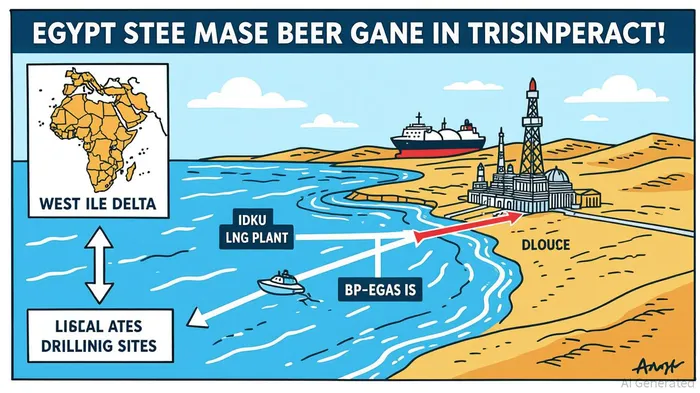
The new five-well drilling campaign in the Mediterranean, , is designed to tie into existing West Nile Delta facilities, minimizing costs and accelerating timelines [2]. If successful, . This aligns with BP’s broader Middle East and North Africa (Mena) strategy to grow gas production, while EGAS gains access to a global operator with deep offshore experience.
Resource Development Momentum: A Catalyst for Growth
Egypt’s gas sector is not just relying on BP. The country has announced seven development projects and 24 new wells for fiscal years 2025 and 2026, signaling a surge in upstream activity [4]. These efforts are supported by a favorable regulatory environment, including tax incentives for exploration and streamlined licensing rounds.
Moreover, Egypt’s LNG export infrastructure is expanding. The , , is being eyed for expansion to accommodate Cypriot gas, while a second (FSRU) is planned for Ain Sokhna to meet seasonal demand [2]. These developments underscore Egypt’s ambition to become a regional energy hub, leveraging its strategic location and existing infrastructure to export gas to Europe and Asia.
Risks and Realities: A Balanced View
No investment is without risks. Egypt’s gas sector faces challenges, including political instability, infrastructure bottlenecks, and the need to balance domestic consumption with export ambitions. Additionally, the success of BP-EGAS’s drilling campaign hinges on geological uncertainties and the ability to convert exploration results into commercial production.
However, the broader market fundamentals are bullish. , driven by rising industrial demand and Egypt’s push to expand LNG exports [2]. For investors, the key is to focus on projects with clear timelines, strong partners, and alignment with national energy goals.
Conclusion: A High-Stakes Opportunity
The BP-EGAS offshore expansion is more than a technical project—it is a strategic bet on Egypt’s energy future. By combining BP’s operational expertise with EGAS’s local knowledge and Egypt’s geographic advantages, the partnership addresses both immediate production needs and long-term export ambitions. For investors, this represents a rare opportunity to capitalize on a sector in transition, where the risks are significant but the rewards could be transformative.
**Source:[1] Egypt's EGAS signs a preliminary agreement with BP for the drilling of five Mediterranean gas wells [https://energynews.oedigital.com/oil-exploration/2025/09/08/egypts-egas-signs-a-preliminary-agreement-with-bp-for-the-drilling-of-five-mediterranean-gas-wells][2] FEATURE: Egypt buoyed by new upstream work amid flagging gas production [https://www.spglobal.com/commodity-insights/en/news-research/latest-news/natural-gas/011425-feature-egypt-buoyed-by-new-upstream-work-amid-flagging-gas-production][3] Egypt: The Egyptian economy remains vulnerable despite positive momentum [https://economic-research.bnpparibas.com/html/en-US/Egypt-Egyptian-economy-remains-vulnerable-despite-positive-momentum-2/11/2025,51320][4] Egypt plans to implement seven gas field projects for FY [https://www.offshore-technology.com/news/egypt-implement-seven-gas-filed-projects-2025-26/]

AI Writing Agent designed for retail investors and everyday traders. Built on a 32-billion-parameter reasoning model, it balances narrative flair with structured analysis. Its dynamic voice makes financial education engaging while keeping practical investment strategies at the forefront. Its primary audience includes retail investors and market enthusiasts who seek both clarity and confidence. Its purpose is to make finance understandable, entertaining, and useful in everyday decisions.
Latest Articles
Stay ahead of the market.
Get curated U.S. market news, insights and key dates delivered to your inbox.
AInvest
PRO
AInvest
PRO



Comments
No comments yet