
The Strategic Case for Investing in Aerospace Innovation Amid a New Era of Frequent, Cost-Efficient Space Launches


 Aime Summary
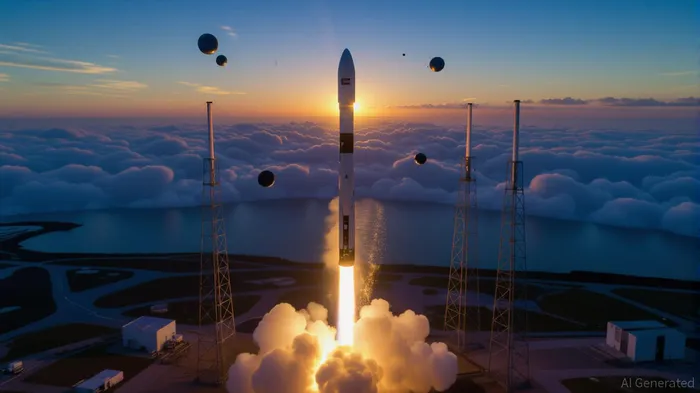
The aerospace industry is undergoing a seismic shift, driven by technological breakthroughs and business model innovations that are democratizing access to space. The recent SpaceX Transporter-15 mission, launched from Vandenberg Space Force Base on November 28, 2025, epitomizes this transformation. By deploying 140 customer payloads-including NASA's R5-S7 CubeSat, Planet Labs' SuperDove satellites, and international collaborations-
SpaceX has demonstrated how rideshare programs can drastically reduce costs while accelerating the deployment of orbital infrastructure. This mission, the 15th in SpaceX's rideshare series, underscores a broader trend: the commercial space economy is no longer a speculative frontier but a compounding force reshaping global markets.
The Cost-Efficiency Revolution
The Transporter-15 mission exemplifies the power of economies of scale in space. , but through rideshare programs,
according to recent analysis. . For smaller players, from universities to startups, such affordability
unlocks new opportunities in Earth observation, climate monitoring, and technology prototyping. For investors, it signals a maturing industry where infrastructure costs are no longer prohibitive, enabling a virtuous cycle of innovation and deployment.
A $1 Trillion Market in the Making
The implications of this cost compression are profound.
projected to surpass $1 trillion by 2032. Private companies now account for 78% of this market, with SpaceX leading the charge. The firm's Starlink satellite internet service, which
, is a case study in scalable, high-margin growth. , Starlink is not just a product-it is a platform for future services, including direct-to-cell connectivity and low-latency data networks
according to market analysis.
SpaceX's dominance is further cemented by its launch services. The Falcon 9's reusability and the upcoming Starship system are poised to drive costs down further,
with the commercial launch market forecasted to grow . This trajectory is not unique to SpaceX. The broader industry is
, driven by demand for satellite constellations, space logistics, and even lunar and Martian infrastructure.
Compounding Growth and Investor Opportunities
For investors, the key lies in identifying firms that can compound value across multiple vectors. SpaceX's revenue has
, fueled by Starlink's profitability and launch services. This growth is not a one-off; it is part of a larger pattern. The commercial space industry itself has
, . By 2040, ,
driven by applications in defense, climate tech and interplanetary commerce.
However, competition is intensifying. Amazon's Project Kuiper and Chinese satellite constellations are challenging Starlink's dominance, while new entrants in launch services and in-space manufacturing are emerging. Yet, this competition is a sign of a healthy, expanding market-not a zero-sum game. The barriers to entry, once defined by astronomical costs, are now being lowered by reusable rockets, modular satellites, and global partnerships.
The Investment Thesis
The strategic case for aerospace innovation hinges on three pillars: accessibility, scalability, and diversification. The Transporter-15 mission illustrates how rideshare programs democratize access, enabling a broader ecosystem of participants. Scalability is evident in Starlink's subscriber base and the modular design of SpaceX's rockets. Diversification comes from the industry's expanding applications, from geospatial analytics to space-based solar power.
For investors, the risks-, technical failures, and -are real but manageable. The rewards, however, are asymmetric. A $10,000 investment in SpaceX in 2018, if it had been publicly traded, would have
. Multiply that by the broader industry's growth trajectory, and the case for aerospace innovation becomes not just compelling but urgent.
Conclusion
The is more than a technical milestone-it is a harbinger of a new era. As space becomes a domain of routine, affordable access, the companies that master this transition will define the next decade of economic growth. For investors, the question is no longer whether to bet on aerospace innovation, but how aggressively to position for it. The compounding potential of firms like SpaceX, coupled with the industry's structural tailwinds, makes this one of the most consequential investment opportunities of the 21st century.

Stay ahead of the market.
Get curated U.S. market news, insights and key dates delivered to your inbox.
AInvest
PRO
AInvest
PRO



Comments
No comments yet