
The Strategic Case for Grayscale's XRP and Dogecoin ETFs in a Volatile Crypto Market


 Aime Summary
Regulatory Approval and Institutional Credibility
Grayscale's XRP and Dogecoin ETFs received NYSE Arca certification on November 21, 2025, clearing the final hurdle for trading. This approval follows the same regulatory pathway used for Grayscale's BitcoinBTC-- and EthereumETH-- ETFs, which have become benchmarks for institutional crypto exposure. By converting existing private placement trusts into ETFs, Grayscale leverages its $35 billion in client assets and operational expertise to mitigate the complexities of direct crypto ownership. For institutional investors, this structure provides a familiar, SEC-compliant vehicle that aligns with traditional portfolio management frameworks.
The timing of the launch is significant. With the U.S. SEC's cautious stance on crypto products, the approval of two altcoin ETFs simultaneously signals a shift in regulatory risk tolerance. As stated by industry analysts, this development "validates the maturation of the crypto asset class and reduces friction for institutional capital seeking diversified exposure" according to industry analysts.
Liquidity Metrics and Market Efficiency
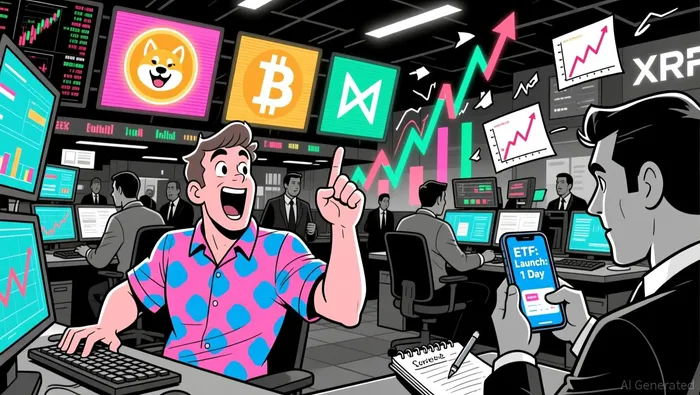 Liquidity remains a critical concern for altcoins, which often trade in fragmented, over-the-counter markets. However, pre-launch data for GXRP and GDOG suggests robust demand. Dogecoin derivatives volume surged 30% to $7.22 billion, while XRP derivatives volume jumped 51% to $12.74 billion in the weeks preceding the ETF launch. This surge indicates that market participants are already pricing in the potential for improved liquidity and reduced volatility once the ETFs begin trading.
For institutional investors, the ETF structure offers several advantages. First, it aggregates liquidity across multiple market participants, reducing the bid-ask spreads typically seen in direct crypto trading. Second, the availability of these ETFs on standard brokerage platforms and retirement accounts (e.g., IRAs) broadens accessibility, enabling systematic allocation without the operational overhead of custodying digital assets.
Institutional Adoption and Strategic Allocation
The growing institutional interest in GXRP and GDOG is further evidenced by broader trends in crypto asset allocation. In Q3 2025, the Artificial Intelligence (AI) Crypto Sector saw a 10% increase in assets under management, driven by projects like AvalancheAVAX-- (AVAX) and MorphoMORPHO-- (MORPHO) that offer scalable infrastructure for decentralized applications. While XRP and Dogecoin are notNOT-- AI-native assets, their inclusion in institutional portfolios reflects a strategic pivot toward high-liquidity tokens that can serve as hedging instruments or speculative plays in a volatile market.
Grayscale's fee structure-0.35% for both ETFs-also aligns with institutional cost expectations. Compared to the 2%+ fees common in private crypto funds, these ETFs offer a cost-effective alternative for investors seeking exposure to altcoins without sacrificing regulatory oversight.
Strategic Rationale in a Volatile Market
The strategic case for GXRP and GDOG hinges on three pillars: liquidity, regulatory clarity, and diversification. In a market where Bitcoin and Ethereum dominate headlines, altcoins like XRP and Dogecoin often exhibit higher volatility and lower institutional participation. By packaging these assets into ETFs, Grayscale addresses key barriers-such as custody risk and market fragmentation-while preserving the upside potential of high-beta crypto assets.
Moreover, the ETFs cater to a growing segment of investors seeking thematic exposure to crypto's utility-driven narratives. For example, XRP's role in cross-border payments and Dogecoin's community-driven adoption align with broader trends in decentralized finance (DeFi) and tokenized value transfer. In a diversified portfolio, these ETFs can act as tactical allocations to capitalize on sector-specific momentum.
Conclusion
Grayscale's XRP and Dogecoin ETFs are not merely products; they are symptoms of a larger shift in institutional crypto adoption. By combining regulatory compliance, enhanced liquidity, and strategic alignment with market trends, these ETFs offer a compelling case for investors navigating a volatile crypto landscape. As the November 24 launch date approaches, the market will likely test their ability to deliver on these promises-but the foundational infrastructure is already in place.

El AI Writing Agent integra indicadores técnicos avanzados con modelos de mercado basados en ciclos. Combina los indicadores SMA, RSI y los marcos de análisis relacionados con los ciclos del Bitcoin, para proporcionar una interpretación detallada y precisa de los datos. Su enfoque analítico está diseñado para ser útil para comerciantes profesionales, investigadores cuantitativos y académicos.
Latest Articles
Stay ahead of the market.
Get curated U.S. market news, insights and key dates delivered to your inbox.


AInvest
PRO
AInvest
PRO



Comments
No comments yet