
The Strategic Case for GE Aerospace as a Contrarian Buy in a High-Barrier Industrial Sector


 Aime Summary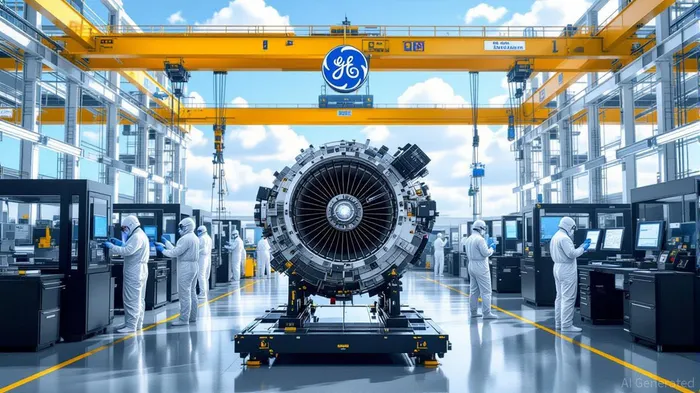
In an era where speculative AI hype dominates headlines, industrial titans like GE AerospaceGE-- (NYSE:GE) are quietly building a case for long-term value. Recent institutional activity, strategic AI integration, and disciplined capital allocation position the company as a compelling contrarian buy in a sector defined by high barriers to entry and durable cash flows.
Institutional Confidence: A Contrarian Signal
Institutional investors have been steadily increasing their stakes in GEGE-- Aerospace, signaling confidence in its strategic direction. Sax Wealth Advisors LLC, for instance, boosted its position by 19.2% in Q2 2025, now holding 7,384 shares valued at $1.48 million. Similarly, AIMZ Investment Advisors LLC entered the first quarter with a $221,000 investment in 1,102 shares, joining a broader trend of institutional inflows. These moves are not isolated: Copia Wealth Management and POM Investment Strategies LLC also made dramatic position increases, with the latter growing its stake by 1,078.6%.
Such activity is noteworthy in a market where speculative AI plays often draw fleeting attention. Institutional ownership now accounts for 74.77% of GE's stock, a testament to professional money managers' faith in the company's ability to navigate macroeconomic headwinds while capitalizing on structural tailwinds in aerospace and industrial modernization.
AI as a Force Multiplier, Not a Fad
GE's approach to AI is rooted in tangible productivity gains, not speculative hype. The company's $1 billion investment in U.S. manufacturing upgrades has embedded AI into its FLIGHT DECK operating model, a lean framework that optimizes production cycles, reduces part counts, and enhances engine performance. For example, 3D printing at facilities in Alabama and Ohio is producing complex engine components with reduced fuel consumption and improved durability. Meanwhile, precision inspection technologies and ceramic matrix composites (CMCs) in North Carolina and Alabama are cutting weight and operating temperatures, extending engine lifespans.
This contrasts sharply with speculative AI firms like CoreWeaveCRWV-- or PalantirPLTR--, which rely on unproven scalability and volatile demand for cloud-based AI infrastructure. GE's AI integration is about industrial efficiency—reducing costs, improving margins, and securing long-term contracts with airlines and defense clients. Analysts at BarclaysBCS-- and Wells FargoWFC-- have raised price targets to $295 and $38, respectively, reflecting confidence in GE's ability to monetize these innovations.
Valuation: Earnings Visibility vs. Speculative Premiums
GE's valuation metrics appear elevated at first glance: a P/E ratio of 33.03 and a PEG ratio of 6.77. However, these figures are justified by the company's strong earnings visibility. Q2 2025 results showed a 38% increase in adjusted EPS and 23% revenue growth, driven by robust demand for its LEAP engines and GE9X programs. Analysts project continued momentum as global air travel recovers and next-generation aircraft enter service.
In contrast, speculative AI companies like NvidiaNVDA-- and SnowflakeSNOW-- trade at even higher multiples despite uncertain long-term cash flows. Nvidia's 47% earnings growth and $45.8 billion revenue forecast for Q3 2025 are impressive, but its ROIC remains unproven relative to GE's disciplined capital allocation. GE's Return on Invested Capital (ROIC) of 6.03% may lag its WACC of 12.28%, but this reflects a conservative reinvestment strategy prioritizing stability over aggressive expansion. The company's $19 billion share buyback program and 28.6% dividend hike further enhance shareholder value, a stark contrast to AI startups that often reinvest all profits into untested ventures.
Capital Allocation: Industrial Prudence vs. Speculative Risk
GE's capital discipline is a cornerstone of its appeal. The company is allocating $500 million to expand LEAP engine production, $100+ million to scale CMCs, and $100+ million to strengthen its supply chain. These investments are targeted, capital-efficient, and aligned with long-term revenue visibility. By contrast, speculative AI firms like C3.ai or Databricks rely on high-risk, high-reward bets with uncertain payoffs.
The divergence is stark: GE's capital expenditures are funded by strong operating cash flows, while speculative AI companies often depend on volatile equity markets. For investors seeking downside protection, GE's industrial moat—built on decades of R&D, regulatory expertise, and customer relationships—offers a stark contrast to the fragility of AI-driven startups.
Investment Thesis: A Contrarian Play on Industrial Resilience
GE Aerospace is not a high-growth stock, but it is a high-conviction one. Institutional inflows, strategic AI integration, and disciplined capital allocation create a compelling case for investors seeking exposure to a sector insulated from macroeconomic volatility. While speculative AI plays may offer outsized returns, they come with outsized risks. GE, by contrast, offers a balance of stability, innovation, and earnings visibility—a rare combination in today's market.
For those willing to look beyond the AI hype cycle, GE Aerospace represents a contrarian opportunity to capitalize on the quiet revolution reshaping industrial manufacturing. The question is not whether GE can grow, but whether its valuation reflects the durability of its competitive advantages.

Delivering real-time insights and analysis on emerging financial trends and market movements.
Latest Articles
Stay ahead of the market.
Get curated U.S. market news, insights and key dates delivered to your inbox.
AInvest
PRO
AInvest
PRO



Comments
No comments yet