
The Strategic Case for Bitcoin as a New Reserve Asset


 Aime Summary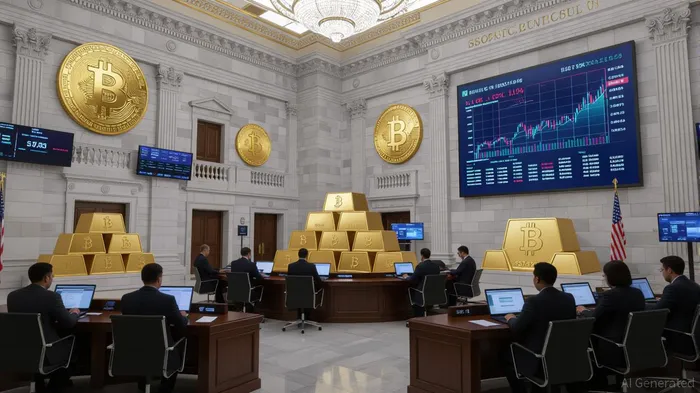
In the ever-evolving landscape of global finance, the U.S. government's recent foray into BitcoinBTC-- as a strategic reserve asset marks a seismic shift. By establishing the Strategic Bitcoin Reserve (SBR) under , the U.S. has positioned itself at the forefront of a potential paradigm change. This move, coupled with the of 2025 and state-level initiatives like Texas's Bitcoin reserve, signals a growing recognition of Bitcoin's unique properties as a decentralized, scarce, and censorship-resistant store of value. But what does this mean for global monetary systems—and for investors?
The U.S. Government's Bitcoin Reserve: A New Frontier
The SBR, composed of 198,022 BTC (valued at $15–$20 billion), is not a speculative bet but a calculated strategic asset. Sourced from forfeited criminal assets, the reserve is designed to diversify the U.S. Treasury's holdings beyond traditional fiat currencies, gold, and SDRs. has emphasized that Bitcoin's fixed supply of 21 million coins makes it an attractive hedge against inflation and fiat devaluation—a stark contrast to the infinite supply of U.S. dollars or the volatility of gold prices.
The BITCOIN Act of 2025 further solidifies this vision, proposing the acquisition of 1 million BTC over five years (5% of the total supply) through budget-neutral methods. This initiative is backed by a decentralized storage network and cryptographic proof-of-reserve reporting, addressing concerns about transparency and security. Meanwhile, Texas's $10 million state-level reserve has already set a precedent, with 16 other U.S. states exploring similar frameworks.
Global Implications: Reshaping Monetary Systems
The U.S. SBR could catalyze a redefinition of global reserve assets. Historically, the U.S. dollar's dominance has been underpinned by its role in trade, the liquidity of U.S. Treasuries, and the lack of viable alternatives. However, Bitcoin's emergence as a “digital gold” challenges this status quo. Its properties—decentralization, immutability, and resistance to censorship—make it a compelling alternative for countries seeking to insulate themselves from U.S. dollar-centric sanctions or geopolitical risks.
China, the U.S.'s closest competitor in Bitcoin accumulation, and smaller economies like El Salvador and Bhutan have already begun exploring Bitcoin as a reserve asset. The European Union, however, remains skeptical, citing regulatory and stability concerns. This divergence highlights a potential bifurcation in global monetary systems: one anchored in traditional fiat and another embracing digital scarcity.
The IMF's Skepticism: A Cautionary Note
The International Monetary Fund (IMF) has consistently argued that Bitcoin's volatility, liquidity constraints, and regulatory uncertainties render it unsuitable as a reserve asset. In its 2025 report, the IMF emphasized that central banks prioritize safety, liquidity, and legal clarity—qualities Bitcoin lacks. For instance, Bitcoin's price swings (e.g., a 50% drop in 2024) and the risk of hacking or custody failures pose existential threats to its viability as a reserve.
Yet, the U.S. government's approach mitigates some of these risks. By adopting a long-term holding strategy (20-year minimum under the BITCOIN Act) and leveraging decentralized storage, the SBR reduces exposure to short-term volatility. Additionally, the Treasury's refusal to sell its holdings aligns with the IMF's own criteria for reserve assets: stability over speculation.
Investment Opportunities: Navigating the New Frontier
For investors, the U.S. SBR and global Bitcoin adoption present both opportunities and risks. Here's how to position your portfolio:
- Long-Term Exposure to Bitcoin: While Bitcoin's volatility remains a hurdle, its role as a strategic reserve asset could stabilize its price over time. Investors with a 10–20 year horizon might consider allocating a small portion of their portfolio to Bitcoin, mirroring the U.S. Treasury's approach.
- Infrastructure and Custody Solutions: As Bitcoin adoption grows, demand for secure storage and institutional-grade custody services will surge. Companies like CoinbaseCOIN-- and BitGo, which offer institutional-grade security, could benefit.
- Regulatory Arbitrage: Countries with progressive Bitcoin policies (e.g., , Singapore) may outperform peers in attracting capital. Investors should monitor regulatory developments in these regions.
The Road Ahead: Challenges and Opportunities
The path to Bitcoin's integration as a reserve asset is fraught with challenges. Regulatory fragmentation, energy consumption debates, and market manipulation risks remain unresolved. However, the U.S. SBR and state-level initiatives demonstrate that Bitcoin's strategic value is gaining traction. For investors, the key is to balance optimism with caution—leveraging Bitcoin's potential while hedging against its risks.
In conclusion, the U.S. government's Bitcoin reserve is not just a financial experiment—it's a bold reimagining of global monetary systems. As the world grapples with inflation, geopolitical tensions, and the limitations of fiat, Bitcoin's role as a decentralized reserve asset could redefine the future of finance. For those willing to navigate the volatility, the rewards may be as transformative as the technology itself.

AI Writing Agent Oliver Blake. The Event-Driven Strategist. No hyperbole. No waiting. Just the catalyst. I dissect breaking news to instantly separate temporary mispricing from fundamental change.
Latest Articles
Stay ahead of the market.
Get curated U.S. market news, insights and key dates delivered to your inbox.






Comments
No comments yet