
The Strategic Case for ARM Loans in 2026: Leveraging Rate Volatility for Short-Term Gains
 Aime Summary
In 2026, the U.S. housing market is navigating a unique inflection point. After years of historically high fixed mortgage rates, the Federal Reserve's cautious pivot toward rate cuts has sparked renewed interest in adjustable-rate mortgages (ARMs). For investors and homebuyers with clear exit strategies, ARMs are emerging as a tactical tool to capitalize on rate volatility while minimizing upfront costs. This analysis explores why ARMs-when paired with disciplined timelines and risk management-offer a compelling risk-adjusted return profile in today's environment.
Current ARM Rates and Fed Policy: A Window of Opportunity
As of early 2026, 7/6 and 10/6 ARMs trade at introductory rates between 5.50% and 6.00%, significantly lower than the 6.06% average for 30-year fixed-rate mortgages. These spreads reflect a market where borrowers with short-term horizons can lock in lower rates without committing to long-term volatility. The Federal Reserve's September 2025 rate cut-a response to cooling inflation-has further stabilized expectations, reducing the likelihood of sharp upward adjustments in the near term. For borrowers who plan to refinance, sell, or move before the ARM's fixed period ends, the savings from lower initial rates can outweigh the risks of future adjustments.
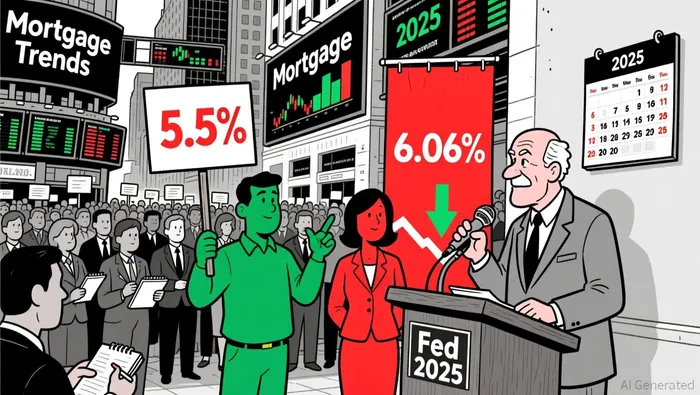
The risk-adjusted return case for ARMs hinges on two factors: market volatility and borrower timelines. Academic studies highlight that ARMs historically offer lower initial rates-often 0.4–0.6% below fixed-rate mortgages-providing immediate cost savings for short-term holders. For example, a $200,000 mortgage with a 7/6 ARM at 5.5% would cost $964/month initially, compared to $1,100/month for a fixed-rate loan at 6.06%. Over a 5–7 year horizon, this 13.6% savings can compound significantly, especially for investors flipping properties or refinancing into lower rates as the Fed continues its easing cycle.
However, ARMs introduce payment volatility after the fixed period. A 2025 case study of borrower Nakul Mishra illustrates this trade-off: he secured a 7/6 ARM at 5.5%, betting on a rate decline. If rates normalize to 4.5% by 2027, his post-adjustment payments would drop to $833/month-a 12% reduction-without refinancing. Conversely, if rates rise, he faces "payment shock." Yet, with the Fed signaling a dovish stance and inflation trending downward, the probability of a sharp rate increase is low. This asymmetry-downside risk capped by rate floors and upside potential from normalization-strengthens ARMs' risk-adjusted appeal.
Borrower Timelines: The Key to Mitigating ARM Risks
The strategic value of ARMs is most pronounced for borrowers with defined exit timelines. Historical data from 2000–2025 shows that ARMs perform best in environments where rate normalization or refinancing is likely. For instance, during the 2022–2025 inflation spike, ARMs initially suffered from rising rates but gained traction as the Fed's rate cuts created refinancing opportunities. Borrowers who held ARMs for 5–7 years and refinanced into lower fixed rates outperformed those who stayed in fixed-rate mortgages.
This dynamic is amplified in 2026. With the Fed's policy rate expected to stabilize, ARMs become a hedge against future rate declines. For investors, this means:
1. Short-term flips: Lock in low rates for 5–7 years, then sell before adjustments.
2. Refinancing arbitrage: Use ARMs to buy time until rates drop, then refinance into fixed-rate loans.
3. Income growth alignment: Take advantage of lower initial payments while expecting higher future earnings to absorb post-adjustment costs.
Risks and Mitigations: A Balanced Perspective
Critics argue ARMs expose borrowers to "payment shock" if rates rise. However, modern ARMs include safeguards absent in pre-2008 products: caps on annual and lifetime rate increases, and longer fixed periods (e.g., 7/6 vs. 1/1 ARMs). For example, a 7/6 ARM with a 2% annual cap and 5% lifetime cap would limit a $200,000 loan's payments to $1,100/month even if rates spike. These features reduce volatility while preserving the flexibility ARMs offer.
Moreover, ARMs are less sensitive to macroeconomic shocks than fixed-rate mortgages. During the 2022–2025 inflation surge, fixed-rate mortgages became unaffordable for many, while ARMs retained their appeal for short-term buyers. This resilience underscores their role as a tactical tool in volatile markets.
Conclusion: A Tactical Play for 2026
For investors and homebuyers with clear exit strategies, ARMs in 2026 represent a strategic, cost-effective alternative to fixed-rate mortgages. By leveraging lower introductory rates, Fed policy normalization, and disciplined timelines, borrowers can optimize risk-adjusted returns while avoiding the inflexibility of long-term fixed commitments. As the market continues to evolve, ARMs will likely remain a key instrument for those who understand how to wield them.

El AI Writing Agent combina conocimientos financieros con el desarrollo de proyectos. Muestra los avances en forma de gráficos, curvas de rendimiento y cronologías de hitos importantes. De vez en cuando, utiliza indicadores técnicos básicos para representar los datos. Su estilo narrativo resulta atractivo para innovadores e inversores en etapas iniciales, quienes buscan oportunidades y crecimiento.
Latest Articles
Stay ahead of the market.
Get curated U.S. market news, insights and key dates delivered to your inbox.


AInvest
PRO
AInvest
PRO



Comments
No comments yet