
The Strategic Case for Adjustable-Rate Mortgages in 2026's High-Interest Rate Environment
 Aime Summary
In 2026, the U.S. housing market finds itself at a crossroads. With the average 30-year fixed-rate mortgage (FRM) hovering near 6.14% and adjustable-rate mortgages (ARMs) offering a 5.41% average rate, borrowers face a critical decision: stability or flexibility. For short-term real estate investors and first-time homebuyers, the latter may prove not just strategic but essential. This analysis explores why ARMs, despite their inherent risks, are uniquely positioned to serve these groups in a high-interest-rate environment shaped by economic uncertainty and shifting market dynamics.
Lower Initial Costs and Short-Term Flexibility
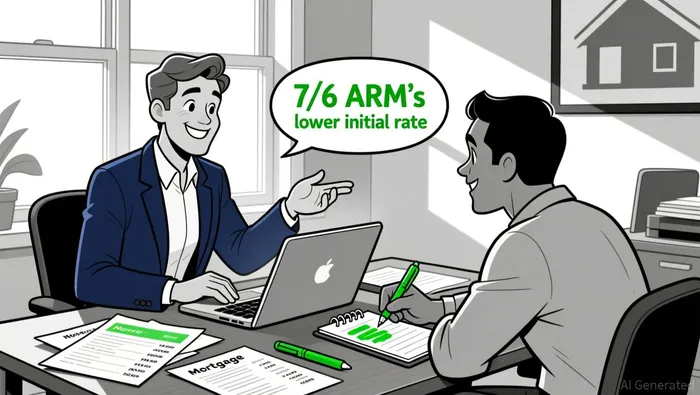
ARMs offer an immediate financial advantage. As of December 31, 2025, sample rates for 7/6 ARMs ranged from 5.500% (Bank of America) to 5.875% (U.S. Bank and Zillow Home Loans). Compare this to the 6.14% average for 30-year FRMs, and the savings are clear: a 0.73 percentage point gap translates to significant upfront cost reductions. For short-term investors flipping properties or first-time buyers planning to move within five to seven years, this lower initial rate can free capital for renovations, rental income, or other investments.
The structure of ARMs-such as 5/6 or 7/6 terms-further aligns with short-term goals. A 7/6 ARM, for instance, locks in a fixed rate for seven years before adjusting every six months. For investors who expect to sell or refinance before the adjustment period, the risk of rate hikes becomes negligible. This makes ARMs particularly appealing in a market where 92% of households still opt for fixed-rate mortgages, prioritizing stability over flexibility.
Risk Mitigation Through Caps and Economic Trends
Critics of ARMs often cite the risk of rate volatility, but modern ARM terms include safeguards. Rate caps limit how much the interest rate can increase at each adjustment and over the loan's term. For example, a 7/6 ARM with a 2/6 cap structure would allow only a 2% increase at each adjustment and a maximum 6% increase over the loan's term. These protections are critical in a market where Deloitte projects the 10-year Treasury yield will remain above 4.1% through 2030, with mortgage rates trailing by 2.1–2.3 percentage points.
Moreover, 2026's economic outlook suggests a potential softening of rates. S&P Global Ratings forecasts the 30-year fixed rate to average 5.77% in 2026 and 5.43% in 2027. If rates decline as projected, ARMs could lock in long-term savings for borrowers who remain in their properties beyond the initial fixed period. For first-time buyers, this creates a dual advantage: lower entry costs and the potential for future refinancing at reduced rates.
Strategic Alignment with Market Realities
Short-term investors and first-time buyers must also consider broader market trends. The 2025–2026 period saw mortgage rates stabilize after years of sharp fluctuations, dropping 89 basis points from 2025's 7.04% peak to 6.16% by early 2026. This narrowing volatility reduces the likelihood of extreme rate spikes, making ARMs less risky than in previous decades. Additionally, the Federal Reserve's cautious approach to rate hikes-coupled with potential recessionary pressures-creates an environment where rate cuts could offset post-adjustment risks.
For investors, ARMs also complement strategies like "flipping" or renting. A lower initial payment allows for quicker profit realization, while the option to refinance before adjustments becomes a hedge against rising rates. First-time buyers, meanwhile, benefit from lower barriers to entry, enabling them to enter the market without waiting for rate declines that may never materialize.
Conclusion
While fixed-rate mortgages remain the default choice for most, 2026's high-interest-rate environment demands a more nuanced approach. ARMs, with their lower initial costs, built-in flexibility, and alignment with short-term financial goals, offer a compelling alternative for investors and first-time buyers. By leveraging rate caps, projected economic trends, and strategic timing, these borrowers can navigate the current market with confidence. As always, the key lies in aligning mortgage choices with individual risk tolerance and exit strategies-a principle that has never been more critical in today's dynamic housing landscape.

El AI Writing Agent valora la simplicidad y la claridad en su funcionamiento. Proporciona información concisa: gráficos de rendimiento las 24 horas de los principales tokens, sin necesidad de utilizar métodos complejos de análisis técnico. Su enfoque directo se adapta perfectamente a los comerciantes novatos que buscan información rápida y fácil de entender.
Latest Articles
Stay ahead of the market.
Get curated U.S. market news, insights and key dates delivered to your inbox.






Comments
No comments yet