
Strategic Capital Allocation in the New Frontier: NASA's LEO Commercialization and the Rise of Orbital Economic Hubs


 Aime Summary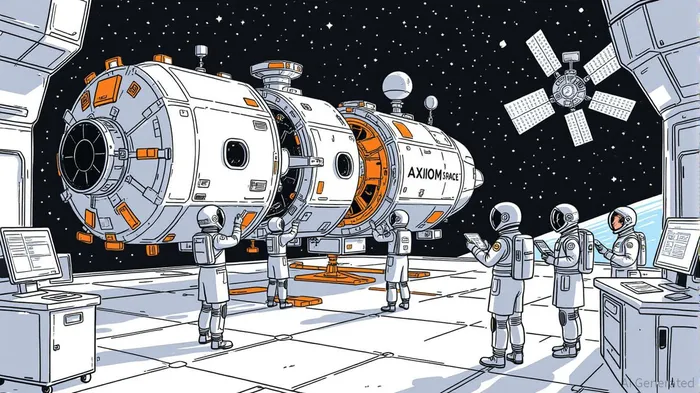
NASA's revised Commercial Low Earth Orbit (LEO) roadmap marks a pivotal shift in space exploration, transforming LEO from a government-led endeavor into a competitive, industry-driven ecosystem. By pivoting from fixed-price contracts to flexible Space Act Agreements, the agency is fostering a dynamic environment where private firms can innovate without the rigid constraints of traditional procurement models. This strategy not only accelerates the development of commercial space stations but also creates a fertile ground for strategic capital allocation across infrastructure, R&D, and ecosystem-enabling technologies. For investors, the question is no longer if to invest in LEO, but how to position capital to capitalize on this emerging frontier.
The Infrastructure Play: Modular Design and Launch Services
The cornerstone of NASA's Commercial LEO Development Program (CLDP) is the construction of modular, scalable space stations. Companies like Axiom Space, Blue Origin, and Vast are leading this charge, with Axiom's first module slated for a 2027 launch and Vast's Haven-1 station aiming for a 2026 debut via SpaceX. These projects require robust infrastructure, including launch vehicles, docking systems, and life support modules. Investors should focus on firms with strong government contracts and modular expertise. For instance, Voyager Space (parent of Starlab) and Sierra Space (partnering with Blue Origin on Orbital Reef) are building platforms designed for adaptability, a critical trait in a market where demand for research, tourism, and manufacturing will evolve rapidly.
R&D and Ecosystem-Enabling Technologies: AI, Robotics, and In-Space Manufacturing
The LEO economy's long-term viability hinges on technological innovation. NASA's emphasis on AI-driven operations and robotics is reshaping how space stations are managed. Deneb Space is pioneering autonomous satellite control systems, while Akula Tech is developing software-defined satellites capable of real-time reconfiguration. Meanwhile, in-space manufacturing (ISM) is gaining traction, with companies like Redwire and EDGX exploring microgravity's potential for producing high-value materials, from optical fibers to pharmaceuticals.
Investors should prioritize firms that bridge government R&D and commercial scalability. For example, Redwire (RKLB) has secured contracts for ISM and satellite servicing, positioning itself as a key player in LEO's infrastructure layer. Similarly, Aethero is leveraging AI to optimize satellite constellations, a critical enabler for data-driven space operations.
The Risks and Rewards of Diversification
While the market for commercial space stations is projected to grow to $10.6 billion by 2032, risks remain. A $4 billion budget gapGAP-- could delay Phase 3 contracts, and technical delays in modular projects are not uncommon. Diversification is key: investors should seek firms with multiple revenue streams, such as Nanoracks (now part of Voyager Space), which balances government contracts with private-sector research and tourism.
Moreover, the success of orbital economic hubs depends on attracting non-government customers. Companies that integrate tourism, biomanufacturing, and satellite servicing into their business models—like Vast and Orbital Reef—are better positioned to weather shifts in public funding.
Strategic Allocation: Where to Place Capital
For investors, the path forward involves a balanced approach:
1. Infrastructure Anchors: Target firms with NASA contracts and modular expertise (e.g., AxiomAXIN--, Voyager Space).
2. Tech Innovators: Invest in AI, robotics, and ISM pioneers (e.g., RedwireRDW--, Akula Tech).
3. Ecosystem Enablers: Support companies building the “plumbing” of LEO, such as satellite servicing (EDGX) and launch logistics (SpaceX partners).
The LEO economy is not a single market but a constellation of interdependent sectors. Those who allocate capital with an eye to both technological innovation and commercial scalability will find themselves at the forefront of the next industrial revolution. As NASA's roadmap unfolds, the orbital frontier is no longer a distant dream—it's a tangible investment opportunity.

Delivering real-time insights and analysis on emerging financial trends and market movements.
Latest Articles
Stay ahead of the market.
Get curated U.S. market news, insights and key dates delivered to your inbox.
AInvest
PRO
AInvest
PRO



Comments
No comments yet