
Strategic Capital Alliances Reshape Asset Management: The Goldman Sachs-T. Rowe Price Partnership and Its Implications for Institutional Investors


 Aime Summary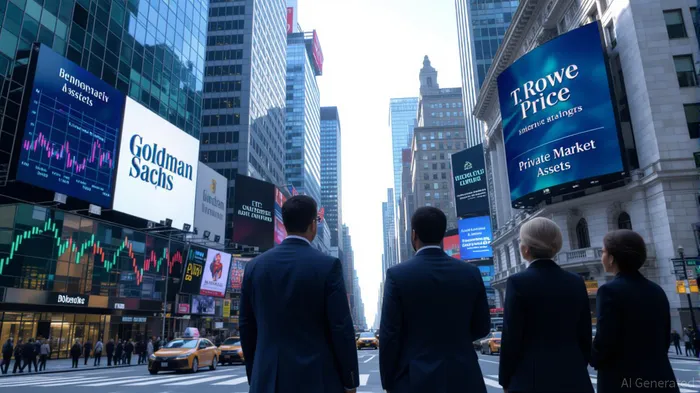
The partnership between Goldman SachsGS-- and T. Rowe Price, announced in September 2025, marks a pivotal shift in the asset management landscape. By combining Goldman Sachs' global expertise in public and private markets with T. Rowe Price's deep retirement planning capabilities, the collaboration is not merely a transactional allianceAENT-- but a strategic reimagining of how institutional investors can access diversified, high-conviction opportunities. For institutional investors, this partnership underscores a broader industry trend: the consolidation of capital and innovation to address the dual challenges of market volatility and the growing demand for alternative assets.
The Strategic Rationale: Synergy in Scale and Expertise
Goldman Sachs' $1 billion investment in T. Rowe Price—elevating its stake to 3.5%—is more than a financial commitment; it is a vote of confidence in a model that bridges traditional wealth management with cutting-edge private market solutions. The alliance's centerpiece, co-branded target-date strategies launching in mid-2026, will integrate T. Rowe Price's retirement blend expertise with Goldman Sachs' and Oak Hill Advisors' (OHA) private market capabilities. These strategies aim to democratize access to private equity, private credit, and infrastructure for retirement portfolios, a sector historically reserved for ultra-high-net-worth individuals and institutions.
For institutional investors, this synergy offers two critical advantages:
1. Diversification: Private markets have long outperformed public markets in periods of macroeconomic uncertainty. By embedding these assets into retirement vehicles, the partnership addresses the liquidity-risk trade-off that has constrained institutional allocations to alternatives.
2. Scalability: The collaboration's focus on technology-driven platforms—such as managed retirement accounts and integrated advisory tools—enables RIAs and plan sponsors to deploy these strategies at scale, reducing the friction that has traditionally limited institutional participation in niche asset classes.
Unlocking New Opportunities: The Rise of Multi-Asset Portfolios
The partnership's planned multi-asset offerings—such as a unified portfolio combining U.S. public and private equity—reflect a growing institutional appetite for holistic risk management. These products are designed to mitigate the volatility of single-asset allocations while capturing the growth potential of private markets. For example, a portfolio blending T. Rowe Price's public equity strategies with OHA's private credit vehicles could offer institutional investors a “best-of-both-worlds” approach, balancing income generation with capital appreciation.
Moreover, the alliance's emphasis on co-branded model portfolios—spanning SMAs, ETFs, and direct indexing—positions it to capitalize on the $30 trillion U.S. retirement market. By integrating retirement planning with alternative assets, the partnership addresses a critical gap: the underrepresentation of private capital in defined contribution plans. This is particularly relevant as demographic shifts and regulatory changes push institutional investors to seek higher returns in a low-yield environment.
Broader Industry Implications: A New Era of Collaboration
The Goldman Sachs-T. Rowe Price alliance is emblematic of a larger trend: the rise of strategic capital alliances as a response to market fragmentation. Traditional asset managers, constrained by liquidity demands and regulatory scrutiny, are increasingly partnering with private market specialists to offer hybrid solutions. This trend is likely to accelerate as institutional investors prioritize flexibility and innovation over siloed strategies.
For example, the collaboration's focus on scalable advisory platforms for RIAs mirrors the industry's shift toward technology-enabled distribution. By embedding retirement planning tools into T. Rowe Price's recordkeeping systems, the partnership reduces the operational burden for advisors, enabling them to serve institutional clients more efficiently. This model could set a precedent for future alliances, where technology and capital are co-optimized to serve niche markets.
Investment Advice: Positioning for the Future
For institutional investors, the key takeaway is clear: strategic alliances like this one are reshaping the asset management value chain. To capitalize on these shifts, consider the following:
1. Allocate to Hybrid Portfolios: Prioritize multi-asset strategies that blend public and private markets, particularly those with a retirement focus. These offerings provide diversification while aligning with long-term liability structures.
2. Monitor Private Market Exposure: As the partnership's products launch in 2026, track their performance against benchmarks like the S&P 500 and private equity indices. Early adopters may gain an edge in accessing high-conviction strategies before broader market adoption.
3. Engage with Technology-Driven Platforms: Institutions should evaluate partnerships with firms that integrate advanced analytics and automation into portfolio management. The ability to scale personalized solutions will be a competitive differentiator.
Conclusion
The Goldman Sachs-T. Rowe Price partnership is not just a corporate milestone—it is a harbinger of how institutional investors will navigate the next decade of market dynamics. By merging capital, innovation, and technology, the alliance redefines the boundaries of asset management, offering a blueprint for how institutions can unlock value in an increasingly complex world. For those who act decisively, the rewards could be substantial.

Stay ahead of the market.
Get curated U.S. market news, insights and key dates delivered to your inbox.
AInvest
PRO
AInvest
PRO



Comments
No comments yet