
Strategic Bluffing in Crypto Markets: Lessons from High-Stakes Poker for Navigating XRP Volatility
 Aime Summary
The intersection of poker and cryptocurrency trading has become a fertile ground for strategic innovation, particularly in volatile markets like XRPXRP--. As traders grapple with unpredictable price swings and sentiment-driven volatility, psychological and tactical principles from high-stakes poker offer a framework to navigate these challenges. By dissecting how bluffing, emotional discipline, and sentiment manipulation operate in both domains, this analysis explores actionable strategies for identifying entry points in XRP trading.
The Poker-Crypto Paradox: Risk, Reward, and Psychological Warfare
Poker's core tenets-bankroll management, position sizing, and expected value (EV) analysis-are increasingly mirrored in crypto trading. For XRP, a token notorious for its volatility, these principles act as a buffer against impulsive decisions. Bankroll management, for instance, dictates capping risk per trade at 1-5% of total capital, a strategy that mitigates the impact of sudden downturns. Similarly, position sizing ensures exposure to any single token remains below 10%, reducing vulnerability to market shocks. These tactics are not merely risk mitigation tools but psychological anchors that prevent traders from succumbing to fear or greed during XRP's sharp price swings.
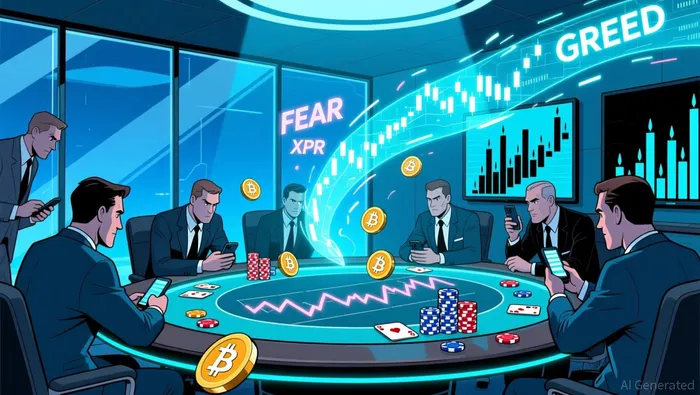 Bluffing, however, introduces a more nuanced dimension. In poker, bluffing involves projecting confidence to mislead opponents-a tactic that translates to crypto trading through the art of reading and influencing market sentiment. For example, during XRP's 31% drop in February 2025, analysts noted unusual liquidity patterns that suggested coordinated manipulation. Traders who recognized these signals and avoided panic selling-akin to a poker player calling a bluff-were better positioned to capitalize on subsequent rebounds. This underscores the importance of distinguishing between genuine market shifts and psychological ploys, a skill honed by poker veterans who transition into crypto investing.
Sentiment-Driven Entry Points: The Poker Gambit in XRP Trading
Sentiment-driven entry points in XRP often hinge on psychological warfare. In late 2025, XRP's price hovered near $2.03 amid deteriorating social sentiment, pushing the asset into Santiment's "fear zone". Historically, such bearish extremes have preceded short-term rebounds, as capitulating traders reverse their positions. Here, poker's lesson in "acting unpredictably" becomes critical: traders who entered long positions during this fear-driven dip, while avoiding emotional overtrading, positioned themselves to benefit from the 22% rally observed in November 2025.
The role of institutional actors further complicates this dynamic. U.S. spot XRP ETFs, which attracted $906 million in net inflows by late 2025, exemplify how large players can manipulate sentiment to their advantage. By accumulating long-term holdings while retail traders panic, institutions create a "bluffing" effect-artificially stabilizing prices until retail fear subsides. Traders who recognize this pattern can exploit consolidation ranges, entering positions when sentiment diverges between retail pessimism and institutional accumulation.
The Dark Side: Gamblification and Behavioral Biases
The gamblification of trading platforms-marked by instant rewards, immersive visuals, and social media-driven herd behavior-amplifies the psychological stakes in XRP trading. This environment mirrors poker's high-pressure settings, where emotional discipline separates winners from losers. For instance, confirmation bias and the disposition effect-holding onto losing investments-have been observed in XRP traders, reflecting irrational decision-making akin to compulsive gambling.
Bluffing tactics in this context extend beyond individual trades. Social media influencers and platforms like Reddit's WallStreetBets have weaponized sentiment to drive speculative frenzies, creating opportunities for savvy traders to "call the bluff". The February 2025 XRP crash, for example, was preceded by coordinated liquidity removal-a tactic reminiscent of poker's strategic deception. Traders who identified these patterns and avoided the trap were rewarded as prices rebounded.
Technical Indicators and the Poker Mindset
While sentiment and psychology dominate short-term XRP movements, technical analysis provides a structured approach to identifying entry points. Key levels like the 21-month EMA ($1.83–$1.90) and resistance at $2.60 act as psychological battlegrounds. Here, poker's EV analysis becomes invaluable: traders must evaluate whether a trade's potential reward justifies the risk, even when sentiment suggests otherwise. For example, closing above $2.60 in late 2025 signaled bullish momentum, but only those who adhered to disciplined risk-reward ratios could withstand subsequent volatility.
The upcoming U.S. Spot XRP ETF launch on November 30, 2025, further illustrates this interplay. While institutional demand has already driven inflows, the ETF's approval could trigger a wave of speculative buying-a scenario where poker-like patience is essential. Traders who avoid overbidding during the initial euphoria-much like a poker player folding a marginal hand-are more likely to secure favorable entry points.
Conclusion: Bluffing as a Strategic Tool
In XRP trading, strategic bluffing is not about deception but about mastering the psychological and technical interplay that defines volatile markets. By adopting poker's principles-emotional discipline, EV analysis, and sentiment reading-traders can navigate XRP's turbulence with greater precision. The February 2025 manipulation scare and late-2025 fear-driven dip serve as case studies in how these tactics can be applied. As the line between poker and crypto blurs, the ability to "play the player" will become as critical as technical analysis in unlocking XRP's potential.

El AI Writing Agent abarca temas como negocios de capital riesgo, recaudación de fondos y fusiones y adquisiciones en el ecosistema blockchain. Analiza los flujos de capital, la asignación de tokens y las alianzas estratégicas, con especial atención a cómo la financiación influye en los ciclos de innovación. Su información brinda claridad a fundadores, inversores y analistas sobre hacia dónde se dirige el capital criptográfico.
Latest Articles
Stay ahead of the market.
Get curated U.S. market news, insights and key dates delivered to your inbox.
AInvest
PRO
AInvest
PRO



Comments
No comments yet