
The U.S. Strategic Bitcoin Reserve: A Geopolitical Power Play and Its Impact on Bitcoin's Institutional Future


 Aime Summary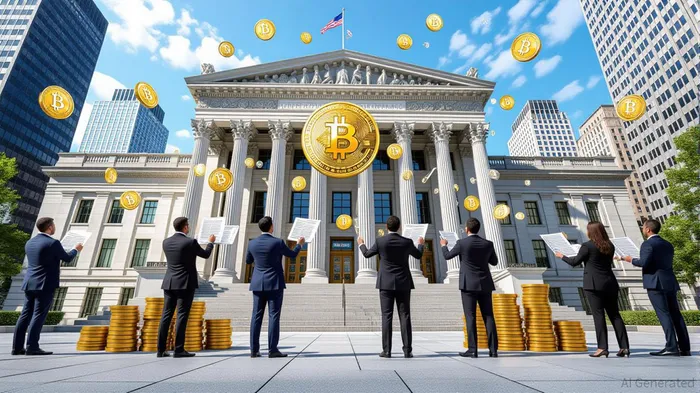
The U.S. Strategic BitcoinBTC-- Reserve (SBR), established in March 2025 under President Donald Trump's executive order, has ignited a seismic shift in global finance. By centralizing 200,000 BTC—valued at $18–22 billion—as a strategic reserve, the U.S. is redefining the role of Bitcoin in national economic planning. This move, which repurposes seized cryptocurrency from criminal forfeitures into a long-term asset, signals a bold departure from traditional reserve models and positions the U.S. as a leader in the digital assetDAAQ-- revolution. For investors, the implications are profound: Bitcoin is no longer a speculative token but a geopolitical tool with institutional legitimacy.
Geopolitical Implications: A New Currency of Power
The SBR's establishment is not merely a financial decision—it is a strategic maneuver to assert U.S. dominance in the digital age. By treating Bitcoin as a reserve asset, the U.S. is challenging the dominance of the dollar and gold in global trade while hedging against geopolitical risks. This shift mirrors Cold War-era strategies, where control over critical resources (oil, gold) dictated economic and political influence. Today, Bitcoin's decentralized, borderless nature makes it a weapon of choice for nations seeking to bypass traditional financial systems.
The SBR's ripple effect is already evident. Countries like Brazil, Ukraine, and the Central African Republic are exploring their own Bitcoin reserves, while European nations like Sweden and Ireland are debating its inclusion in national portfolios. Even skeptics, such as the UK and Switzerland, are forced to reckon with the U.S. precedent. This global competition for digital sovereignty is accelerating the normalization of Bitcoin as a reserve asset, with the U.S. setting the regulatory and institutional framework.
Monetary Policy: From Speculation to Strategy
The BITCOIN Act of 2025, which mandates the acquisition of 1 million BTC over five years, underscores the U.S. government's commitment to Bitcoin as a macroeconomic tool. By leveraging gold revaluation to fund these purchases, the SBR avoids taxpayer costs while reinforcing Bitcoin's legitimacy. This budget-neutral strategy aligns with traditional reserve logic—gold's scarcity and durability made it a store of value; Bitcoin's capped supply and programmable nature offer similar, if not superior, attributes.
Institutional adoption has followed suit. BlackRock's Bitcoin Trust, for instance, attracted $50 billion in assets post-SBR announcement, reflecting confidence in Bitcoin's role as a diversified reserve. The U.S. CLARITY Act, which reclassified Bitcoin as a CFTC-regulated commodity, further solidified its institutional appeal. However, volatility remains a double-edged sword. The Treasury's August 2025 decision to halt new SBR purchases triggered a 10% price drop and $1 billion in liquidations, highlighting the market's sensitivity to regulatory shifts.
Institutional Adoption: A Structural Shift
The SBR has catalyzed a structural shift in how institutions view Bitcoin. States like Texas, New Hampshire, and Arizona have enacted laws allowing state-level Bitcoin reserves, with Texas's SB 21 requiring cold storage and multi-signature custody. These initiatives reflect a growing recognition of Bitcoin's utility in hedging against inflation and geopolitical instability.
Gemini and Glassnode's June 2025 report noted that over 30% of Bitcoin's circulating supply is now held by centralized entities, including sovereigns and ETFs. This trend suggests a maturation of the market, where long-term capital and strategic custody replace speculative trading. For investors, this means Bitcoin's volatility is being tempered by institutional-grade infrastructure, making it a more viable component of diversified portfolios.
Investment Advice: Balancing Risk and Reward
For investors, the SBR represents both opportunity and caution. The U.S. government's endorsement elevates Bitcoin's status, but its volatility and regulatory uncertainty remain risks. Here's how to navigate this landscape:
- Diversify: Allocate Bitcoin as a small portion of a broader portfolio, balancing it with gold, stablecoins, and traditional assets.
- Secure Custody: Prioritize institutional-grade custody solutions (cold storage, multi-signature wallets) to mitigate security risks.
- Monitor Policy Shifts: Track regulatory developments, such as the BITCOIN Act's implementation and state-level SBR laws, which could influence Bitcoin's value.
- Long-Term Mindset: Avoid short-term trading. The SBR's 20-year holding period for federal reserves signals a long-term strategy, which investors should emulate.
Conclusion: A New Era in Global Finance
The U.S. Strategic Bitcoin Reserve is more than a policy experiment—it is a catalyst for a new era in global finance. By integrating Bitcoin into its reserves, the U.S. is reshaping the geopolitical and monetary landscape, challenging traditional power structures and redefining economic resilience. For investors, this means Bitcoin's long-term value proposition is no longer speculative but strategic. As the world races to adopt digital assets, the SBR sets a precedent that will influence markets, regulations, and investment strategies for decades to come.


Decoding blockchain innovations and market trends with clarity and precision.
Latest Articles
Stay ahead of the market.
Get curated U.S. market news, insights and key dates delivered to your inbox.


AInvest
PRO
AInvest
PRO



Comments
No comments yet