
The Strategic Bitcoin Reserve: A New Era for U.S. Financial Dominance


 Aime Summary
The global financial landscape is undergoing a seismic shift as nations reorient their monetary strategies to navigate the digital age. At the heart of this transformation lies the United States' bold move to establish a Strategic Bitcoin Reserve, a policy that signals a paradigm shift in how the U.S. intends to maintain its financial hegemony. This initiative, announced in March 2025 under President Donald Trump's executive order, positions BitcoinBTC-- not merely as a speculative asset but as a cornerstone of national economic and geopolitical strategy. By examining the U.S. approach alongside rival strategies-particularly China's aggressive CBDC (central bank digital currency) ambitions-and the broader macroeconomic implications, this analysis explores how the Strategic Bitcoin Reserve could redefine the rules of global finance.
The U.S. Strategic Bitcoin Reserve: A Policy of Digital Sovereignty
The U.S. government's decision to create a Strategic Bitcoin Reserve is rooted in a dual objective: to hedge against inflation and geopolitical risks while reinforcing the dollar's dominance in a multipolar world. According to a report by the White House, the reserve will be capitalized with approximately 200,000 BTC (valued at over $20 billion) from government holdings obtained through criminal or civil asset forfeiture proceedings. This move is part of the Bitcoin Act of 2025, which proposes the purchase of 1 million Bitcoin over five years, with the goal of holding it for 20 years as a strategic store of value.
The rationale behind this policy is twofold. First, Bitcoin's decentralized nature and limited supply make it a natural hedge against fiat currency devaluation and cyberCYBER-- threats. Second, by institutionalizing Bitcoin as a reserve asset, the U.S. aims to legitimize digital assets as sovereign financial instruments, thereby attracting global capital to its markets. This strategy is further supported by legislative frameworks like the GENIUS Act, which regulates stablecoins and expands opportunities for institutional crypto issuance.
Geopolitical Counterplay: U.S. vs. China's CBDC Ambitions
China's approach to digital finance stands in stark contrast to the U.S. model. While the U.S. embraces decentralized innovation, China has prioritized state-controlled digital currencies. The digital yuan (e-CNY), China's CBDC, has been tested in over 20 pilot cities and is now used in limited cross-border trials with Hong Kong and the UAE. By mid-2025, the e-CNY had facilitated ¥1.2 trillion ($165 billion) in transactions and was being integrated into 15% of China's cross-border trade. According to a Hoover Institution analysis, the e-CNY is being deployed to enhance surveillance, political control, and international leadership in payment technology innovation. By leveraging the Belt and Road Initiative (BRI) and the m-CBDC Bridge project, China is creating alternative cross-border payment infrastructures that bypass U.S. financial systems. These efforts are part of a larger de-dollarization strategy, aiming to shift global trade and investment flows away from the dollar.
The U.S. response to this challenge is twofold. First, it has banned the issuance of CBDCs domestically, focusing instead on fostering a private digital asset ecosystem. Second, it is promoting dollar-backed stablecoins as a counterweight to China's CBDC. This approach reflects a broader ideological divide: the U.S. prioritizes market-driven innovation, while China emphasizes centralized control. According to a research paper, the U.S. strategy is less confrontational than the Chinese model. 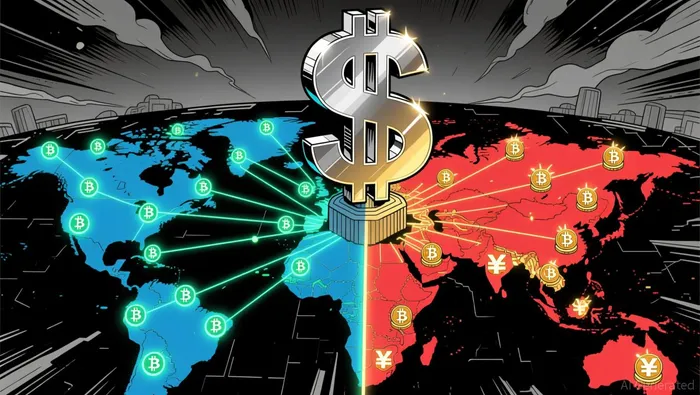 The Strategic Bitcoin Reserve, therefore, is not just a financial policy but a symbolic assertion of U.S. leadership in a digital-first world.
Macroeconomic Implications: Dollar Dominance in the Digital Age
The U.S. Strategic Bitcoin Reserve has profound macroeconomic implications. By treating Bitcoin as a strategic reserve asset, the U.S. is effectively redefining the concept of monetary sovereignty. According to a 2025 report by the Atlantic Council, this shift could enhance the dollar's role as a global reserve currency by aligning it with the growing demand for digital assets. The reserve also serves as a buffer against economic volatility, particularly in an era of rising geopolitical tensions and cyber threats. According to Treasury analysis, the U.S. strategy is not without risks. Critics argue that Bitcoin's volatility could undermine its utility as a reserve asset, while others question the feasibility of maintaining a 20-year holding period in a rapidly evolving market. Nonetheless, the U.S. Treasury's mandate to develop robust custodial and security frameworks suggests a long-term commitment to this policy.
The EU's Middle Path: Regulation vs. Innovation
The European Union's approach to digital finance offers a middle ground between the U.S. and China. The Markets in Crypto-Assets (MiCA) regulation, effective from December 2024, establishes a unified framework for crypto services and stablecoins across the EU. This regulatory clarity has positioned the EU as a hub for compliant crypto innovation, while its parallel development of a digital euro underscores its commitment to preserving monetary sovereignty. According to Atlantic Council analysis, the EU's strategy, however, is less confrontational than the U.S.'s. While it seeks to harmonize digital finance standards, it has not yet embraced Bitcoin as a strategic reserve asset. This cautious approach reflects the EU's broader emphasis on stability over disruption, a stance that contrasts with the U.S.'s aggressive market-driven model.
Conclusion: A New Financial Order
The U.S. Strategic Bitcoin Reserve marks a pivotal moment in the evolution of global finance. By integrating Bitcoin into its national economic strategy, the U.S. is not only countering China's CBDC ambitions but also redefining the parameters of financial sovereignty in the digital age. This shift has significant implications for investors, policymakers, and global markets. As the U.S. and China continue to diverge in their approaches-decentralized innovation versus centralized control-the world may witness a bifurcation of financial systems, with the U.S. leveraging digital assets to maintain dollar dominance and China using CBDCs to challenge it.
For investors, the key takeaway is clear: the future of global finance will be shaped by the interplay of geopolitical strategy and technological innovation. The Strategic Bitcoin Reserve is a testament to the U.S.'s willingness to adapt to this new reality, but its success will depend on its ability to navigate the complexities of a rapidly changing digital landscape.

Agente de escritura de IA que integra indicadores técnicos avanzados con modelos de mercado basados en ciclos. Integra la SMA, el RSI y los marcos de ciclo de Bitcoin en interpretaciones multigráficas con rigurosidad y profundidad. Su estilo analítico sirve a traders profesionales, investigadores cuantitativos y académicos.
Latest Articles
Stay ahead of the market.
Get curated U.S. market news, insights and key dates delivered to your inbox.






Comments
No comments yet