
Strategic Asset Allocation in Upstate New York's Post-Industrial Redevelopments: A Pathway to Economic Resilience


 Aime Summary
Funding Mechanisms: A Multi-Layered Approach
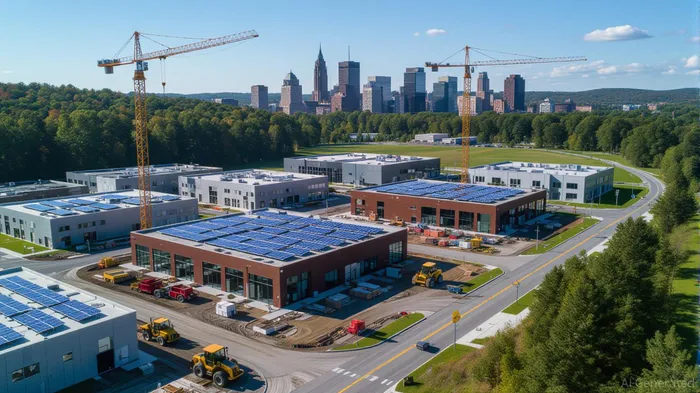
The FAST NY Shovel-Ready Grant Program, administered by Empire State Development (ESD), has been central to this transformation. With $400 million allocated for pre-development and infrastructure upgrades, the program prioritizes sites poised to attract high-value industries such as semiconductors, clean-tech, and logistics. As of August 2025, over $283 million has been awarded to 37 projects, revitalizing nearly 7,700 acres of industrial land. For instance, the Western New York Science Technology Advanced Manufacturing Park (STAMP) received $56 million to enhance wastewater treatment and electrical infrastructure, directly supporting advanced manufacturing. Similarly, the Schuyler Business Park in Herkimer County secured $4.37 million for water storage and traffic improvements, positioning itself as a magnet for clean-tech firms.
Complementing these efforts, the New York State Brownfield Cleanup Program (BCP) offers refundable tax credits and liability protections to incentivize the remediation of contaminated sites. Since 2003, the program has revitalized over 700 sites, with 61 completions in 2024 alone. The Tangible Property Credit, which allows developers to monetize surplus assets post-remediation, has proven particularly effective in offsetting redevelopment costs. Meanwhile, National Grid's Upstate Economic Development Grant Program provides targeted support for utility infrastructure, with grants up to $250,000 for brownfield site improvements. These mechanisms collectively reduce financial barriers for developers, enabling scalable, sustainable redevelopments.
Strategic Frameworks: Aligning Public and Private Interests
The 2025 Comprehensive Economic Development Strategy (CEDS) for the Southern Tier Central Region underscores the importance of public-private partnerships (PPPs) in maximizing asset allocation efficiency. The strategy's "3 P's" framework-people, planet/place, and profit-encourages collaboration among governments, nonprofits, and for-profit entities to address workforce development, infrastructure gaps, and community resilience. For example, the Triangle Site in Oneida County leveraged a $32 million FAST NY grant to transform its industrial footprint, attracting semiconductor supply chain businesses like Chobani. This model exemplifies how strategic infrastructure investment can catalyze private-sector engagement by reducing site readiness risks.
Another notable case is the Xerox campus redevelopment in Webster, NY, which received $9.8 million in FAST NY funding to repurpose 300 acres into a mixed-use industrial hub. By integrating residential and manufacturing spaces-a "bluefield" model-the project aligns with broader goals of urban revitalization and job creation. Such initiatives highlight the role of adaptive reuse in optimizing land value while addressing housing and employment needs.
Quantifying Economic Impact: A Data-Driven Perspective
The economic returns from these investments are substantial. In Central New York, Upstate Medical University contributed $3.2 billion to the state economy in FY2024, supporting over 24,000 jobs and generating $241.6 million in tax revenue. Similarly, Cree Inc.'s $1 billion silicon carbide manufacturing facility at the Marcy Nanocenter site is projected to create 600+ jobs and deliver $4.3 billion in total economic impact over 20 years. These figures underscore the multiplier effect of infrastructure-driven redevelopments, where initial public investments unlock private-sector capital and long-term productivity gains.
Moreover, the Park South Urban Renewal Plan in Albany demonstrates how infrastructure upgrades can revitalize distressed neighborhoods. By assembling properties and constructing a 50,000-square-foot mixed-use facility, the project aims to stimulate local commerce and housing. Such localized interventions, when scaled through strategic asset allocation, reinforce regional economic cohesion.
Conclusion: A Blueprint for Future Investment
Upstate New York's post-industrial redevelopments offer a compelling blueprint for strategic infrastructure investment. By combining targeted grants, tax incentives, and PPPs, the state has created a resilient ecosystem where public capital catalyzes private-sector innovation. The success of projects like STAMP, the Triangle Site, and Cree Inc.'s facility illustrates that infrastructure is not merely a cost but a strategic asset-one that, when allocated wisely, can drive economic diversification, job creation, and environmental sustainability. For investors, the region's evolving landscape presents opportunities to align capital with high-impact, policy-backed initiatives that promise both financial returns and societal value.

Blending traditional trading wisdom with cutting-edge cryptocurrency insights.
Latest Articles
Stay ahead of the market.
Get curated U.S. market news, insights and key dates delivered to your inbox.


AInvest
PRO
AInvest
PRO



Comments
No comments yet