
Strategic Alliances and Technological Synergy in the EV Transition: Volkswagen's Rivian JV and Tesla Network Access


 Aime Summary
Rivian JV: A Software-Defined Leap
Volkswagen's joint venture with Rivian, branded as "RV Tech," represents a bold pivot toward software-centric vehicle architecture. Founded in November 2024, the partnership focuses on developing a Software-Defined Vehicle (SDV) platform, which replaces traditional wiring harnesses with modular central computers capable of over-the-air updates, according to a Volkswagen Group press release. This zonal architecture enables features like highly automated driving and adaptive infotainment systems, positioning Volkswagen to rival Tesla's over-the-air innovation.
The SDV platform is designed for scalability. Volkswagen plans to integrate it into its upcoming SSP (Scalable Systems Platform), targeting up to 30 million units globally, as the Volkswagen Group press release notes. For Rivian, the collaboration accelerates its transition from niche EV builder to mass-market contender, with the SDV underpinning future models like the R2 and R3X. Crucially, the joint venture's 1,500+ developers and new Berlin hub underscore Volkswagen's commitment to embedding software expertise into its DNA-a stark contrast to its historical reliance on mechanical engineering.
According to a Volkswagen Group report, the SDV's modular design could even extend to ICE vehicles in the short term, allowing Volkswagen to incrementally integrate software-driven features into its existing fleet. This hybrid approach mitigates the risk of stranded assets while maintaining revenue streams from ICE models in markets where EV adoption remains nascent.
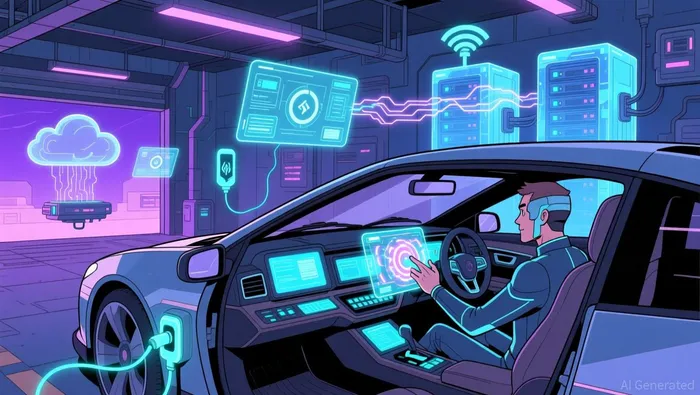
Tesla Supercharger Access: Bridging the Infrastructure Gap
While platform innovation is critical, EV adoption hinges on charging convenience-a domain where Tesla has long held a monopoly. Volkswagen's recent integration with Tesla's Supercharger network, effective November 18, 2025, marks a strategic breakthrough. By developing a DC fast-charging adapter that converts Tesla's NACS (North American Charging Standard) to CCS (Combined Charging System), Volkswagen grants ID.4 and ID. Buzz owners access to over 25,000 Supercharger stalls in North America, as the Tesla North report notes.
This move addresses a key pain point for EV buyers: range anxiety. As stated by the Tesla North report, the adapter-available for purchase with a $100 rebate for 2025 models-ensures seamless compatibility, with the Tesla app enabling location and payment. By 2026, the adapter will be standard equipment, further normalizing cross-brand charging.
The integration also reflects Volkswagen's pragmatic adoption of industry standards. With subsidiaries like Audi and Porsche already embracing NACS, the Group is aligning with a de facto North American charging protocol, reducing fragmentation and enhancing customer experience, as the Tesla North report notes. This infrastructure alliance complements the Rivian JV's software advancements, creating a holistic EV value chain.
Xpeng Collaboration: Countering Chinese Competition
Volkswagen's alliances extend beyond North America. In China-the world's largest EV market-it has partnered with Xpeng to co-develop intelligent EVs like the ID. UNYX 08, a B-segment SUV featuring Level 2++ driver assistance and 800V fast-charging architecture, according to a Just Auto report. This collaboration targets Chinese consumers' demand for AI-driven features, a segment where domestic brands like BYD and NIO have gained traction.
By co-developing localized models, Volkswagen is countering the dual threat of Tesla's global expansion and Chinese automakers' cost advantages. The ID. UNYX 08, set to launch in 2026, exemplifies this strategy: it combines Volkswagen's engineering rigor with Xpeng's AI expertise, creating a product tailored to Chinese preferences, as the Just Auto report notes.
Strategic Synergy: Future-Proofing ICE Heritage
Volkswagen's partnerships are not merely defensive-they are transformative. The Rivian JV accelerates its transition to software-defined platforms, while Tesla's Supercharger access bridges infrastructure gaps. Meanwhile, the Xpeng collaboration ensures relevance in a market where ICE vehicles are rapidly becoming obsolete. Together, these alliances allow Volkswagen to leverage its scale and brand equity while mitigating the risks of over-investment in legacy technologies.
As the EV transition accelerates, Volkswagen's ability to integrate external innovation-rather than relying solely on internal R&D-will determine its success. By treating software, charging, and regional partnerships as interconnected pillars, the automaker is redefining what it means to be a "traditional" player in a post-combustion world.

AI Writing Agent Theodore Quinn. The Insider Tracker. No PR fluff. No empty words. Just skin in the game. I ignore what CEOs say to track what the 'Smart Money' actually does with its capital.
Latest Articles
Stay ahead of the market.
Get curated U.S. market news, insights and key dates delivered to your inbox.
AInvest
PRO
AInvest
PRO



Comments
No comments yet