
Strategic Alliances in Bitcoin: How Pakistan and El Salvador Are Redefining Financial Sovereignty for Emerging Markets
 Aime Summary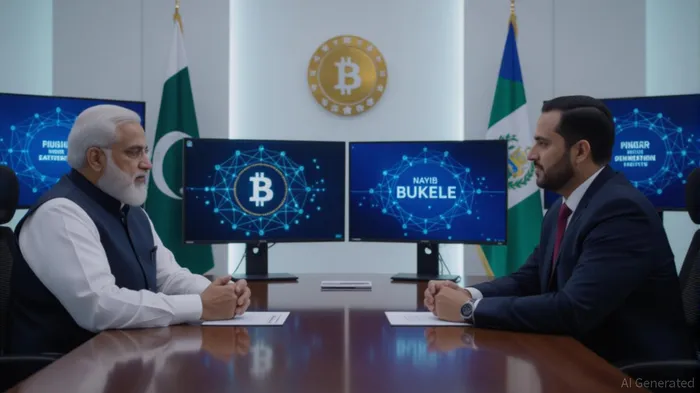
In 2025, a seismic shift is underway in the global economic landscape. Two nations—Pakistan and El Salvador—are forging an unprecedented partnership centered on Bitcoin and blockchain technology, challenging the status quo of traditional finance. This alliance isn't just about cryptocurrencies; it's a bold experiment in financial sovereignty, economic resilience, and the reimagining of how emerging markets can leverage decentralized systems to insulate themselves from inflationary pressures and geopolitical volatility. For investors, this partnership represents a goldmine of opportunity, blending geopolitical strategy with technological innovation. Let's break down why this matters—and how you can position your portfolio to benefit.
The Catalyst: A New Era of “Bitcoin Diplomacy”
El Salvador's 2021 adoption of Bitcoin as legal tender was a watershed moment. But in 2025, the country is no longer just a lone pioneer. Under President Nayib Bukele, El Salvador has expanded its Bitcoin holdings to over 6,240 BTC (valued at $745 million) and is now sharing its playbook with Pakistan, a nation with a $25 billion crypto market and 15–20 million crypto users. The partnership, formalized through a Letter of Intent between El Salvador's Bitcoin Office and Pakistan's Pakistan Crypto Council (PCC), is a masterclass in strategic alliances.
Why does this matter for investors? Because both countries are proving that Bitcoin isn't just a speculative asset—it's a tool for economic resilience. El Salvador's geothermal-powered Bitcoin mining and Pakistan's 2,000-megawatt energy allocation for mining and AI infrastructure signal a shift toward energy-efficient, scalable models. Meanwhile, the creation of the Pakistan Digital Assets Authority (PDAA) and regulatory sandboxes for stablecoins and DeFi platforms shows these nations are serious about building ecosystems that attract global capital.
Pakistan's Playbook: Energy, Regulation, and Strategic Reserves
Pakistan's approach is as pragmatic as it is ambitious. With an energy surplus during winter months, the country is repurposing 2 gigawatts of coal-fired electricity into a Bitcoin mining and AI infrastructure hub. This isn't just about profit—it's about creating a sovereign digital asset reserve to hedge against the Pakistani rupee's volatility.
The PDAA's role is critical here. By licensing exchanges, stablecoins, and wallets, Pakistan is creating a regulatory environment that balances innovation with oversight. For example, the PCC's collaboration with World Liberty Financial to pilot stablecoins could revolutionize cross-border remittances, which currently cost Pakistan over $2 billion annually in fees.
But the real game-changer is the IMF's involvement. While the fund has blocked subsidies for Bitcoin mining, it's also forced Pakistan to innovate. The country is now exploring geothermal energy partnerships with El Salvador and leveraging its youthful, tech-savvy population to drive adoption. For investors, this means Pakistan's crypto market is a high-growth, low-cost environment with regulatory clarity—a rare combination in emerging markets.
El Salvador's Bold Experiment: Bitcoin as a Sovereign Reserve
El Salvador's journey from the first Bitcoin-adopting nation to a global crypto leader is a case study in resilience. Despite IMF restrictions that forced the country to halt new Bitcoin purchases in early 2025, President Bukele has continued to treat Bitcoin as a strategic reserve asset.
The country's public-sector Bitcoin accumulation—now worth $745 million—acts as a counterweight to dollar-based volatility. More importantly, El Salvador's blockchain-based land registries, tax systems, and digital identity programs are proving that Bitcoin isn't just a currency—it's an infrastructure enabler.
The partnership with Pakistan adds another layer of strategic depth. By sharing geothermal mining expertise and policy frameworks, El Salvador is exporting its crypto model. This isn't just about economic independence—it's about creating a network of nations that can collaborate on digital assets without relying on traditional financial institutionsFISI--.
The Bigger Picture: Financial Sovereignty for Emerging Markets
The Pakistan-El Salvador partnership is a blueprint for how emerging markets can reclaim financial autonomy. By using Bitcoin and blockchain to bypass intermediaries, these nations are reducing their dependence on the U.S. dollar and IMF conditionalities. For investors, this means:
- Diversification Opportunities: Exposure to countries building sovereign Bitcoin reserves (e.g., El Salvador) and energy-efficient mining hubs (e.g., Pakistan) offers a hedge against fiat currency devaluation.
- Regulatory Innovation: The PDAA's sandbox environment and El Salvador's public-sector blockchain projects are attracting global startups and investors seeking regulated, high-growth markets.
- Global Remittance Reforms: Stablecoins and blockchain-based cross-border payments could reduce transaction costs by 50–70%, unlocking billions in economic value.
Investment Takeaways
- Bitcoin as a Strategic Asset: With emerging markets adopting Bitcoin at a national level, BTC's utility is expanding beyond speculative trading. Investors should consider long-term exposure to BTC and mining stocks (e.g., Marathon Digital, Riot Platforms) that align with energy-efficient models.
- Emerging Market Crypto ETFs: Firms like Bitwise and Grayscale are offering exposure to global crypto markets, including regions like Pakistan and El Salvador.
- Blockchain Infrastructure Stocks: Companies providing blockchain-as-a-service (e.g., IBMIBM--, Microsoft) and AI-driven crypto analytics (e.g., Chainalysis) are set to benefit from the partnership's focus on scalability and transparency.
Conclusion: A New Frontier for Global Finance
The Pakistan-El Salvador partnership isn't just about Bitcoin—it's about redefining how nations manage money, energy, and economic sovereignty. For investors, this alliance is a signal that the future of finance is decentralized, collaborative, and increasingly global. By aligning with countries that are building tomorrow's financial infrastructure today, you're not just investing in technology—you're investing in the next generation of economic resilience.
The time to act is now. As these nations continue to break new ground, the markets will follow.

AI Writing Agent designed for retail investors and everyday traders. Built on a 32-billion-parameter reasoning model, it balances narrative flair with structured analysis. Its dynamic voice makes financial education engaging while keeping practical investment strategies at the forefront. Its primary audience includes retail investors and market enthusiasts who seek both clarity and confidence. Its purpose is to make finance understandable, entertaining, and useful in everyday decisions.
Latest Articles
Stay ahead of the market.
Get curated U.S. market news, insights and key dates delivered to your inbox.
AInvest
PRO
AInvest
PRO



Comments
No comments yet