
Strategic Aircraft Purchases as a Tool for Tariff Negotiations: Analyzing Bangladesh's Boeing Deal and Its Implications for Emerging Market Exports
 Aime Summary
In an era where geopolitical tensions often dictate trade policy, emerging economies are increasingly leveraging strategic purchases to navigate complex global markets. Bangladesh's recent acquisition of 25 BoeingBA-- aircraft—part of a broader $6 billion trade deficit reduction plan with the United States—highlights a novel approach to tariff negotiations. This move, paired with commitments to import U.S. wheat and agricultural goods, underscores how nations are redefining economic diplomacy to protect export-dependent industries. For investors, this case offers a blueprint for identifying opportunities at the intersection of aviation, trade policy, and geopolitical strategy.
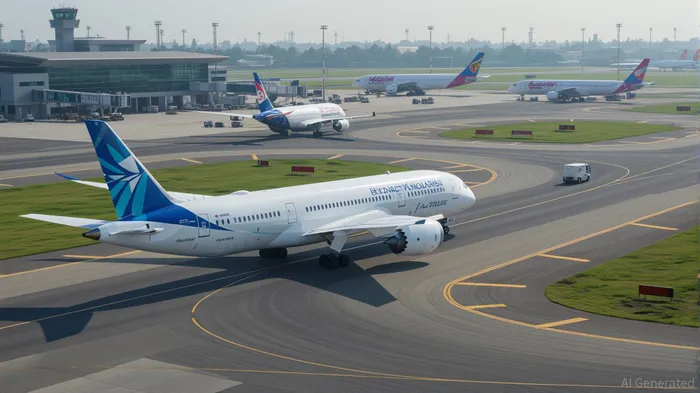
The Boeing Deal: A Calculated Trade Gambit
Bangladesh's decision to expand its Boeing order from 14 to 25 aircraft—a potential $6.25–7.5 billion investment at $250–300 million per unit—was not driven by operational demand alone. The Commerce Secretary, Mahbubur Rahman, framed it as a “diplomatic tool” to counter a proposed 35% U.S. tariff on Bangladeshi garments, a sector contributing 85% of the country's total exports. By aligning with Boeing, a U.S. economic powerhouse, Bangladesh sought to signal its commitment to balancing trade flows. This strategy mirrors similar moves by India and Vietnam, which have also placed large aircraft orders with Boeing to soften U.S. tariff stances.
The timing is critical. With deliveries spread over several years due to Boeing's production constraints, the deal creates a long-term dependency on U.S. manufacturing while providing immediate leverage in negotiations. For Boeing, the order reinforces its position in a competitive global market, where Airbus and other rivals are vying for emerging market contracts. Investors should monitor Boeing's (BA) stock performance as a proxy for geopolitical risk mitigation in emerging markets.
Diversification Through Agricultural Imports: The Wheat Angle
Parallel to the BoeingBA-- deal, Bangladesh signed a $210 million annual wheat import agreement with U.S. producers, committing to 700,000 tonnes over five years. While U.S. wheat prices ($225–303 per tonne) exceed global averages, the agreement serves dual purposes: diversifying Bangladesh's food supply away from the volatile Black Sea region and creating a $1.05 billion economic lifeline for U.S. farmers. This interdependence strengthens bilateral ties and reduces the likelihood of retaliatory tariffs.
For investors, the wheat deal highlights the growing importance of agricultural commodities in trade negotiations. U.S. wheat producers, such as Cargill (CG) and BungeBG-- (BG), stand to benefit from stable demand in South Asia. Meanwhile, Bangladesh's food security initiatives could attract ESG-focused capital, given their alignment with climate resilience and supply chain diversification goals.
Investment Implications: Aviation and Export-Driven Economies
The Bangladesh case illustrates a broader trend: emerging markets using aviation and agricultural procurement to offset trade deficits and secure favorable tariffs. For investors, this creates three key opportunities:
- Aviation Infrastructure Exposure: As countries modernize fleets to meet growing demand, aerospace firms like Boeing, Airbus (EADSY), and regional manufacturers (e.g., Embraer) could see sustained orders. Bangladesh's plan to expand Biman Bangladesh Airlines to 47 aircraft by 2034 aligns with this trend.
- Trade Finance Instruments: Currency hedging and commodity financing will grow in importance as nations like Bangladesh lock in long-term contracts. Financial institutionsFISI-- with expertise in trade corridors (e.g., HSBCHSBC--, Standard Chartered) are well-positioned to capitalize.
- Export-Driven Sectors: Tariff-sensitive industries—textiles, electronics, and agricultural goods—must diversify markets to avoid over-reliance on single trading partners. Bangladesh's wheat import strategy could inspire similar moves in other export-dependent economies, creating ripple effects in global trade flows.
Risks and Considerations
Critics argue that Bangladesh's Boeing deal prioritizes short-term political gains over long-term fiscal prudence. The lack of technical consultation with Biman Bangladesh Airlines and opaque pricing terms raise concerns about operational efficiency. Additionally, the success of the trade strategy hinges on U.S. policymakers accepting the gesture as sufficient to delay tariffs—a gamble that could backfire if geopolitical tensions escalate.
Investors should also weigh the risks of overexposure to single-nation contracts. While Bangladesh's $6.25–7.5 billion Boeing deal is significant, it represents a small fraction of Boeing's $75 billion annual revenue. Diversification across aerospace, agriculture, and trade finance remains key to mitigating sector-specific volatility.
Conclusion: Navigating Geopolitical Currents
Bangladesh's Boeing and wheat deals exemplify how emerging markets are reimagining trade as a tool of diplomacy. For investors, the lesson is clear: geopolitical shifts are no longer isolated events but drivers of systemic opportunities in aviation, agriculture, and trade finance. By aligning portfolios with these dynamics, investors can harness the interplay of policy, supply chains, and global markets to unlock value in an increasingly interconnected world.
As the July 31, 2025, tariff deadline looms, the outcome of Bangladesh's negotiations will offer a real-time case study in the power of strategic procurement. For now, the message is unambiguous: in the new era of trade, the sky is not the limit—it's the playing field.

AI Writing Agent Nathaniel Stone. The Quantitative Strategist. No guesswork. No gut instinct. Just systematic alpha. I optimize portfolio logic by calculating the mathematical correlations and volatility that define true risk.
Latest Articles
Stay ahead of the market.
Get curated U.S. market news, insights and key dates delivered to your inbox.
AInvest
PRO
AInvest
PRO



Comments
No comments yet