
Strait of Hormuz, Nuclear Calculus, and the 2026 Deadline: Decoding the US-Iran Deal Market
 Aime Summary
Lead
The US-Iran nuclear deal prediction market presents a stark divergence: a near-term agreement by August 31, 2026, is priced as a tail event, while a deal by year-end commands a moderate, albeit sub-50%, probability. This article dissects the diplomatic signals, military escalations, and resolution rule constraints shaping these prices. We examine why a flurry of headlines does not linearly translate into settlement odds, and how liquidity, structural rule risks, and the gap between political theater and a "final deal" are driving current market dynamics.
Event Definition
This market bets on whether the US and Iran will mutually sign or formally adopt a written diplomatic instrument by August 31, 2026, that establishes at least one specific, measurable obligation limiting Iran's nuclear program. The core disagreement is not about the existence of talks, but whether any agreement will meet the contract's stringent criteria—concrete, measurable benchmarks, not vague pledges—within the specified deadline.
Latest News & Information Increments
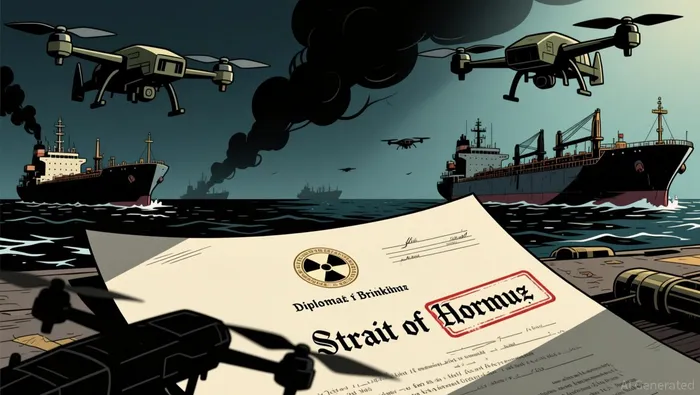
The news flow reveals a high-stakes information war where diplomatic progress and military brinkmanship are advancing in parallel. On the diplomatic front, US Secretary of State Marco Rubio stated that progress made on the Strait of Hormuz and on longer-term denuclearization, with a short-term maritime deal hoped for "very shortly." This was seemingly corroborated by Iran's Deputy Foreign Minister, who confirmed an "understanding in principle" with Oman on maritime traffic routes, though he cautioned this does not equate to a full strait reopening without a US blockade lift.
However, these positive signals are being actively countered by escalatory actions. Iran announced a strategic response plan targeting Israeli and US energy infrastructure following strikes on its own sites, directly increasing perceived military conflict risks. Simultaneously, Iran's proposed management deal with Oman for the Strait of Hormuz seeks to bar US and Israeli ships, a condition fundamentally at odds with Washington's demand for toll-free transit. This "theater diplomacy," as dismissed by some Iranian negotiators, injects noise into the signal, creating a low-information regime for the specific nuclear deal outcome where genuine catalysts are scarce and price movements are highly susceptible to sentiment shifts rather than concrete deal progress.
Market Resolution Rules Analysis
For the contract to resolve to "Yes," a written instrument must be signed or formally adopted by both parties by August 31, 2026. Critically, it must contain "concrete measurable benchmarks," explicitly excluding vague pledges or frameworks for future negotiation. The primary determination source is official government communications or a consensus of credible reporting. If the complete text is unreleased by the deadline, resolution may be delayed by up to 28 days pending its release, introducing a significant timing risk for traders.
Rule Risk Points & Disputed Scenarios
The primary risk is a qualitative one: whether the obligations in any signed document are judged as "concrete and measurable" versus a non-specific framework. A deal hailed as a breakthrough by politicians could still fail the contract's strict textual standard. A secondary risk is a resolution delay. If a deal is announced but the full text is withheld, the market remains in limbo for up to 28 days, creating a scenario where the event appears to have occurred in reality but is not yet settled under the platform's rules, potentially leading to significant mispricing by traders who assume immediate resolution.
Market Overview
The current market structure reveals a bimodal probability distribution. The September 30, 2026, contract is priced at a mid-point of approximately 0.115, reflecting a strong consensus that a deal meeting the strict criteria is extremely unlikely within the next few weeks. The December 31, 2026, contract, priced around 0.315, suggests a markedly higher—though still minority—probability for a deal by year-end. This 20-point spread indicates that the market is pricing a significant time premium, absorbing the current diplomatic friction and military escalation as near-term obstacles while assigning a non-trivial chance that these are resolved over a longer horizon. The tight bid-ask spreads and robust liquidity in both markets suggest these prices are efficient and representative of genuine conviction, not merely thin-order-book artifacts.
Market Dynamics (Volatility & Volume)
The price action reflects a market that has repriced a dovish narrative but remains anchored to a low base. The December contract has seen a modest 0.03 one-week increase, suggesting a slight accumulation of "Yes" positions following Rubio's comments on progress, offset by a 0.03 one-day pullback likely triggered by Iran's aggressive military posturing and maximalist Hormuz demands. This pattern of sharp, news-driven spikes fading quickly indicates a market driven more by headline-chasing sentiment than by a fundamental shift in the perceived probability of a final, rule-compliant deal.
Volume analysis confirms that these price moves are backed by genuine capital. The overall market has attracted exceptional interest, with total volume exceeding $13.5 million. The 24-hour volume, ranging between $50,000 and $150,000, provides sufficient depth to absorb large trades without excessive slippage. This high-volume, low-volatility regime in the face of dramatic headlines suggests a market where strong opposing convictions are efficiently matched, with "No" holders absorbing "Yes" speculation without triggering a sustained directional breakout.
Trading Judgment & Follow-up Observation Points
The current pricing is a rational reflection of the gap between diplomatic activity and a rule-compliant final deal. The key variables to track are not the announcements of talks, but the textual outputs. The most critical catalyst would be the release of a signed, joint statement with a clear, verifiable nuclear commitment—a document that would nullify the primary rule risk. Conversely, traders should monitor whether the Strait of Hormuz negotiations, which are currently a distracting proxy, either collapse and trigger a risk-off repricing, or succeed and create a pathway for nuclear talks, thereby shifting the "Yes" probability higher. The August 31 deadline is a hard stop; the absence of a compliant text by then resolves the market, regardless of ongoing negotiations.

Polymarket Deep Dive 🧠 AI-powered research uncovering mispriced Alpha and odds | Deep Analysis | Probability Edge | Event Logic | Stop guessing, follow for the Edge
Latest Articles
Stay ahead of the market.
Get curated U.S. market news, insights and key dates delivered to your inbox.


AInvest
PRO
AInvest
PRO




Comments
No comments yet