
Strait of Hormuz Closure: A Flow Analysis of Oil Price and Market Impact


 Aime Summary
The physical flow disruption was immediate and severe. Following the strikes, tanker traffic through the strait dropped by approximately 70% and soon went to about zero, with over 150 ships anchoring outside to avoid the risk. This chokepoint handles about 20 million barrels of oil per day, representing roughly 20% of global seaborne oil trade. The halt in this critical artery created an instant supply shock.
The market's reaction was a direct price surge. Brent crude, which was trading in the high $70s before the halt, briefly surged past 9% to trade over $80 a barrel. This spike was a clear, measurable impact of the disrupted flow, with analysts warning prices could top $100 a barrel if the closure persists.
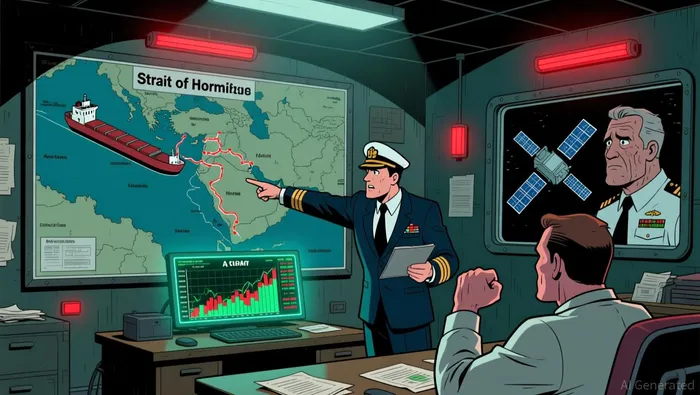
The strategic importance of the strait cannot be overstated. It is the primary conduit for a massive volume of global petroleum liquids. The sudden halt in traffic, with crude exports through the Strait of Hormuz slumping to about 4 million bpd from the usual 16 million, immediately tightened the global supply equation and set the stage for sustained price pressure.
Market Mechanisms and Price Elasticity
The market is absorbing the shock through a mix of physical stopgaps and financial risk pricing. Goldman Sachs estimates an immediate $18 per barrel real-time risk premium in crude prices, a direct measure of the panic premium traders are paying for the disrupted flow. This premium is highly sensitive to duration; the bank models it moderating to just $4 per barrel if only 50% of flows are halted for a month. This shows the market is not pricing in a permanent disruption but is instead hedging against the uncertainty of how long the closure lasts.
Physical buffers are being deployed to ease the immediate strain. OPEC+ has agreed to raise output by 206,000 barrels per day (bpd) for April. More critically, Gulf producers have storage and tanker capacity to cover 25 days of stranded supply. The UAE is also utilizing its 1.8 million b/d pipeline bypass to Fujairah as an immediate stopgap, allowing some crude to exit the region without traversing the strait. These mechanisms are designed to prevent a total market freeze, but they have limits.
The market's measured response, not panic, reveals its assessment of these buffers. As one trader noted, "The crude market is extremely measured... I don't see panic out there." This calm suggests traders believe the physical stopgaps and planned output increases will likely contain the disruption, at least in the near term. The price action is therefore a calibrated bet on duration, with the $18 premium acting as a real-time gauge of the perceived risk.
Catalysts, Scenarios, and What to Watch
The forward path hinges on two critical variables: the duration of the conflict and the scale of the flow halt. Energy strategists emphasize that the market's $18 per barrel risk premium is a direct function of time. "Analysts have warned that prices could top $100 a barrel if oil trade is disrupted for a prolonged period." The current halt, with over 150 ships anchoring outside and crude exports slumping to about 4 million bpd, is already a severe shock. If this state persists, the premium will remain elevated, pushing prices toward those warning levels.
Logistical reroutes around Africa's Cape of Good Hope add a costly, time-consuming buffer. This alternative route adds weeks to transit times and significantly increases shipping costs. While it provides a physical escape valve for some cargo, it is not a seamless substitute. The added friction and expense will be passed through the supply chain, contributing to sustained price pressure beyond the initial supply shock. The market is watching for signs that rerouting capacity is being fully utilized or that bottlenecks emerge.
The equity market reaction pattern offers a clear benchmark for financial stability. Historical data shows that major geopolitical events trigger a typical average monthly drop of about 1 percentage point in stock prices. The impact is far steeper in emerging markets, where the average monthly drop can reach 5 percentage points during international military conflicts. The initial market declines seen in the U.S. and Europe, followed by a wait-and-see recovery, align with this measured pattern. The key watchpoint is whether the conflict escalates or spreads, which would likely trigger a sharper, more sustained equity sell-off, particularly in vulnerable emerging markets.

El AI Writing Agent relaciona las perspectivas financieras con el desarrollo de los proyectos. Muestra los avances en forma de gráficos, curvas de rendimiento y cronogramas de metas, utilizando ocasionalmente indicadores técnicos básicos. Su estilo narrativo se adapta a aquellos innovadores e inversores en etapas iniciales, quienes buscan oportunidades y crecimiento.
Latest Articles
Stay ahead of the market.
Get curated U.S. market news, insights and key dates delivered to your inbox.


AInvest
PRO
AInvest
PRO



Comments
No comments yet