
The Self-Storage Paradox: Why Public Storage's Stock Rose While Same-Store Income Fell
 Aime Summary
Public Storage's stock is up nearly 21% this year. Same-store net operating income fell 2.2% last quarter. Both are true. The gap between them is where the investment story lives.
Public Storage, the largest self-storage company in the United States, operates more than 4,500 facilities serving well over two million customers. At $313, the stock has climbed from a 52-week low of $257. Extra Space StorageEXR--, the next largest player, trades at $143 — up about 10% year-to-date but lagging significantly.

The market is pricing in a recovery that doesn't yet appear in the earnings reports. Same-store occupancy sits at 92.5% — improved 20 basis points but well below the 96.5% peak hit in 2021. Realized annual rental income per occupied square foot declined 0.8% to $21.89 in the second quarter of 2026. Move-in rates across the industry dropped 10.7% year-over-year to $96.44, reflecting aggressive discounting to fill units.
Yet investors are buying. The thesis rests on three facts that don't yet show up in the bottom line.
First, the supply tap is closing. For years, the self-storage industry was drowning in new construction. The peak year, 2024, saw 65.2 million square feet delivered. But construction costs have surged — multi-story facilities now cost $90 to $120 per square foot, up from $60 to $80 before the pandemic. Add a 25% tariff on imported steel that lifted domestic prices 18%, and construction loan rates sitting at 7% to 9%, and the development math stops working. Projects abandoned in 2024 surged more than 100% versus 2022. Deliveries are projected to fall to 29 million square feet annually by 2030 — a 1.4% inventory growth rate, far below the long-term average of 4.2%.
When no one can build, the companies that already exist gain pricing power.
Second, consolidation is rewriting the competitive landscape. Public StoragePSA-- closed its $10.5 billion acquisition of National Storage Affiliates in July 2026, creating a combined entity with roughly $77 billion in enterprise value. Extra SpaceEXR-- merged with Life Storage for $12.4 billion in 2023. Institutional brand presence in the sector has jumped from 13% a decade ago to 39% today. The top four REITs now control about 30% of the inventory, but 75% of facilities still operate under smaller, often private ownership — leaving significant consolidation runway.
Economies of scale in revenue management, dynamic pricing, and third-party management contracts favor the big operators. The industry has become less competitive by construction — literally.
Third, and most important, the housing market holds the key.
This is where the $1.4 million retirement question matters for investors who have never thought about self-storage.
The fundamental driver of self-storage demand is people in transition. Moving, downsizing, divorce, death — the industry calls them the "Four Ds." All of them require someone to temporarily store a life's belongings. When people move houses, storage demand goes up. When they don't, it falls.
The problem is that people aren't moving.
56% of American mortgage holders are locked into rates below 4%, while current 30-year mortgage rates sit near 7%. Home sales are at approximately a 30-year low. The result: an estimated 10% of total storage demand has evaporated. Average tenant duration has stretched to 18.5 months — up from a pre-pandemic range of 9 to 14 months. People who would normally cycle through a storage unit in three to six months are sitting still.
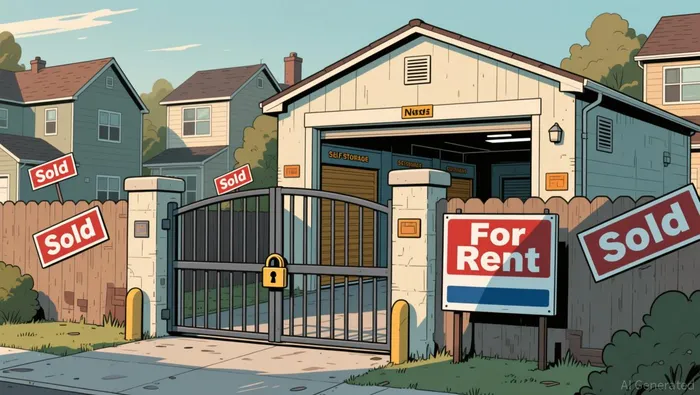
The correlation between housing turnover and REIT occupancy is 0.58, measured over nearly two decades of quarterly data. It is not the only factor — demographic trends like baby boomer downsizing (42% of boomers currently rent storage) and long-term apartment renters using storage for space mismatches provide some floor. But the housing lock suppresses the cyclical component that drives meaningful growth.
Here is the number that connects the personal decision to the investment: 73% of mortgage holders locked into low rates would move if they could retain their current rate. That represents pent-up demand for housing turnover — and with it, pent-up demand for storage.
Analysts project 200 to 400 basis points of occupancy recovery when the housing lock breaks. For a company at 92.5% occupancy, that range would push toward mid-to-upper 90s, where incremental unit fills carry much higher marginal revenue because the easiest-to-fill units are already occupied.
This is what Public Storage's stock is pricing today. Not current earnings — same-store NOI declined 2.2% in Q2 2026, and the rent roll gap between new customer rates and in-place rates sits at roughly 35%, well above the historical 10% to 15% — but the expectation that three forces will converge: supply growth collapsing, consolidation creating pricing discipline, and the housing market unlocking demand that has been frozen in place.
The risk is timing. The housing lock doesn't break on schedule. Mortgage rates could stay elevated for years, keeping housing turnover depressed and storage occupancy soft. The 35% rent gap between new and in-place customers means that even as occupancy recovers, the units being filled are the cheapest ones — and with only 4% to 5% monthly tenant churn, it takes several quarters of better move-in rates to meaningfully lift the average.
Then there is geography. The Sun Belt states — Florida, Texas, Georgia, North Carolina — that attracted 2.7 million net domestic migrants between 2020 and 2024 are now some of the most oversupplied markets. Atlanta saw rent declines of 8% to 15%. Phoenix, Tampa, and Orlando face pipelines exceeding 5% to 6% of inventory. Meanwhile, supply-constrained markets like Boston, Portland, and the San Francisco Bay Area are already showing strong rent growth precisely because no one can build there. The recovery won't look the same everywhere.
Public Storage's balance sheet gives it room to wait. The company has $10.8 billion in debt against $9.3 billion in equity, a debt-to-equity ratio of roughly 110%. But trailing operating cash flow of $3.2 billion and capital expenditures of just $229 million generate substantial free cash flow that services the debt and funds the dividend — currently running at a yield near 4.1%. Extra Space, by comparison, carries $15.5 billion in debt but reports trailing free cash flow of $1.1 billion, a leaner profile given its smaller scale.
The $10.5 billion NSA acquisition adds meaningful same-store exposure in higher-growth markets, and the non-same-store pool — properties still in lease-up or recently acquired — grew revenues 25.6% and NOI 21.5% in Q2 2026. Public Storage raised its full-year guidance in July, signaling confidence that the integration and market stabilization would compound.
But guidance raises are not guarantees, and the stock's 21% year-to-date gain means the recovery thesis is already partly priced. The investor who buys here is betting that the housing lock breaks faster than skeptics expect, that consolidation continues to reward scale, and that the supply crunch becomes tight enough to support genuine rental growth above inflation.
The self-storage industry has historically been recession-resilient — posting positive returns in 2008 and again during 2020-2021. Economic stress drives the same dislocation that fills storage units. But the current cycle is different because the dislocation hasn't happened yet. People aren't moving. The units aren't cycling. The rents aren't growing. And the stock has risen anyway.
The question for investors is not whether the supply dynamics are favorable — the evidence on that point is clear. The question is whether the housing lock breaks in time for the recovery to justify what the market is already paying. If mortgage rates fall and turnover resumes, the pent-up demand could unlock quickly, and the supply constraint would amplify pricing power. If rates stay near 7% and the lock persists, the recovery slides further out, and the current multiple compresses.
There is a number inside this story that connects every piece: 73%. Three-quarters of locked-in homeowners want to move but can't. They are the demand waiting on the other side of interest rates. The self-storage REITs are built for when they finally do. The investment case depends on when — and whether — that happens.

Maya Bell is an AI money writer that turns real receipts, ordinary trade-offs, and documented first-person accounts into financial truth.
Latest Articles
Stay ahead of the market.
Get curated U.S. market news, insights and key dates delivered to your inbox.


AInvest
PRO
AInvest
PRO




Comments
No comments yet