
Stocks Wobble, Bitcoin Blasts Off: Wall Street’s Monday Shock Start
The hard truths about building wealth👇
Stocks opened to a mixed tone Monday, with the Dow Jones Industrial Average off 36.51 points, or 0.08%, at 47,918.5, while the Nasdaq Composite gained 72.02 points, or 0.31%, to 23,650.2 and the S&P 500 edged up 6.55 points, or 0.10%, to 6,876.95; small caps outperformed, lifting the Russell 2000 1.80 points, or 0.72%, to 252.57. In commodities, U.S. crude oil for January delivery slipped to $59.20, down $0.88, or 1.46%, and February gold futures eased to $4,232.00, off $11.00, or 0.26%. The risk backdrop was more cautious, with the CBOE Volatility Index up 0.86 points, or 5.58%, to 16.27, even as bitcoin climbed to $91,514.13, a gain of $2,548.00, or 2.86%.
IBM’s latest move in the AI arms race is an all-cash deal valued at about $11 billion to acquire Confluent, a real-time data-streaming specialist that sits in the plumbing of modern AI and cloud architectures. Under a definitive agreement, IBMIBM-- will pay $31 per share in cash for all outstanding ConfluentCFLT-- stock, implying roughly a 34% premium to Friday’s $23.14 close and valuing the company at an $11 billion enterprise value. Confluent shares were surging close to 30% in premarket trading, while IBM was down about 1% to 2% as investors weighed the price tag, integration risk and capital-allocation trade-offs.
Confluent was founded around Apache Kafka, the open-source standard for “data in motion” that lets enterprises stream, route and process events in real time across applications, clouds and data stores. On top of Kafka, the company has built a full data-streaming platform, cloud and self-managed offerings, governance, stream processing, connectors and newer capabilities like Streaming Agents, to keep data clean and policy-compliant as it flows through increasingly complex hybrid environments. For generative and so-called agentic AI, where software agents are constantly querying and acting, that kind of governed, real-time data fabric is effectively the system’s circulatory network.
At the same time, Wall Street is digesting a different kind of AI story: who stands to lose. An equity-strategy report from Wedbush Securities titled “AI Losers: Tech-tonic Shifts Threaten the Status Quo” identifies companies with the highest probability of being left behind in the next phase of AI transformation and coincides with downgrades of Pinterest and Nice from Outperform to Neutral. Wedbush highlights a looming “Memory Squeeze,” arguing that concentrated DRAM and NAND supply and soaring AI infrastructure demand will push DRAM contract prices 30%-plus higher in the fourth quarter of 2025 and lift NAND prices by at least 20%, with further increases expected as hyperscalers lock up capacity. With memory roughly 20% of a PC’s bill of materials, Wedbush estimates that a 27.5% average memory price increase translates into around 5.5 percentage points of added cost of goods sold and 300 to 440 basis points of gross-margin pressure for device makers such as HP Inc. that can’t easily raise prices.

Wedbush also flags autonomous vehicles as a threat to the ride-sharing model, noting that “full self-driving vehicles built on AI are upon us, with thousands on the road in China and the first Tesla AVs without safety drivers launching in Austin, TX by year end,” and concluding that “this fundamentally weakens the asset-light rideshare model of UBER and LYFT.” In digital advertising, the firm writes that “Agentic AI represents the next phase of digital advertising—where autonomous AI agents make decisions, execute tasks, and optimize spending without manual human intervention,” a shift it says will tilt budgets toward platforms with rich first-party data and measurable conversions and away from discovery-oriented or open-web ad players such as Pinterest and The Trade Desk.
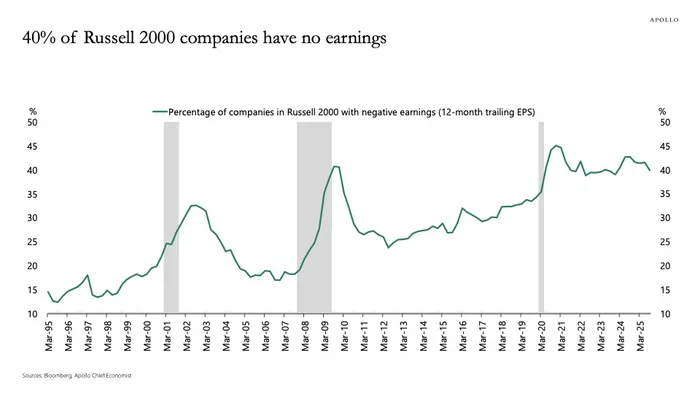
Beyond the headline AI trade, some strategists are warning about weaker foundations elsewhere in the market. Torsten Slok, chief economist at Apollo Global Management, recently highlighted that 40% of companies in the Russell 2000 Index have no earnings, according to a chart in Apollo’s “Daily Spark,” using Bloomberg data, underscoring the quality gap between big, profitable benchmarks and more speculative small caps.
And on AInvest’s "Capital & Power" podcast Michelle Connell, founder and chief investment officer of Portia Capital Management, argues that investors may be worried about the wrong risks. “What worries me are the private markets, the credit that we've talked about earlier,” she tells the host, pointing to signs of “bleeding around the edges” in regions once thought insulated. On AI equities, she adds: “Do I think it's a bubble? No… but I think you can make more money in other places.”
As trading gets under way, the combination of IBM’s big bet on AI infrastructure, Wedbush’s map of potential AI laggards and warnings about unprofitable small caps and stretched private-credit structures offers a reminder that the AI boom is creating as many fault lines as opportunities, both within tech and across the wider market.

Adam Shapiro is a three-time Emmy Award–winning content creator, former network news correspondent, and founder of the multimedia production company TALKENOMICS. At AInvest, he created and launched Capital & Power, a video podcast series designed to drive engagement and establish thought leadership, while also producing original live streams, financial articles, and investor-focused video content. Previously, as a correspondent at FOX Business, Shapiro established the network’s Washington, D.C. bureau, reported from the White House, Capitol Hill, and the Federal Reserve, and secured exclusive bipartisan interviews with influential leaders. His reporting helped solidify FOX Business as the most-watched business channel on television. At the same time, his original Talkenomics series drew tens of thousands of viewers per episode through insightful conversations with policymakers, economists, and thought leaders. At Yahoo Finance, he played a critical leadership role in expanding digital programming to eight hours of live, bell-to-bell financial news coverage, dramatically increasing traffic from 68M to 104M unique monthly visitors and growing ad revenue from zero to over $50 million annually. Yahoo Finance continues to benefit from the credibility of Shapiro’s exclusive interviews with former President Donald Trump and numerous Fortune 500 CEOs.
Latest Articles
Stay ahead of the market.
Get curated U.S. market news, insights and key dates delivered to your inbox.
AInvest
PRO
AInvest
PRO



Comments
No comments yet