
U.S. Stocks Open Mixed as Investors Weigh AI Policy Shift, Earnings Scrutiny and Retirement Pressures
U.S. equities opened Friday with modest, mixed moves as investors balanced a major federal policy shift on artificial intelligence, renewed scrutiny of richly valued technology stocks, and fresh evidence of mounting retirement shortfalls across the workforce.
At the opening bell, the Dow Jones Industrial Average rose 72.49 points, or 0.15%, to 48,776.5. The Nasdaq Composite fell 85.99 points, or 0.36%, to 23,507.9, while the S&P 500 slipped 9.75 points, or 0.14%, to 6,891.25. The Russell 2000 edged up 0.14 points, or 0.05%, to 257.94, signaling relative stability in small-cap shares.
The hard truths about building wealth👇
Market volatility remained subdued, with the Cboe Volatility Index (VIX) ticking up 0.05 points to 14.90, reflecting limited near-term stress despite crosscurrents in policy and earnings.
A key policy catalyst arrived overnight. President Donald Trump signed a sweeping executive order establishing a single federal regulatory framework for artificial intelligence, a move aimed at curbing a fragmented patchwork of state rules. According to Wedbush Securities, the order removes “significant regulatory hurdles” by bringing AI oversight under one federal standard while preserving incentives for innovation. The order also creates an AI Litigation Task Force, directs the Securities and Exchange Commission to review disclosure and transparency rules for advisers, and instructs the Federal Trade Commission to investigate deceptive practices in AI markets. Wedbush analysts said the move was designed to reinforce U.S. leadership in what they described as an “AI arms race” with China and to prevent state-level regulation from stifling startup formation and large-scale infrastructure investment.
Technology investors, however, continued to show less tolerance for ambiguity around margins. Shares of major AI-linked companies have faced heightened scrutiny following recent earnings, most notably Broadcom’s fiscal fourth-quarter report. While the company exceeded revenue and earnings expectations and guided higher for the current quarter, investors focused on management’s acknowledgment that the fastest-growing AI-related businesses carry lower margins. According to company commentary, AI semiconductor revenue is expected to double year over year to $8.2 billion in the first quarter, but margin compression tied to system sales and third-party components has raised concerns about valuation sustainability .
Beyond technology, longer-term structural pressures also featured in investor discussions. New data highlighted the depth of the U.S. retirement savings gap. According to analysis by Torsten Slok, chief economist at Apollo Global Management, fewer than one in six workers aged 45 to 54 are contributing the maximum amount to their 401(k) plans.
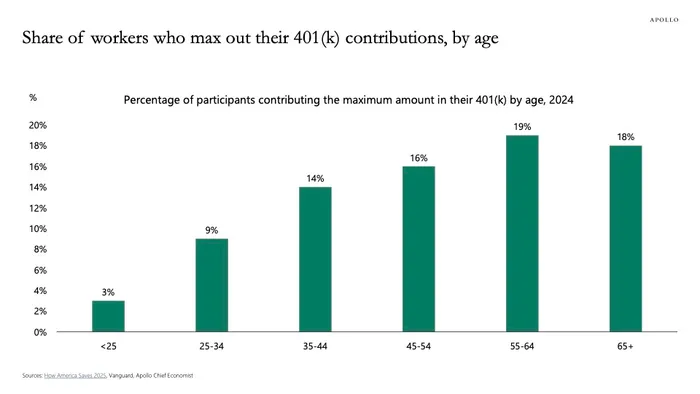
The shortfall is particularly acute among younger cohorts, where participation rates are far lower, underscoring what Apollo describes as a growing retirement crisis amid rising living costs and the eventual depletion of the Social Security trust fund. The findings draw on data from Vanguard’s How America Saves 2025 report and point to the risk that inadequate household savings could weigh on long-term economic stability .
Taken together, Friday’s opening tone reflects a market recalibrating expectations. Federal policy is moving to clear a path for large-scale AI investment, but equity valuations, especially in technology, are increasingly sensitive to execution and profitability. At the same time, demographic and savings trends highlight longer-term challenges that could influence consumption and capital markets in the years ahead.

Adam Shapiro is a three-time Emmy Award–winning content creator, former network news correspondent, and founder of the multimedia production company TALKENOMICS. At AInvest, he created and launched Capital & Power, a video podcast series designed to drive engagement and establish thought leadership, while also producing original live streams, financial articles, and investor-focused video content. Previously, as a correspondent at FOX Business, Shapiro established the network’s Washington, D.C. bureau, reported from the White House, Capitol Hill, and the Federal Reserve, and secured exclusive bipartisan interviews with influential leaders. His reporting helped solidify FOX Business as the most-watched business channel on television. At the same time, his original Talkenomics series drew tens of thousands of viewers per episode through insightful conversations with policymakers, economists, and thought leaders. At Yahoo Finance, he played a critical leadership role in expanding digital programming to eight hours of live, bell-to-bell financial news coverage, dramatically increasing traffic from 68M to 104M unique monthly visitors and growing ad revenue from zero to over $50 million annually. Yahoo Finance continues to benefit from the credibility of Shapiro’s exclusive interviews with former President Donald Trump and numerous Fortune 500 CEOs.
Latest Articles
Stay ahead of the market.
Get curated U.S. market news, insights and key dates delivered to your inbox.


AInvest
PRO
AInvest
PRO



Comments
No comments yet