
Stocks Open Mixed as Dow Advances but Tech Slips, Volatility Eases
 Aime Summary
Stocks opened on a mixed footing Tuesday, with the Dow Jones Industrial Average rising 125.45 points, or 0.27%, to 46,573.7, while the Nasdaq Composite fell 96.44 points, or 0.42%, to 22,775.6 as early weakness in tech weighed on the benchmark. The S&P 500 edged down 8.65 points, or 0.13%, to 6,696.47, and the Russell 2000 gained 1.01 points, or 0.42%, to 240.91. In commodities, crude oil dropped 1.35 to $57.49, down 2.29%, while gold climbed $44.00 to $4,174.80, up 1.07%. The CBOE Volatility Index slipped to 20.13, down 0.39 points or 1.90%, signaling a mild retreat in implied equity-market stress. Meanwhile, BitcoinBTC-- advanced 1.04% to $86,912.94, extending its recent stretch of resilient crypto-market inflows.
The real drivers behind cost-of-living, home prices, taxes, and government bloat 👇
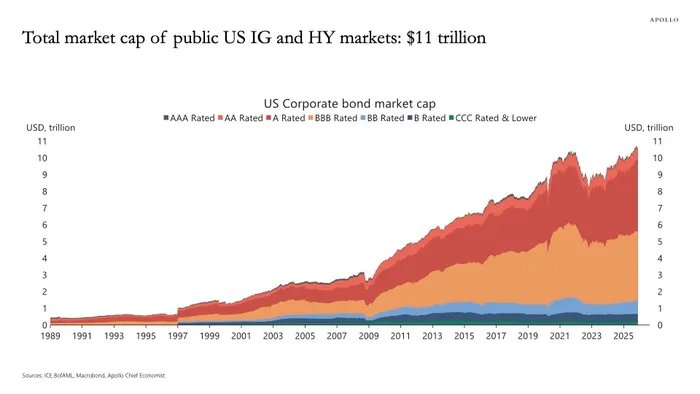
Credit markets remain in sharp focus. According to Torsten Slok, chief economist at Apollo Global Management, the total amount of U.S. public investment-grade and high-yield bonds outstanding has surged from $3 trillion in 2009 to $11 trillion today, with BBB and A-rated bonds accounting for 79% of the market. Slok contrasted that figure with the roughly $2 trillion in private credit outstanding, noting that “public credit markets have grown much faster than private credit markets both in percent and in dollars.”
That expansion comes as some strategists warn of rising stress in parts of the technology sector’s balance sheets. In a recent analysis, Michael Green of Simplify Asset Management highlighted “rising credit stress, particularly in the tech sector,” pointing to widening credit-default-swap spreads at companies including Oracle and newly listed contracts on Meta. He argued that correlations across equities have increased as major technology names continue to drive index-level behavior, while inflation concerns—“notably absent from any market-based indication”—are weighing on Federal Reserve officials.
Green’s research also examines the broader economic landscape, arguing that the officially measured U.S. poverty line dramatically understates the true cost structure facing families. He wrote that the Social Security Administration’s 1963 model based on food representing one-third of household spending no longer reflects reality, as food now represents just 5% to 7% of budgets. Updating the original methodology yields a modern poverty threshold between $130,000 and $150,000 for a family of four, Green said. He added that a realistic “Basic Needs” budget reaches roughly $136,500 once childcare, housing, transportation, healthcare, and taxes are included.
Against that backdrop of consumer and credit-market strain, technology stocks are getting support from another bullish update from Wedbush. Dan Ives, the firm’s longtime technology analyst. His latest Disruptive Technology research note, says that today’s environment is “NOT an AI bubble,” citing accelerating AI-driven deal flow at hyperscalers and an expected $550 billion to $600 billion in Big Tech capital spending in 2026. Ives described the moment as “a 1996 Moment… and NOT a 1999 Bubble Moment,” and reiterated Wedbush’s list of top AI-beneficiary stocks, including Microsoft, Palantir, Nvidia, AMD, Tesla, Apple, Meta, Alphabet, CrowdStrike, and Palo Alto Networks.
'The combination of swelling public-credit issuance, heavy AI infrastructure investment, and deepening household pressure shaped a complex trading backdrop. Major indexes continued to move largely in tandem yesterday, a trend Green called the “real fear index”, as markets reacted to the crosscurrents of tightening financial conditions and optimism around long-cycle technological transformation.

Adam Shapiro is a three-time Emmy Award–winning content creator, former network news correspondent, and founder of the multimedia production company TALKENOMICS. At AInvest, he created and launched Capital & Power, a video podcast series designed to drive engagement and establish thought leadership, while also producing original live streams, financial articles, and investor-focused video content. Previously, as a correspondent at FOX Business, Shapiro established the network’s Washington, D.C. bureau, reported from the White House, Capitol Hill, and the Federal Reserve, and secured exclusive bipartisan interviews with influential leaders. His reporting helped solidify FOX Business as the most-watched business channel on television. At the same time, his original Talkenomics series drew tens of thousands of viewers per episode through insightful conversations with policymakers, economists, and thought leaders. At Yahoo Finance, he played a critical leadership role in expanding digital programming to eight hours of live, bell-to-bell financial news coverage, dramatically increasing traffic from 68M to 104M unique monthly visitors and growing ad revenue from zero to over $50 million annually. Yahoo Finance continues to benefit from the credibility of Shapiro’s exclusive interviews with former President Donald Trump and numerous Fortune 500 CEOs.
Latest Articles
Stay ahead of the market.
Get curated U.S. market news, insights and key dates delivered to your inbox.






Comments
No comments yet