
Stocks Slip on Weak ADP Jobs Data as Investors Weigh Fed Path, Small Caps Buck the Trend
U.S. stocks slipped at the opening bell Wednesday as investors digested a weak ADPADP-- payrolls report and recalibrated expectations ahead of the Federal Reserve’s coming policy decision. The Dow Jones Industrial Average fell 41.80 points, or 0.09%, while the Nasdaq Composite dropped 106.95 points, or 0.46%. The S&P 500 declined 16.00 points, or 0.23%. In contrast, the Russell 2000 edged up 0.67 points, or 0.27%, extending its recent stretch of small-cap outperformance.
Why so many Americans are falling behind 👇
The latest ADP National Employment Report showed that private-sector employers shed 32,000 jobs in November, underscoring a cooling labor backdrop heading into year-end. According to ADP Research, hiring softness was concentrated in manufacturing, information, construction, and professional and business services. Dr. Nela Richardson, ADP’s chief economist, said hiring has been uneven as employers “weather cautious consumers and an uncertain macroeconomic environment.”

Small businesses remained the most pressured cohort, cutting 120,000 positions, while large firms added jobs—signs that the labor market’s resilience is narrowing. Wage dynamics also continued their gradual glide path: pay for job-stayers rose 4.4% year over year, a slight downshift from October, while job-changers saw 6.3% annual growth.
Despite the labor signal, commodities, on Wednesday morning, presented a strikingly different picture of economic mood. Crude oil rose 1.23% to $59.36, reclaiming early-week losses as traders reassessed demand trends. Gold gained 1.11% to $4,267.80, extending a steady climb that has mirrored investor hedging behavior through the fall. BitcoinBTC--, often treated as a speculative risk proxy, rallied 4.61% to $91,883.21, continuing a volatile multi-week ascent. Meanwhile, the CBOE Volatility Index (VIX) edged down to 16.32, pointing to contained equity-market anxiety.
Flows remain a significant undercurrent shaping U.S. trading dynamics. In a Citi “Markets Edition” discussion published Tuesday, Scott Chronert, Citi’s head of U.S. equity strategy, highlighted that U.S.-listed have absorbed $1.2 trillion year to date, including about $130 billion in recent sessions—an extraordinary tide of capital that continues to lift broad benchmarks.
A major structural force behind those flows is the rapid expansion of model-portfolio investing. Tushar Yadava, head of markets for BlackRock Model Portfolios, said the industry has eclipsed $3 trillion in assets and is on track to reach $11 trillion by decade-end as advisors increasingly channel clients into systematic allocation frameworks. He noted that BlackRock recently increased its equity overweight to 3% within a 60-40 baseline portfolio, boosted U.S. exposure to its highest levels in years, and remains tilted toward technology themes tied to AI and defense spending.
Those flows, and their concentration in growth-oriented ETFs, have intensified market leadership around the AI ecosystem. Sector positioning remains a focal point for investors seeking to interpret whether high-multiple technology shares can continue to weather a shifting macro backdrop.
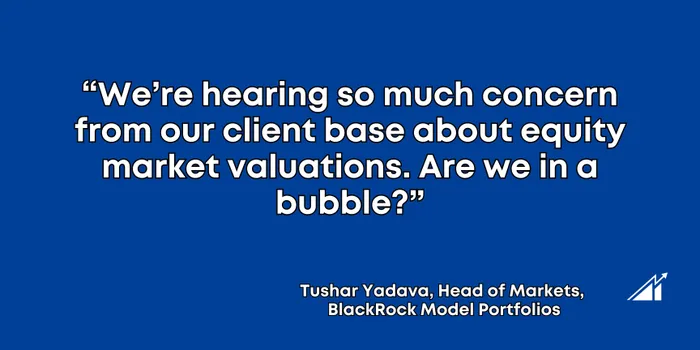
Yadava said client conversations have increasingly centered on whether soaring equity prices are approaching speculative territory. “We’re hearing so much concern from our client base about equity market valuations. Are we in a bubble?” he said, underscoring how the rapid rise in U.S. equities has sharpened investor sensitivity to any sign of overheating. Despite those worries, he noted that BlackRock’s own assessment views valuations as “full, but not bubble-ish,” a stance that supported the firm’s move to raise its equity overweight to 3% in its latest rebalance.
As markets digest November’s hiring downturn and await the BLS larger government jobs report, to be released on December 16, sentiment appears pulled between signs of slowing labor momentum and a still-powerful allocation wave into U.S. equities. With volatility indicators subdued and commodity strength reasserting itself, traders are preparing for a session likely defined by rotation rather than broad directional conviction.

Adam Shapiro is a three-time Emmy Award–winning content creator, former network news correspondent, and founder of the multimedia production company TALKENOMICS. At AInvest, he created and launched Capital & Power, a video podcast series designed to drive engagement and establish thought leadership, while also producing original live streams, financial articles, and investor-focused video content. Previously, as a correspondent at FOX Business, Shapiro established the network’s Washington, D.C. bureau, reported from the White House, Capitol Hill, and the Federal Reserve, and secured exclusive bipartisan interviews with influential leaders. His reporting helped solidify FOX Business as the most-watched business channel on television. At the same time, his original Talkenomics series drew tens of thousands of viewers per episode through insightful conversations with policymakers, economists, and thought leaders. At Yahoo Finance, he played a critical leadership role in expanding digital programming to eight hours of live, bell-to-bell financial news coverage, dramatically increasing traffic from 68M to 104M unique monthly visitors and growing ad revenue from zero to over $50 million annually. Yahoo Finance continues to benefit from the credibility of Shapiro’s exclusive interviews with former President Donald Trump and numerous Fortune 500 CEOs.
Latest Articles
Stay ahead of the market.
Get curated U.S. market news, insights and key dates delivered to your inbox.




Comments
No comments yet