
Main Street Is Running: How Retail Traders — and ETF Flows — Are Rewriting The Tape
 Aime Summary
Retail investors aren’t just influencing “meme stocks” like GMEGME-- and AMCAMC-- anymore—they’re upending institutional strategies, steering market volatility, and driving massive fund flows in major ETFs such as QQQ and ARKKARKK--.
Retail accounts for roughly 20% of total trading volume, exceeding the share of hedge funds, which now sits below 15%. Their participation is influencing far more than just social media-fueled runs on stocks—they’re prompting strategists at firms like Goldman Sachs to prioritize stocks with high retail activity, including Palantir Technologies and Advanced Micro Devices.
Earnings days are where retail moves markets
Earnings season used to be a primarily institutional theater; now it’s a mass participation event. Research and market commentary show bigger one-day price reactions around reports than in the past: the typical stock that reports can see absolute one-day moves well into the high single digits — substantially above historical norms — as immediate retail and quant responses compound headline-driven volatility. That short, concentrated window often accounts for a career-making chunk of a stock’s quarterly move.
What’s new is not just magnitude but directional crowd behavior: retail traders sometimes buy the dip after a messy print, amplify momentum trades into options markets, or funnel capital into ETFs that conveniently package thematic exposure. Those behaviors create feedback loops: a large earnings surprise → sudden retail buying/selling → ETF creations/redemptions and option flows → broader market price action.
ETF Flows: The New Battleground
Retail money isn’t just swirling around single stocks—it’s transforming the ETF landscape. The U.S. market saw ETF inflows top $500B in 2025, powered by steady retail participation despite volatility and macro risks. Two funds epitomize this retail-driven action:
QQQ: Tech Optimism and Wild Swings
On Aug 7, 2025, QQQ captured $1.645B in inflows—the highest for any ETF that day—pushing its assets to $361.77B. Yet it saw $254M in outflows just the day prior, showcasing retail-driven sector rotation and the tech sector’s role as both a growth engine and a volatility magnet.
ARKK: Innovation, Speculation, and Record Flows
ARK Innovation ETF (ARKK) led all ETFs in inflows with $5.518B in one week and $4.683B year-to-date, rebounding from net outflows earlier in the year. ARKK’s renewed popularity mirrors retail conviction in disruptive tech and speculative bets, with a strong 34.34% YTD return electrifying trader sentiment.
Other notable ETFs attracting retail flows in 2025 include Vanguard S&P 500 ETF (VOO), Communication Services Select Sector SPDR Fund (XLC), and option-strategy ETFs targeting volatility and thematic growth.
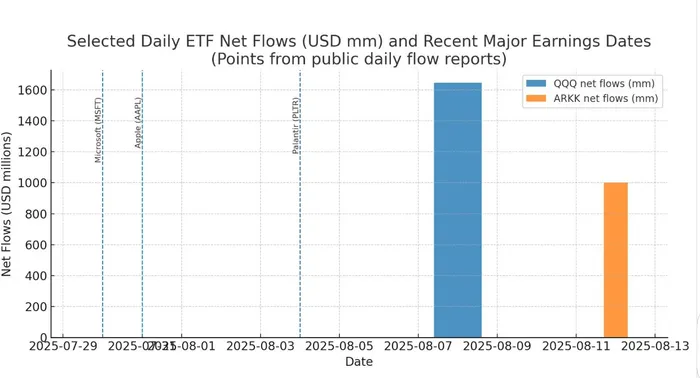
*The chart shows timing correlation, not causation.
Strategic Shifts: Institutions Are Following Retail’s Lead
Institutional players, once defining the narrative, now find themselves responding to retail moves. As retail trading drives off-the-charts volatility, particularly around earnings, the line between “sheep” and “shepherd” is blurring. Hedge funds and asset managers are forced to adjust tactics, sometimes chasing the trades retail sets in motion.
The takeaway
Retail investors are no longer peripheral noise — they are a measurable force that reshapes intraday and event-driven market behavior. That shift hasn’t eliminated the edge for sophisticated investors, but it has changed how edge is earned: success increasingly depends on modeling retail flows, ETF plumbing, and the interplay between headlines, options, and short-term liquidity. In short, the herd is bigger — and sometimes the shepherd, too.
Compare QQQ and ARKK — quickly view flows, performance, fees, and top holdings in ETF Compare Tool

Market Radar delivers concise, daily trading ideas by tracking everything from options activity and market sentiment to high-profile political trades.
Latest Articles
Stay ahead of the market.
Get curated U.S. market news, insights and key dates delivered to your inbox.




Comments
No comments yet