
Stocks Jump at the Open as Fed Uncertainty Collides With AI Boom
U.S. stocks surged out of the gate Thursday as investors balanced fresh signs of economic resilience with another wave of AI-driven enthusiasm. The Dow Jones Industrial Average jumped about 521 points (1.13%) to 46,660, while the S&P 500 gained 97 points (1.46%) to 6,739 and the Nasdaq Composite rallied 452 points (2.01%) to 23,017. Early risk appetite in equities contrasted sharply with crypto, where Bitcoin slipped to about $90,749, down 0.77%, extending a morning slide that briefly pushed it near $90,700. Commodities were mixed: crude oil climbed to roughly $59.80, up 0.93%, supported by global demand expectations, while gold eased to about $4,073, down 0.23%, reflecting a softer bid for traditional safe havens as stocks caught a strong early tailwind.
📺 Why private credit has become Wall Street’s most dangerous illusion 👇
Fed Still “Flying Blind” After Shutdown
The latest BLS employment report, the first major macro release since the 44-day government shutdown, showed the U.S. labor market growing more slowly but with notable resilience. Nonfarm payrolls rose +119,000, more than twice consensus expectations, while the unemployment rate ticked up to 4.4%. Average hourly earnings cooled to a month-over-month gain of 0.2%, according to the Bureau of Labor Statistics.
The results eased recession fears but sharpened the debate heading into the Fed’s December 10 meeting. Minutes from the last Fed meeting, released Wednesday, revealed an unusually divided committee and reinforced Chair Jerome Powell’s recent description of policymaking as akin to “driving in the fog.” Several members opposed the October rate cut, while others argued that a softening labor market warranted more caution.
Markets largely agreed: futures pricing now implies that any additional easing is more likely pushed into 2026, with traders favoring a “no move + dovish guidance” approach to avoid sparking volatility.
2026 Growth Outlook Turns Brighter
Against this uncertain policy backdrop, forecasts for 2025 have already tracked the ebb and flow of this year’s trade war. As Apollo Chief Economist Torsten Slok noted, consensus GDP expectations fell sharply after the conflict escalated in March but have been recovering steadily since the summer as trade deals were signed across multiple partners.
Slok sees 2026 as a potential reacceleration year, supported by reduced trade uncertainty, a softer dollar, and the fiscal tailwind from the One Big Beautiful Bill, legislation the Congressional Budget Office estimates will add nearly one percentage point to GDP in 2026 through accelerated depreciation.
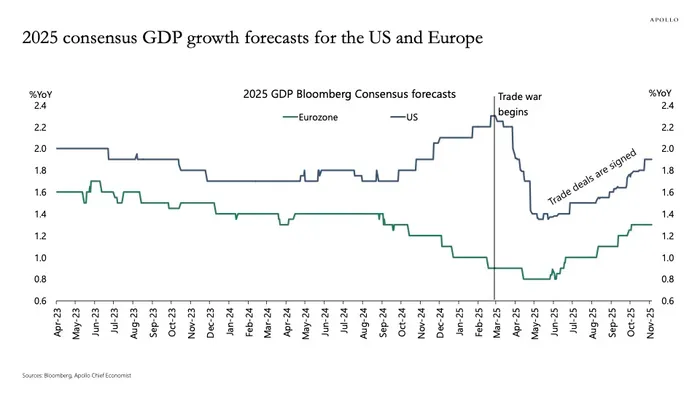
A chart included in Slok’s analysis shows U.S. and Eurozone 2025 GDP forecasts troughing around the onset of the trade war, then rebounding as agreements were finalized heading into autumn.
Ives: Nvidia’s Quarter Was “the Conference Call Heard Around the World”
Yet the clearest source of market conviction remains the AI boom, which again dominated investor conversations after NvidiaNVDA-- delivered a blockbuster earnings report and guidance that blew past even bullish expectations.
Wedbush Managing Director Daniel Ives, in one of his most forceful research notes of the year, argued that Nvidia’s results settle the debate over whether the AI surge represents a bubble.
“The Godfather of AI Jensen and Nvidia answered the ‘AI Bubble’ question loud and clear with a drop-the-mic quarter/guidance,” Ives wrote, calling the earnings event “the conference call heard around the world that tech bulls NEEDED to hear.”
He added that Nvidia’s performance marks “a 1996 Moment... and NOT a 1999 Bubble Moment,” projecting that the company could enter the $6 trillion market-cap club within 12 to 18 months as AI capex accelerates.
Wedbush estimates that each dollar spent on Nvidia hardware generates an $8–$10 multiplier across the broader tech ecosystem — a dynamic that has kept mega-cap technology shares at the center of the market’s leadership.
The Big Picture
Despite the choppiness in equity indices, the narrative remains consistent: • The economy is slowing but stable. • The Fed is divided and cautious. • AI-driven capital spending continues to surge. • And forward-looking expectations — from GDP to corporate investment — are firming into 2026.
Investors are now turning to additional data releases and Fed communications heading into December, where the central bank’s messaging may matter more than any single policy move.

Adam Shapiro is a three-time Emmy Award–winning content creator, former network news correspondent, and founder of the multimedia production company TALKENOMICS. At AInvest, he created and launched Capital & Power, a video podcast series designed to drive engagement and establish thought leadership, while also producing original live streams, financial articles, and investor-focused video content. Previously, as a correspondent at FOX Business, Shapiro established the network’s Washington, D.C. bureau, reported from the White House, Capitol Hill, and the Federal Reserve, and secured exclusive bipartisan interviews with influential leaders. His reporting helped solidify FOX Business as the most-watched business channel on television. At the same time, his original Talkenomics series drew tens of thousands of viewers per episode through insightful conversations with policymakers, economists, and thought leaders. At Yahoo Finance, he played a critical leadership role in expanding digital programming to eight hours of live, bell-to-bell financial news coverage, dramatically increasing traffic from 68M to 104M unique monthly visitors and growing ad revenue from zero to over $50 million annually. Yahoo Finance continues to benefit from the credibility of Shapiro’s exclusive interviews with former President Donald Trump and numerous Fortune 500 CEOs.
Latest Articles
Stay ahead of the market.
Get curated U.S. market news, insights and key dates delivered to your inbox.




Comments
No comments yet