
Stocks Jump 350 Points as Recession Risk Fades but Oil Surge Threatens Fed Pivot
U.S. stocks opened higher Tuesday, with the Dow Jones Industrial Average rising roughly 350 points, or about 0.7%, in early trading. The S&P 500 gained approximately 25 points, or 0.5%, while the Nasdaq Composite added around 70 points, up 0.4%, as investors showed early-session resilience despite a renewed surge in oil prices and increasing uncertainty around the Federal Reserve’s policy path.
Energy markets were a key driver early in the session. West Texas Intermediate crude for April delivery climbed $1.86 to $94.32 per barrel, a 2.0% increase that underscores renewed supply concerns tied to geopolitical tensions. The move higher in oil is reintroducing inflation risks just as policymakers had been preparing to shift toward rate cuts.
In contrast, natural gas futures fell $0.84, or 3.6%, to $22.67, highlighting a divergence within the energy complex and suggesting that the current inflation impulse is being driven more by oil-specific disruptions than by a broad-based commodity rally.
A key macro theme shaping investor thinking comes from Apollo Global Management Chief Economist Torsten Slok, who argues that recessions are becoming less frequent over time as economic cycles lengthen.
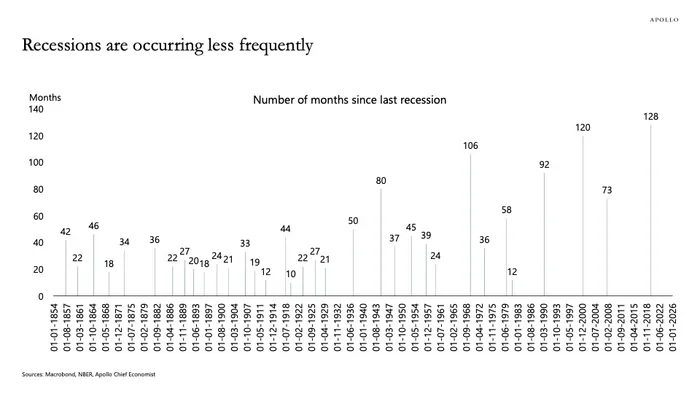
Historical data shows that the number of months between downturns has increased significantly, pointing to a structural shift in how economic risk manifests.
Rather than broad, economy-wide contractions, Slok notes that investors are increasingly facing “sector-specific cycles” that occur within ongoing expansions.
Recent examples include the energy downturn from 2014 to 2016, stress in traditional retail between 2016 and 2019, and the commercial real estate cycle from 2022 to 2024. More recently, weakness has begun to emerge in parts of the software sector. The implication is a more continuous opportunity set for investors—but also a more fragmented and harder-to-time risk environment.
Nvidia’s Trillion-Dollar AI Vision Meets a Higher Bar
Nvidia was also in focus following CEO Jensen Huang’s GTC keynote, where he outlined a sweeping vision for artificial intelligence that includes as much as $1 trillion in cumulative revenue opportunity through 2027.
The company introduced new systems spanning GPUs, inference chips, CPUs, and networking infrastructure, reinforcing its strategy of building a vertically integrated AI platform.
Despite the scale of the announcements, Nvidia shares failed to sustain early gains and slipped back into negative territory during Monday's session. The muted reaction reflects a growing challenge for mega-cap technology stocks: expectations have risen so sharply that even transformative long-term projections may not translate into immediate upside without clear evidence of near-term earnings acceleration.
Oil Spike Creates Policy Trap for the Fed
The Federal Reserve begins its two-day meeting Tuesday facing a renewed policy dilemma as rising energy prices threaten to complicate the path toward lower interest rates.
According to reporting from Yahoo Finance, the recent surge in oil—driven by geopolitical conflict and supply disruptions—is creating tension between inflation and growth. Higher energy prices tend to lift headline inflation and feed into broader costs across the economy, while simultaneously acting as a drag on consumer spending and business activity.
This dynamic has already begun to shift market expectations. Short-term Treasury yields, particularly the two-year, have moved higher in recent weeks as traders push back the timing of rate cuts.
Economists widely expect the Fed to leave rates unchanged at this meeting, but the tone of policymakers will be closely watched for signals on how they are weighing the renewed inflation risk against signs of slowing growth.
Tuesday’s early gains highlight a market that remains resilient on the surface but increasingly sensitive to macro shifts underneath. Slok’s framework suggests that while a near-term recession may be less likely, risks have not disappeared—they have simply become more localized and more frequent across individual sectors. At the same time, the rebound in oil prices threatens to reaccelerate inflation just as central banks were preparing to pivot, raising the risk that monetary policy remains restrictive for longer than investors had anticipated.

Adam Shapiro is a three-time Emmy Award–winning content creator, former network news correspondent, and founder of the multimedia production company TALKENOMICS. At AInvest, he created and launched Capital & Power, a video podcast series designed to drive engagement and establish thought leadership, while also producing original live streams, financial articles, and investor-focused video content. Previously, as a correspondent at FOX Business, Shapiro established the network’s Washington, D.C. bureau, reported from the White House, Capitol Hill, and the Federal Reserve, and secured exclusive bipartisan interviews with influential leaders. His reporting helped solidify FOX Business as the most-watched business channel on television. At the same time, his original Talkenomics series drew tens of thousands of viewers per episode through insightful conversations with policymakers, economists, and thought leaders. At Yahoo Finance, he played a critical leadership role in expanding digital programming to eight hours of live, bell-to-bell financial news coverage, dramatically increasing traffic from 68M to 104M unique monthly visitors and growing ad revenue from zero to over $50 million annually. Yahoo Finance continues to benefit from the credibility of Shapiro’s exclusive interviews with former President Donald Trump and numerous Fortune 500 CEOs.
Latest Articles
Stay ahead of the market.
Get curated U.S. market news, insights and key dates delivered to your inbox.


AInvest
PRO
AInvest
PRO



Comments
No comments yet