
U.S. Stocks Edge Higher in Shortened Black Friday Session as Consumers Stay Resilient
Why the middle class may be living in poverty's new "valley of death!" 👇
U.S. stocks extended gains in a quiet Black Friday session, with the major indexes finishing higher during a holiday-shortened day that saw markets close at 1 p.m. ET. The Dow Jones Industrial Average rose 289.30 points, or 0.61%, to 47,716.4, while the Nasdaq Composite added 151.00 points, or 0.65%, to 23,365.7. The S&P 500 advanced 36.48 points, or 0.54%, to 6,849.09, and the small-cap Russell 2000 climbed 0.47% to 248.47, according to the provided index dashboard screenshot.
A major point of conversation heading into the weekend came from Michael Green, portfolio manager and chief strategist at Simplify. His latest newsletter warns that the middle and upper middle class may be living in the new poverty. Green argues that federal poverty metrics, unchanged in structure since the 1960s, no longer capture the economic pressures borne by middle-income households. “There’s a valley that I decry as the valley of death, basically between about $40,000 and $100,000 in which you’ve gained $60,000 worth of quote-unquote income… and you’re not any better off,” Green said.
Green told AInvest that the current federal poverty definition still relies on a 1963 formula that assumed food made up one-third of a household budget. “We never changed the metrics over the time period in which food prices have fallen dramatically relative to all the other costs that people experience,” he said. The result, he argues, is an official poverty threshold “around $32,000” that is far below his estimate of “anything less than about $100,000 a year” for a family of four. In high-cost regions, he added, families may need “somewhere around 140 to $150,000” before they can begin saving.
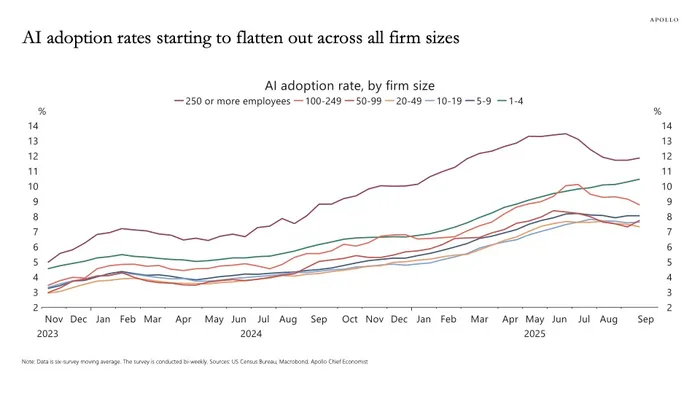
Another theme influencing sentiment came from Apollo Global Management’s chief economist Torsten Sløk, who highlighted early signs that corporate AI adoption may be plateauing. Drawing on Census Bureau and Ramp data, Sløk said AI adoption rates “are starting to flatten out across all firm sizes,” citing the Ramp AI Index, which tracks activity across more than 40,000 U.S. businesses using the company’s payments platform. The flattening trend introduced a note of caution for investors who have leaned on AI as a durable growth catalyst this year.
Still, with macroeconomic data sparse during the holiday period and no major corporate earnings on deck, Friday’s gains largely reflected technical positioning rather than conviction buying. Market participants will turn next to early-December labor data and the next Fed meeting to determine if momentum can carry into the final month of the year.

Adam Shapiro is a three-time Emmy Award–winning content creator, former network news correspondent, and founder of the multimedia production company TALKENOMICS. At AInvest, he created and launched Capital & Power, a video podcast series designed to drive engagement and establish thought leadership, while also producing original live streams, financial articles, and investor-focused video content. Previously, as a correspondent at FOX Business, Shapiro established the network’s Washington, D.C. bureau, reported from the White House, Capitol Hill, and the Federal Reserve, and secured exclusive bipartisan interviews with influential leaders. His reporting helped solidify FOX Business as the most-watched business channel on television. At the same time, his original Talkenomics series drew tens of thousands of viewers per episode through insightful conversations with policymakers, economists, and thought leaders. At Yahoo Finance, he played a critical leadership role in expanding digital programming to eight hours of live, bell-to-bell financial news coverage, dramatically increasing traffic from 68M to 104M unique monthly visitors and growing ad revenue from zero to over $50 million annually. Yahoo Finance continues to benefit from the credibility of Shapiro’s exclusive interviews with former President Donald Trump and numerous Fortune 500 CEOs.
Latest Articles
Stay ahead of the market.
Get curated U.S. market news, insights and key dates delivered to your inbox.


AInvest
PRO
AInvest
PRO



Comments
No comments yet