
Stocks Drop Oil Jumps; Hatfield Says Worst Case Is $140 Crude, $6 Gas
U.S. stocks fell Thursday at the closing bell as oil prices surged sharply amid supply concerns tied to geopolitical tensions. The Dow Jones Industrial Average closed at 46,677.9, down 739.42 points (1.56%), while the S&P 500 finished at 6,672.62, falling 103.18 points (1.52%) and the Nasdaq Composite ended at 22,312.0, down 404.16 points (1.78%), according to market dashboard data.
The selloff coincided with a sharp rally in energy markets. West Texas Intermediate crude for April delivery rose to $96.36 a barrel, up $9.11 or 10.44%, pushing oil close to the psychologically important $100 level.
Energy markets have become a key driver of equity sentiment, and analysts say the trajectory of oil prices could determine whether the recent market volatility deepens.
Jay Hatfield, CEO and CIO of Infrastructure Capital, said the oil spike reflects fears of potential supply disruptions in the Middle East, particularly around shipping routes such as the Strait of Hormuz. “All it takes is one tweet saying the U.S. will escort ships through the Strait and oil could fall sharply” Hatfield said in an interview with AInvest.
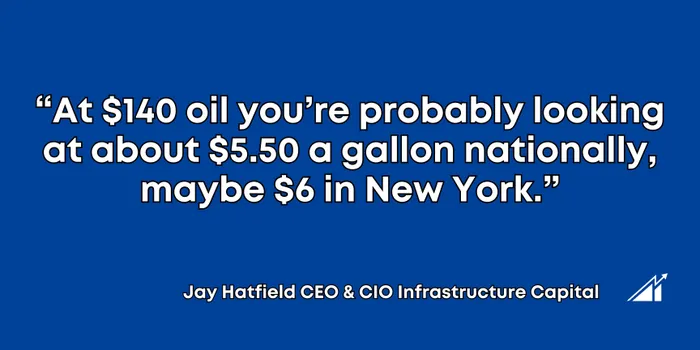
Hatfield said energy markets can be analyzed through supply and demand elasticity, estimating that each loss of 1 million barrels of daily supply could add roughly $5 per barrel to oil prices. In a hypothetical worst-case scenario where about 16 million barrels per day were removed from global supply, oil could theoretically reach around $140 per barrel, he said.
“That’s kind of the worst-case scenario,” Hatfield pointed out, adding that such an outcome would require an extremely unlikely long-term shutdown of key shipping routes.
More realistically, he expects crude prices to stabilize in a broad $80–$100 range, noting that higher prices typically trigger increased production and hedging activity by major energy companies.
One dynamic investors often overlook, Hatfield said, is how major oil producers hedge production when prices spike. Energy companies typically sell futures contracts during rallies to lock in prices, which can dampen sustained price spikes.
“The real players in the business will come in and hedge their long-term production,” Hatfield said.
Despite the current surge, futures markets further out on the curve suggest expectations for lower prices later this year. Hatfield noted oil contracts several months out are trading closer to $70 per barrel, indicating the market expects the current risk premium to fade.
Still, if oil were to approach the extreme $140 scenario, Hatfield said consumers would feel the impact quickly at the pump.
National gasoline prices could climb to roughly $5.50 per gallon, or closer to $6 in high-cost regions such as New York, he estimated. Even then, Hatfield said the U.S. economy would likely weather the shock better than Europe due to America’s large domestic energy supply.
The bigger risk to markets, he added, is the uncertainty itself. Markets can swing quickly on geopolitical headlines, meaning energy prices — and equities — could reverse rapidly if tensions ease.
Hatfield said a clear signal that shipping routes will remain open could quickly send oil lower and lift equities. “All it takes is one announcement that shipping will resume,” he said, adding that oil could quickly fall back toward $70 while stocks rebound.
For now, Hatfield describes the current environment as a seasonal period of heightened fear in markets. “This is the season for fear,” he said, noting that the lack of earnings catalysts in early spring often allows macro risks such as energy shocks to dominate investor sentiment.

Adam Shapiro is a three-time Emmy Award–winning content creator, former network news correspondent, and founder of the multimedia production company TALKENOMICS. At AInvest, he created and launched Capital & Power, a video podcast series designed to drive engagement and establish thought leadership, while also producing original live streams, financial articles, and investor-focused video content. Previously, as a correspondent at FOX Business, Shapiro established the network’s Washington, D.C. bureau, reported from the White House, Capitol Hill, and the Federal Reserve, and secured exclusive bipartisan interviews with influential leaders. His reporting helped solidify FOX Business as the most-watched business channel on television. At the same time, his original Talkenomics series drew tens of thousands of viewers per episode through insightful conversations with policymakers, economists, and thought leaders. At Yahoo Finance, he played a critical leadership role in expanding digital programming to eight hours of live, bell-to-bell financial news coverage, dramatically increasing traffic from 68M to 104M unique monthly visitors and growing ad revenue from zero to over $50 million annually. Yahoo Finance continues to benefit from the credibility of Shapiro’s exclusive interviews with former President Donald Trump and numerous Fortune 500 CEOs.
Latest Articles
Stay ahead of the market.
Get curated U.S. market news, insights and key dates delivered to your inbox.


AInvest
PRO
AInvest
PRO



Comments
No comments yet