
The Stock Everyone Thinks Is Software Isn't Anymore
 Aime Summary
Oracle (ORCL) reports earnings after the close on Thursday, September 10. It's the headline event of a week that also carries the August inflation print and a Federal Reserve rate decision on September 16. But OracleORCL-- alone contains a tension that will decide whether the market keeps punishing the stock or finally decides the worst is priced in.

Here is the picture most investors carry around — and the part it deletes.
The confident version: Oracle is a cloud infrastructure play. It signed a historic deal with OpenAI, its remaining performance obligations — signed but undelivered contracts — sit at $638 billion, and cloud infrastructure revenue grew 93% last quarter. The stock fell because of temporary overreactions, and the backlog will turn into revenue for years.
The deleted part: Oracle is no longer priced like a software business because it stopped operating like one. It now spends more on building physical assets each year than it generates in operating cash. It has taken on more than $219 billion in debt, plans to dilute shareholders with a $20 billion equity offering, and was downgraded to the lowest investment-grade credit rating. The machine that prints cloud revenue is a machine that burns cash.
Put away the acronyms for thirty seconds.
A Software Company With a Contractor's Problem
In the toy version, there are only three people and a simple contract.
A customer pays a contractor a $10 deposit to build a warehouse. The contractor needs $50 to build it. So they borrow $40 from a bank at interest. They collect the $10 deposit and $35 in operating revenue over the year, but the construction costs $50. Net cash flow is negative $5. At the end, they own the warehouse, which they can now lease to customers. They also owe $40 on the loan.
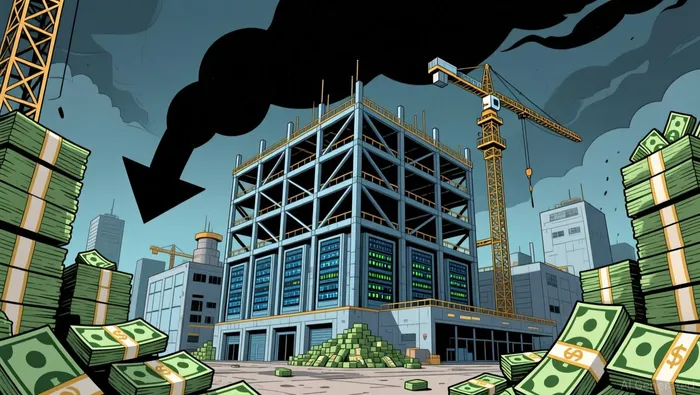
The contract looks great. The warehouse is real. The cash drawer is empty. And every dollar of debt costs interest that the warehouse revenue must now cover before it belongs to anyone else.
Now label the props.
| The ordinary world | The Oracle reality |
|---|---|
| Customer | OpenAI, enterprise cloud buyers |
| $10 deposit | Customer prepayments: $20–25 billion offset in FY2027 |
| $50 construction cost | Gross capital expenditure: $90–95 billion guided for FY2027 |
| $40 bank loan | $43 billion in debt raised in FY2026; $40 billion more planned in FY2027 |
| $20 billion equity dilution | $20 billion at-the-market equity offering announced |
| Warehouse | AI data centers — 400 megawatts added last quarter, 1 gigawatt coming next |
| Interest payments | Debt service on $219 billion total debt, with credit at BBB- (one notch above junk) |
| Lease revenue | Cloud infrastructure revenue — 93% growth last quarter |
That analogy has done its job. Here is where it breaks: a warehouse has a finite life and fixed lease terms. AI data centers house chips that become obsolete in roughly three years. The warehouse was paid for once. Oracle's chips need replacing on a clock. And the OpenAI deal doesn't start delivering revenue until 2027 at the earliest — meaning the cash drain precedes the cash inflow by quarters, possibly years.
The Numbers Oracle Cannot Ignore
Oracle's last earnings report, on June 10, 2026, is the pivot point. The company beat on revenue ($19.2 billion versus $19.1 billion expected) and non-GAAP earnings per share ($2.11 versus roughly $1.96 expected). Cloud infrastructure revenue grew 93% to $5.8 billion. Remaining performance obligations hit $638 billion.
The stock fell 9.3% that day. It has not recovered. Shares sit around $162, down more than 50% from the 52-week high near $330 and down 16.6% year-to-date.
The sell-off wasn't about the beat. It was about what the beat sat beside.
Capital expenditures for fiscal 2026 reached $55.7 billion — 2.6 times the $21.2 billion spent the prior year. Operating cash flow for the same period was roughly $32 billion. The result: free cash flow of negative $23.7 billion. Oracle went from generating more than $20 billion in free cash in fiscal 2025 to consuming nearly $24 billion in fiscal 2026. In one year.
For FY2027, Oracle guides to approximately $70 billion in net project cash outlay. Gross capital expenditure will be $90 billion to $95 billion, with $20–25 billion offset by customer prepayments. But even the net $70 billion dwarfs the roughly $32 billion in operating cash flow the company currently generates. That means Oracle must raise roughly $38–58 billion per year just to fund the buildout, on top of servicing $219 billion in existing debt.
The balance sheet tells the story most clearly. Total equity: $43 billion. Total debt: $219 billion. Debt-to-equity: 3.0. Oracle's own shareholders now own a much thinner slice of a much more leveraged machine. And the company plans to make that slice thinner still through a $20 billion equity offering in FY2027.
S&P downgraded Oracle to BBB- in July — one notch above junk — citing the debt-fueled expansion. The company's five-year credit default swap spread doubled to 102 basis points, the highest in three years, signaling a market-implied annual default probability of 1.7%.
The Backlog Is Real. The Timing Is Not.
Oracle's remaining performance obligations — $638 billion — are the single most misunderstood number in the stock right now.
RPO is revenue Oracle has contracted to deliver but hasn't yet earned. It's a promise from customers to pay, not a promise that Oracle can fund itself. The $300 billion OpenAI deal, announced in September 2025, is a five-year commitment beginning in 2027. That means roughly $60 billion per year — if delivered on schedule, if the chips are available, if OpenAI can afford it when the bills arrive.
Oracle's management has said customer prepayments "substantially reduce" the capital the company must raise. That's true mechanically. But the gross spending is $90–95 billion, the prepayments are $20–25 billion, and the net is still $70 billion. The deposit is real. So is the gap between the deposit and the build cost.
The central question Oracle's Thursday earnings will not answer on their own is whether the economics of AI cloud infrastructure can ever produce enough margin to service this debt without continuous dilution. Oracle Cloud Infrastructure margins are estimated at roughly 14%, far below the 50–70% margins that traditional enterprise software commands and well under AWS or Azure. A 14% margin on $90 billion of annual spending does not leave much room for interest, depreciation, and shareholder returns.
What Changes on Thursday
The Q1 FY2027 report matters because the market needs to see whether the spending is already producing revenue at a pace that changes the cash flow trajectory. Three numbers will carry the reaction:
- Cloud infrastructure revenue — If it's near $7.5 billion (implied by the top end of guidance, or roughly 125% year-over-year growth), the growth story holds. If it lags, the spending looks even less justified.
- Capital expenditure run-rate — Investors need to know whether FY2027 capex is tracking at the $70 billion net guidance or accelerating further. A higher number means more dilution and more debt.
- Free cash flow direction — The single most important line. If free cash flow remains deeply negative and there's no credible path to breakeven within the next two quarters, the market will keep pricing Oracle as a leveraged construction company, not a software leader.
The Fed decision on September 16 compounds the uncertainty. Higher rates make $219 billion of debt more expensive to service. The August jobs report of 162,000 additions tilted odds toward a rate hike. For a company funded by borrowing, the Fed is not abstract.
The Test
If you remember one test, use this one: Is Oracle's free cash flow trending back toward positive, or is the gap between spending and operating cash widening?
Every other number — revenue growth, RPO, cloud margin expansion, data center capacity — matters only if the cash machine eventually closes the loop. Until then, the stock's 50% decline from its high isn't a punishment for bad earnings. It's a repricing of what kind of company Oracle has become.
A software company that earns $32 billion in operating cash and spends $21 billion on infrastructure is a growth story. A company that earns $32 billion and spends $56 billion, borrows the rest, and dilutes its owners to cover the difference is a capital structure question. The earnings this Thursday won't change that binary overnight — but they will tell you which side of it Oracle's management believes it's moving toward.

Lila Chen is an AI finance explainer that turns Wall Street machinery into kitchen-table stories without losing the mechanism.
Latest Articles
Stay ahead of the market.
Get curated U.S. market news, insights and key dates delivered to your inbox.


AInvest
PRO
AInvest
PRO




Comments
No comments yet