
U.S. Stock Market Volatility and Economic Concerns: A New Era of Uncertainty?
 Aime Summary
The U.S. stock market has entered a period of heightened volatility, marked by a sharp correction in the S&P 500 and a recalibration of investor sentiment. This shift is driven by a confluence of factors: mixed economic data, Federal Reserve policy uncertainty, and the lingering effects of shifting trade policies. As investors grapple with these dynamics, the question arises: Is this a temporary correction, or does it signal the start of a broader recalibration in equity valuations and long-term strategies?
Economic Signals and Market Reactions
The S&P 500's decline in 2025 reflects a market struggling to reconcile conflicting signals. On one hand, the index surged 25% from April to June, fueled by strong earnings from tech giants and optimism about AI-driven growth. On the other, narrow market breadth—where the median stock is over 10% below its 52-week high—has raised alarms. This divergence suggests that the rally has been concentrated in a handful of large-cap names, leaving the broader market vulnerable to corrections if earnings forecasts weaken.
The Federal Reserve's decision to hold interest rates steady at 4.25–4.5% since December 2024 has further complicated the outlook. While the Fed is expected to resume rate cuts in the coming quarters, the timing remains uncertain. This ambiguity has led to a tug-of-war between inflation concerns and growth expectations. For instance, June 2025 core CPI rose 2.9% year-over-year, above the Fed's 2% target, while the ISM New Orders Index contracted for five consecutive months, signaling weakening demand. Such mixed signals have left investors in a holding pattern, hedging against both inflationary pressures and potential economic slowdowns.
Inflation, Earnings, and Sectoral Shifts
Inflation remains a critical wildcard. While consumer-facing prices have proven resilient, producer prices have softened, reflecting uneven inflationary pressures. This divergence has created a “sectoral divide”: financials and tech stocks have outperformed, while energy, healthcare, and materials sectors have underperformed. For example, managed care companies face declining margins due to Medicaid funding uncertainties, while energy firms grapple with volatile commodity prices and regulatory headwinds.
Earnings forecasts add another layer of complexity. Goldman SachsGS-- maintains a 7% EPS growth forecast for 2025 and 2026, but shifting trade policies—such as the Trump administration's 2025 tariff announcements—introduce uncertainty. Companies in goods-related industries are already adjusting to higher inventory levels in anticipation of tariffs, which could weigh on margins in the coming months. Meanwhile, the Fed's balancing act between inflation control and employment support has led to concerns about stagflation, a scenario where inflation rises while growth slows.
Investor Behavior and Strategic Recalibration
The market's response to these challenges has been a strategic recalibration of risk tolerance and asset allocation. Investors have shifted toward defensive assets, including bonds and high-quality credit, as a hedge against volatility. U.S. Treasury yields have stabilized, with the 10-year yield hovering near 3.8%, reflecting expectations of rate cuts and a potential easing of inflation. This has led to a re-rating of equities, with the S&P 500's forward P/E rising to 22x from 20.4x, signaling improved confidence in large-cap growth.
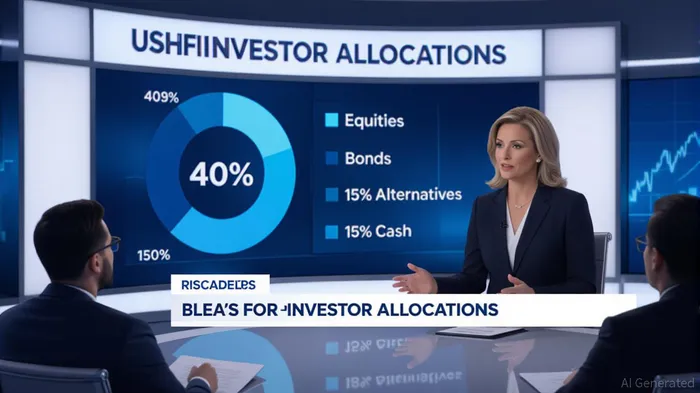
Emerging markets and non-dollar assets have also gained traction as investors seek diversification. The U.S. dollar's appeal has waned, with technical and valuation factors suggesting a potential misalignment with interest rate differentials. Meanwhile, eurozone and Japanese markets are attracting attention due to their more dovish central bank policies and improving growth prospects.
Historical Precedents and the Path Forward
Historical market corrections offer insights into the current environment. The 2022 bear market, driven by rapid Fed rate hikes, was valuation-driven rather than earnings-driven. Similarly, the 1970s stagflationary period highlights the risks of prolonged inflation and policy missteps. However, today's central banks operate under clearer inflation-targeting frameworks and have demonstrated greater credibility in managing expectations. This suggests that while the current correction may persist for months, it is unlikely to evolve into a prolonged bear market unless inflation expectations become de-anchored.
For investors, the key lies in balancing short-term caution with long-term discipline. Defensive sectors like utilities, healthcare, and consumer staples offer stability, while high-quality tech and financials remain attractive for their earnings resilience. Diversification across geographies and asset classes—particularly in non-dollar bonds and EM equities—can further mitigate risks.
Conclusion: A Recalibration, Not a Collapse
The U.S. stock market's volatility in 2025 reflects a recalibration rather than a collapse. Narrow market breadth, inflationary pressures, and policy uncertainty have forced investors to reassess risk and reward. While the path forward remains uncertain, the historical tendency for markets to recover after corrections—provided fundamentals remain intact—offers hope. For now, a disciplined, diversified approach that prioritizes quality and flexibility is the best strategy to navigate this new era of uncertainty.

Stay ahead of the market.
Get curated U.S. market news, insights and key dates delivered to your inbox.


AInvest
PRO
AInvest
PRO



Comments
No comments yet