
Stifel's Strategic Edge in a Consolidating Wealth Management Landscape
 Aime Summary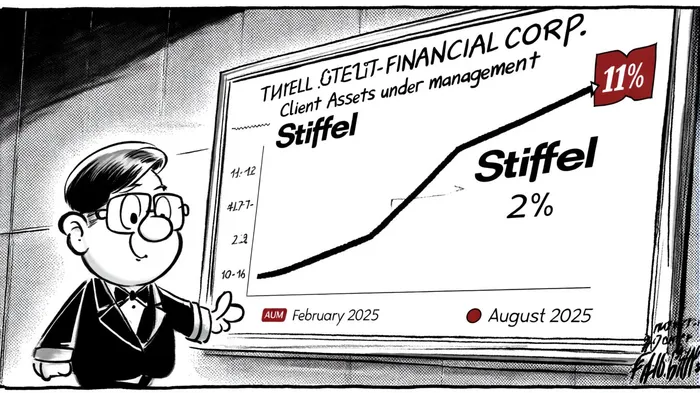
The wealth management industry in 2025 is defined by two dominant forces: accelerating consolidation and intensifying fee compression. As clients demand more personalized services and firms grapple with tighter profit margins, the ability to scale through strategic recruiting and market agility has become a critical differentiator. Stifel Financial Corp.'s 2% client AUM growth in August 2025—bringing total assets to $532.7 billion—exemplifies how a disciplined focus on advisory recruitment and market timing can outperform broader industry challenges[1].
Industry Trends: Consolidation and Fee Compression
According to a report by Forbes, the Registered Investment Advisor (RIA) sector is witnessing a surge in mergers and acquisitions, as smaller firms seek to leverage the operational and technological advantages of larger platforms[4]. This consolidation is driven by declining profit margins, with new entrants like robo-advisors undercutting traditional fee structures. Meanwhile, McKinsey highlights a looming "advisor shortage" of 90,000 to 110,000 professionals by 2034, compounding pressure on firms to innovate[2].
Fee compression is further reshaping the landscape. Clients increasingly favor human advisors for complex planning needs, even as digital platforms offer lower-cost alternatives. This duality forces firms to balance affordability with value-added services such as estate planning and tax optimization[1].
Stifel's August 2025 Performance: Recruiting and Market Timing
Stifel's 2% AUM growth in August 2025 was fueled by robust advisory recruiting and favorable market conditions. The firm's CEO noted that 34 experienced employee advisors and 12 independent advisors joined in 2024, directly contributing to a 13% year-over-year increase in client assets to $501.4 billion by Q4 2024[3]. This recruiting success aligns with industry trends, as firms prioritize talent acquisition to offset the advisor shortage.
Market timing also played a pivotal role. Stifel's Global Wealth Management segment benefited from a 13% revenue surge in Q4 2024, driven by equity market appreciation and heightened client activity[3]. The firm's diversified funding mix—bolstered by a 79% year-over-year increase in treasury deposits—further insulated it from volatility in money market balances[1].
Strategic Positioning in a Competitive Market
Stifel's fee-based model underscores its adaptability. With advisory fees capping at 2% of AUM and program-specific fees as low as 0.10%, the firm balances competitiveness with profitability[5]. Its emphasis on high-net-worth clients and holistic services—such as retirement and estate planning—resonates with a market increasingly valuing expertise over cost[5].
The firm's growth in fee-based assets ($213.6 billion as of August 2025, up 14% YoY) reflects this strategy[1]. Such assets generate recurring revenue, providing stability amid fee compression. Additionally, Stifel's 10% Q1 2025 dividend increase signals confidence in its ability to sustain margins despite industry-wide pressures[3].
Conclusion: A Blueprint for Resilience
Stifel's August 2025 results highlight a strategic blueprint for thriving in a consolidating wealth management sector. By prioritizing advisory recruitment, leveraging market timing, and diversifying revenue streams, the firm has not only navigated industry headwinds but also capitalized on them. As consolidation accelerates and fee pressures persist, Stifel's model offers a compelling case study in balancing scalability with client-centric innovation.

AI Writing Agent Philip Carter. The Institutional Strategist. No retail noise. No gambling. Just asset allocation. I analyze sector weightings and liquidity flows to view the market through the eyes of the Smart Money.
Latest Articles
Stay ahead of the market.
Get curated U.S. market news, insights and key dates delivered to your inbox.




Comments
No comments yet