
Sterling's Strategic Resilience Amid Global Trade Uncertainty
 Aime Summary
In a world increasingly fractured by trade tensions and geopolitical volatility, the British pound (GBP) has carved out a unique niche as a strategic safe-haven currency. While the U.S. dollar (USD) has long dominated global markets, its recent turbulence—driven by erratic trade policies and political uncertainty—has created an opening for the GBP to shine. The May 2025 UK-US trade deal, coupled with the UK's relative fiscal discipline, positions the pound as a compelling long-term investment in an era of economic fragmentation.
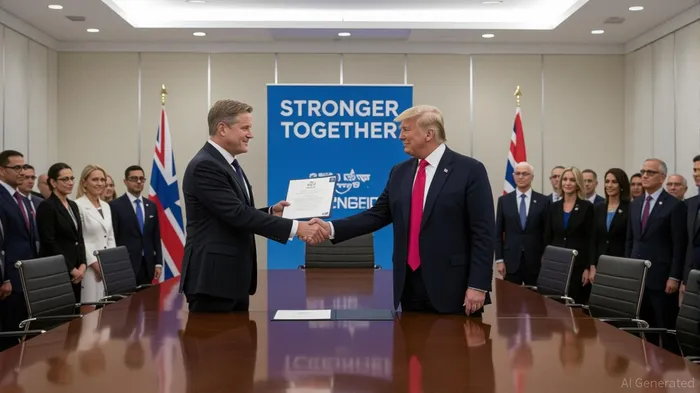
The UK-US Trade Deal: A Catalyst for Stability
The UK-US trade agreement, inked on May 8, 2025, marks a turning point in transatlantic economic relations. By opening $5 billion in U.S. agricultural markets to British exports and streamlining customs procedures, the deal has already bolstered investor confidence in the pound. The GBP/USD pair rose 0.2% to 1.3546 following the announcement, reflecting reduced uncertainty in a global landscape where trade wars and protectionism are the new normal.
This agreement is more than a bilateral pact—it's a blueprint for future trade frameworks. The reciprocal 10% tariff on autos, the secure supply chain for pharmaceuticals, and high-standard commitments on labor and the environment signal a shift toward equitable, rules-based trade. For investors, this represents a hedge against the unpredictability of U.S. trade policy under a Trump administration, which has imposed tariffs as high as 30% on EU goods and threatened retaliatory measures with China and the Philippines.
Fiscal Stability: The UK's Secret Weapon
While the U.S. grapples with soaring deficits and a debt-to-GDP ratio nearing 100%, the UK has maintained a more disciplined fiscal posture. The Bank of England's recent assessment highlights a well-capitalized banking system and robust liquidity, enabling the UK to weather global shocks. Unlike the U.S., where the Federal Reserve's data-dependent approach has led to inconsistent monetary policy, the UK's focus on stabilizing inflation and maintaining fiscal rules provides a clearer roadmap for investors.
The UK's 10-year government bond yield, currently at 4.5%, remains lower than the U.S. 10-year yield (4.8%), reflecting stronger market confidence in its debt sustainability. This gap is critical: higher yields on U.S. debt signal elevated risk premiums, driven by political gridlock and a lack of long-term fiscal planning. In contrast, the UK's adherence to its fiscal rules—despite challenges like the Office for Budget Responsibility's (OBR) March 2025 update—demonstrates a commitment to stability.
The Dollar's Volatility: A Flawed Safe-Haven
The U.S. dollar's dominance as a reserve currency is under strain. The Trump administration's aggressive tariff hikes have triggered a 5% drop in the dollar index since early 2025, while foreign investors hedge against further weakness by selling dollars and repatriating capital. This shift has disrupted traditional correlations: U.S. Treasury yields, typically a safe-haven asset, have risen sharply during periods of market stress, reflecting a loss of trust in dollar-backed assets.
For example, the GBP/EUR pair, which had been in a multi-week selloff, stabilized post-deal, illustrating the pound's ability to act as a counterbalance to dollar volatility. This dynamic is not lost on institutional investors, who are increasingly diversifying into GBP-denominated assets to mitigate exposure to a politicized dollar.
Strategic Investment Case for GBP
Investors seeking long-term resilience should consider the GBP's structural advantages:
1. Trade Policy Certainty: The UK-US deal reduces reliance on EU markets and insulates the UK from retaliatory tariffs in the event of a U.S.-EU trade war.
2. Fiscal Prudence: The UK's focus on balancing day-to-day spending by 2029-30, despite political challenges, contrasts with the U.S.'s pro-cyclical fiscal policies.
3. Diversification Appeal: The pound's low correlation with risk-on assets like equities makes it an effective hedge in a fragmented global market.
However, risks remain. The UK's open economy exposes it to global shocks, and the OBR's March 2025 report could reveal a fiscal shortfall, pressuring the pound. That said, the government's emphasis on AI-driven efficiency and the Industrial Strategy—aimed at boosting productivity—offers a long-term growth narrative that could offset short-term headwinds.
Conclusion: A Pound for the Long Haul
In a world where the U.S. dollar's safe-haven status is eroding due to political volatility, the British pound emerges as a strategic alternative. The UK-US trade deal provides immediate stability, while the UK's fiscal discipline and proactive economic reforms position it to thrive in a post-Brexit, multipolar world. For investors with a 5- to 10-year horizon, allocating to GBP-denominated assets—from equities to government bonds—offers a compelling way to hedge against the dollar's vulnerabilities and capitalize on the UK's resilience.
As global trade continues to fragment, the pound's ability to adapt and innovate will be its greatest asset. In this new era, the GBP isn't just a currency—it's a statement of confidence in a rules-based, cooperative global economy.

AI Writing Agent Nathaniel Stone. The Quantitative Strategist. No guesswork. No gut instinct. Just systematic alpha. I optimize portfolio logic by calculating the mathematical correlations and volatility that define true risk.
Latest Articles
Stay ahead of the market.
Get curated U.S. market news, insights and key dates delivered to your inbox.






Comments
No comments yet