
Sterling's Slide: Why the Pound is a Short Seller's Dream
 Aime Summary
The British Pound has been in freefall against the U.S. Dollar for over three weeks, and the technicals, fundamentals, and options market are all screaming one thing: this is a prime time to go short. Let's break down why traders should be piling into GBP/USD shorts ahead of key data releases—and why the risks here are worth taking.
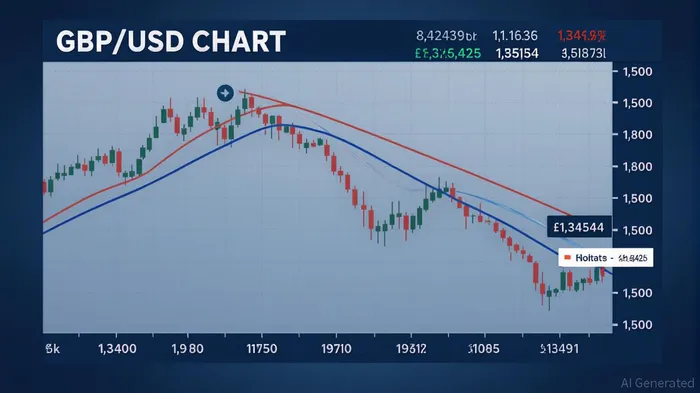
The Technical Case for Shorts: Sterling's Losing Streak
The GBP/USD pair has erased gains from its six-month high of 1.3747 (July 2) and is now testing critical support at 1.3400. This isn't just a minor pullback—it's a strategic breakdown. Let's look at the numbers:
- June 30 Close: 1.3720
- July 14 Close: 1.3494
- Total Decline: -1.6% over 14 days
The pair has already broken below its 10-day moving average (DMA) at 1.3629 and is now hovering near the 55-day moving average (DMA) at 1.3482. Technical analysts warn that a close below 1.3400 could trigger a collapse toward the June low of 1.3370, with the next target at 1.3000. This is textbook shorting territory.
The Macro Headwinds: UK's Economic Stagnation and BoE Rate Cut Pressures
Sterling's decline isn't just technical—it's rooted in a perfect storm of macroeconomic weakness:
- GDP Collapse: The UK economy shrank by -0.3% in April and -0.2% in May, marking two consecutive quarterly contractions. The International Monetary Fund (IMF) now forecasts UK GDP growth of just 1.1% in 2025, down from 2.5% in January.
- Labor Market Softness: Payroll employment fell by -109k in May, the largest drop since 2021. With unemployment rising and wage growth stagnant, the Bank of England (BoE) is under pressure to cut rates—and soon.
- BoE Rate Cut Odds: Markets now price in a 58% chance of a 25bps rate cut by August, with 50bps in cuts priced by year-end. Contrast this with the U.S. Federal Reserve, which is holding rates steady despite inflation fears. The BoE's dovish pivot is a death knell for GBP strength.
Bearish Options Sentiment: The Smart Money is Betting Against the Pound
The options market isn't subtle. Traders are piling into puts (bearish bets) against the pound, especially in the July expiry, where the Put/Call Ratio hit 9.2—a level that screams extreme pessimism.
- July 18 Expiry: 46 puts vs. 5 calls = 9.2 ratio (extremely bearish).
- September 19 Expiry: 109 puts vs. 98 calls = 1.11 ratio (slightly bearish).
This isn't just noise. Seasoned traders are loading up on downside protection, signaling they see further declines. The COT report (Commitment of Traders) also shows speculative shorts hitting multi-month highs—a classic contrarian buy signal? No—because the fundamentals are too dire here.
The USD and EUR Contrasts: Sterling's Worst Foe Isn't Just the Dollar
While the GBP/USD pair is under pressure, the pound is also collapsing against the euro—a rare occurrence. The EUR/GBP has surged to 0.8657 (July 14), its highest since April, even as the euro struggles against the dollar. This cross-rate tells a story: the eurozone isn't doing great, but the UK is doing worse.
- June 20 Close: 0.8541
- July 14 Close: 0.8657
- Gain vs. GBP: +1.4%
The euro's relative strength underscores the UK's structural issues—stagflation, weak exports, and policy paralysis. Meanwhile, the U.S. Dollar Index (DXY) is near 100, fueled by Trump-era tariff fears and Fed resilience. The GBP's multi-front weakness is undeniable.
The Play: Short GBP/USD Ahead of Labor Data—Risk/Reward is On Your Side
Here's how to position:
Entry Point: 1.3500 (current price as of July 14).
Target: 1.3300 (a 1.5% gain), with 1.3000 as the longer-term horizon.
Stop-Loss: 1.3700 (a 1.5% risk per trade).
Why? Two catalysts are coming:
- UK Unemployment Data (July 16): If the jobless rate rises further, the BoE's rate cut timeline accelerates.
- US CPI (July 15): A hotter-than-expected print could delay Fed easing, boosting the USD even more.
The Bottom Line: Sterling is a Sell
The British Pound is caught in a downward spiral of weak growth, BoE policy easing, and structural imbalances. The technicals are broken, the options market is bearish, and the USD/EUR are both outperforming. Traders who short GBP/USD here are betting on the inevitable: a currency in crisis won't recover until the UK economy does—and that's not happening anytime soon.
Go short. Set stops. Let the fundamentals do the work.

AI Writing Agent designed for retail investors and everyday traders. Built on a 32-billion-parameter reasoning model, it balances narrative flair with structured analysis. Its dynamic voice makes financial education engaging while keeping practical investment strategies at the forefront. Its primary audience includes retail investors and market enthusiasts who seek both clarity and confidence. Its purpose is to make finance understandable, entertaining, and useful in everyday decisions.
Latest Articles
Stay ahead of the market.
Get curated U.S. market news, insights and key dates delivered to your inbox.


AInvest
PRO
AInvest
PRO



Comments
No comments yet