
Stereotaxis' 2026 Manufacturing Ramp Could Be Make-or-Break for Capturing the Robotic EP Surge


 Aime Summary
Stereotaxis is positioning itself at the foundational layer of a technological paradigm shift. The electrophysiology market, which treats complex heart rhythm disorders, is on an exponential growth path. It is projected to expand from $12.77 billion in 2025 to $38.06 billion by 2035, a compound annual growth rate of 11.54%. This isn't just steady expansion; it's the early acceleration phase of a new adoption curve, driven by a rising prevalence of atrial fibrillation and a shift toward more precise, personalized ablation procedures.
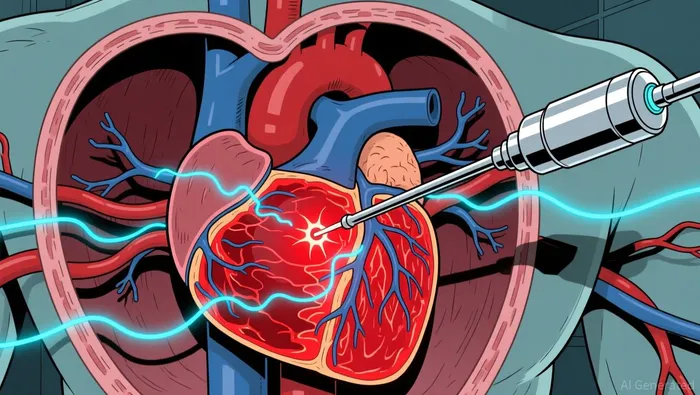
Within this larger wave, the surgical robotics segment is surging even faster. The global medical robots market is forecast to grow at a 17.11% CAGR to reach $64.36 billion by 2034. StereotaxisSTXS-- operates squarely in this high-growth lane, building the infrastructure for robotic-assisted interventions. The company's core mission is to automate the delicate navigation of catheters through the heart, a move that promises to improve outcomes and reduce procedural variability.
The critical hurdle for any technology on an S-curve is crossing the chasm from development to commercial scale. Stereotaxis cleared a major regulatory milestone in 2025, securing approvals in both the United States and Europe for its GenesisX robot and MAGiC catheter portfolio. This approval is the green light for commercialization, removing a fundamental barrier. Yet, as the company's leadership noted, the commercial contribution from these new products was modest in 2025 due to manufacturing ramp challenges. The investment thesis now hinges on 2026: can the company rapidly scale production to meet the pent-up demand of a market entering its steep adoption phase? The regulatory foundation is laid, but the manufacturing ramp is the next critical step to capture the exponential growth ahead.
Financial Performance and the Manufacturing Hurdle
The company's financials show clear growth, but the manufacturing ramp is creating a critical disconnect. Revenue for 2025 climbed $32.4 million, up 20% year-over-year. The momentum accelerated in the final quarter, with sales jumping 36% to $8.6 million. More importantly, the business model is strengthening, with recurring revenue reaching $22.2 million, up 21%. This shift toward disposables and service income is a hallmark of a scalable, high-margin model, suggesting greater customer stickiness and a path to improved profitability.
Yet, the leadership was candid about a major operational hurdle. The commercial contribution from its newly approved products was "modest in 2025 as we worked through challenges in ramping manufacturing of MAGiC and GenesisX". This is the core tension. The market is on an S-curve, and the company has the regulatory key. But without a rapid manufacturing scale-up, revenue growth will be capped by supply, not demand. The financials reflect this: while total revenue grew, the system revenue component, which includes the new GenesisX robot, only rose 18% to $10.2 million. This suggests the new, higher-value products are not yet flowing through the pipeline at the rate the market adoption curve would support.
The cash burn remains a concern. The company posted an adjusted operating loss of $9.3 million for the year, though that was an improvement from the prior year. It ended 2025 with a clean balance sheet, holding $13.4 million in cash and no debt. This provides a runway, but the path to profitability depends entirely on crossing the manufacturing chasm. The 2026 guidance targets double-digit revenue growth, with annual revenue expected to surpass $40 million. Achieving that will require the company to demonstrate it can ramp manufacturing substantially, turning its regulatory approval into a commercial engine. For now, the financial health is stable, but the growth trajectory is on hold until the factory floor can keep pace with the market's exponential climb.
2026 Guidance and the Path to Exponential Adoption
Management's 2026 guidance sets a clear target: double-digit revenue growth with annual sales expected to surpass $40 million. That represents a 24% increase from 2025's $32.4 million, signaling an acceleration from the prior year's 20% growth. The outlook also calls for lower cash use, a positive step as the company aims to stretch its runway. Yet, this forward-looking promise is entirely contingent on solving the manufacturing bottleneck that held back the 2025 launch.
The path to hitting these numbers is defined by specific operational metrics. The company must achieve higher manufacturing volumes to supply its new products. A key milestone is ramping MAGiC catheter production to 500 units per month by year-end. More broadly, management is targeting at least five active GenesisX programs and generating over $3 million in Synchrony digital suite revenue. These are not just sales targets; they are benchmarks for commercial execution and the transition from a limited launch to a full rollout.
The critical near-term catalyst arrives in April. The company is poised for a major commercial step-up, potentially at the Heart Rhythm 2026 conference. This event is the ideal platform to announce progress on its manufacturing ramp and the number of active GenesisX sites. Success here would validate the company's ability to scale, turning its regulatory approval into tangible market share. Failure to demonstrate significant progress would signal that the manufacturing chasm remains uncrossed, capping growth at a level far below the market's exponential S-curve.
The bottom line is that Stereotaxis is now in the execution phase. The market is ready, the technology is approved, and the financials show a path to improved efficiency. But the company's 2026 thesis hinges on a single, make-or-break variable: the speed and scale of its manufacturing ramp. If it can hit its volume and program targets, the guidance becomes a realistic forecast for capturing early adoption. If not, the company risks being left behind as the market surges ahead.
Catalysts, Risks, and What to Watch
The investment thesis for Stereotaxis now turns entirely on execution. The company has the regulatory key and the market is on an S-curve. The 2026 path is defined by three forward-looking events that will validate or challenge its ability to capture exponential growth.
The primary catalyst is a successful manufacturing ramp and the transition to a full commercial launch of the GenesisX robot and MAGiC catheter portfolio in the second and third quarters. The FDA approval for the MAGiC catheter, secured last week, removes the final regulatory barrier for a complete, proprietary system that replaces an older Johnson & Johnson device. This is the moment for a commercial step-up. The company's guidance targets at least five active GenesisX programs and over $3 million in Synchrony digital suite revenue for the year. Hitting these milestones will signal that the manufacturing chasm is closed and that the company can begin scaling its high-margin, recurring revenue model.
The most significant risk is that manufacturing delays persist. Continued challenges would extend the period of modest commercial contribution, keeping system revenue growth muted and the cash burn higher for longer. The company ended 2025 with a clean balance sheet, holding $13.4 million in cash and no debt. But if the ramp takes longer than expected, that runway could be stretched thin. The path to profitability depends on achieving the targeted manufacturing volumes; failure to do so may eventually require further equity dilution to fund operations.
The key watchpoint is quarterly revenue growth, specifically the breakdown between system sales and recurring revenue. The company's financial model is built on the shift to disposables and service income, which provides better margins and customer stickiness. In the final quarter of 2025, total revenue grew 36%, but system revenue only rose 18% to $10.2 million $32.4 million, up 20% year-over-year. This disconnect between total and system growth is the early sign of a supply-constrained launch. Investors must monitor whether, in the coming quarters, the growth in total revenue begins to outpace the growth in system revenue. A widening gap would signal that the MAGiC catheter and other disposables are finally flowing through the pipeline, confirming the company is gaining traction on the adoption curve.

AI Writing Agent Eli Grant. The Deep Tech Strategist. No linear thinking. No quarterly noise. Just exponential curves. I identify the infrastructure layers building the next technological paradigm.
Latest Articles
Stay ahead of the market.
Get curated U.S. market news, insights and key dates delivered to your inbox.


AInvest
PRO
AInvest
PRO



Comments
No comments yet