
Stellar XLM Price Stagnation Amid Strong Fundamentals and Grayscale Trust Gains
 Aime Summary
- Stellar XLMXLM-- trades near $0.17, constrained by BitcoinBTC-- beta correlation and sector rotation despite robust network adoption metrics.
- Grayscale StellarXLM-- Lumens Trust (GXLM) swung to a $1.94 million operational profit in Q2 2026, driven by valuation gains on XLM holdings.
- The Stellar network continues to expand its Real World Asset (RWA) tokenization ecosystem, processing $5.5 billion in stablecoin settlements last quarter .
- Market sentiment remains cautious with a Crypto Fear and Greed Index of 35, limiting upward price momentum for XLM.
- Key technical resistance sits at the 7-day SMA near $0.1689, while support is anchored at $0.1596 .
Stellar (XLM) is currently trading near $0.17, remaining firmly within a defined consolidation band . The token is constrained between established support at $0.14175 and resistance at $0.18342 . This price action tracks a decline of roughly 3% over the past week, indicating a lack of immediate bullish catalysts . The movement closely mirrors Bitcoin's broader market beta, suggesting that gains are primarily driven by general market dynamics rather than organic demand specific to Stellar . Trading volume for XLM fell 33% to $83.6 million, underscoring a significant lack of dedicated buying pressure .
The Grayscale Stellar Lumens Trust (GXLM) reported a significant financial turnaround in the second quarter of 2026 . The trust recorded a net increase in net assets from operations of $1.94 million for the three months ended June 30, 2026 . This represents a stark contrast to the $2.78 million loss recorded in the same quarter of the prior year . The positive operational outcome was primarily driven by the trust recognizing gains tied to its underlying XLM holdings . Despite this operational profit, total net assets for the trust declined by 6% year-to-date, ending at $21.8 million . This decline was largely attributable to the depreciation in the price of XLM, which reduced the Net Asset Value (NAV) .
Despite the stagnant price action, underlying network fundamentals remain highly robust . The Stellar Development Foundation processed $5.5 billion in stablecoin settlement volume last quarter . Additionally, the network has surpassed $2 billion in tokenized real-world assets (RWAs) . These developments create structural, non-speculative demand for XLM, as every account and transaction on the network requires lumens . The network currently hosts approximately $3.06 billion in tokenized RWAs, with stablecoin supply surging 38.3% monthly . Institutional credibility is further enhanced by partnerships with the Depository Trust & Clearing Corporation (DTCC) to tokenize assets like U.S. Treasuries by early 2027 .
However, the disconnect between strong fundamental adoption and stagnant price action persists . Network growth currently lags behind market valuations, creating a scenario where strong adoption yields minimal price movement . Broader sector weakness contributes to this bearish pressure, evidenced by a falling Altcoin Season Index . Stellar faces intense competition in cross-border payments and RWA tokenization from rivals like RippleRLUSD-- (XRP) . Consequently, XLM's price remains susceptible to broader market downturns and risk-off rotations . High Bitcoin dominance of 58.45% indicates cautious capital allocation by investors .
From a technical perspective, XLM remains in a downtrend, trading below key moving averages . The path of least resistance is currently downward, though oversold conditions present a potential for a short-term bounce . The RSI-14 stands at 31.49, suggesting the asset is oversold if broader sentiment improves . Key resistance lies at the 7-day SMA near $0.1689 and the Fibonacci 23.6% retracement level at $0.1871 . A break below the recent swing low of $0.1596 risks extending the downtrend toward yearly lows .
Protocol upgrades aim to enhance scalability and developer experience in the near future . Protocol 27 (Zipper), voting on July 8, 2026, introduces delegated authentication to the network . The 2026 roadmap also highlights privacy features utilizing ZK-proofs and the expansion of Soroban smart contracts . While successful upgrades could attract developers and broaden use cases, price impact is rarely immediate . Delays or technical issues could dampen sentiment in the short-to-medium term .
The Grayscale Stellar Lumens Trust operates as a passive, sponsor-managed vehicle that holds no cash . The sponsor sells XLM as needed to pay expenses and collects the sponsor fee in XLM . Creations occur via Authorized Participants, while redemptions are currently suspended . Fair value is based on a selected trading platform, with the principal market reviewed quarterly and annually . The trust's Total Expense Ratio stands at 2.50% .
Historically, GXLM shares have traded at substantial premiums or discounts to their Net Asset Value (NAV) . In July 2026, the market price increased by 11.94% over one month, while the NAV per share decreased by 8.32% . Over the past year, the market price fell 32.90%, whereas the NAV per share dropped 59.03% . As of August 7, 2026, the trust had approximately $18.99 million in non-GAAP assets under management . The trust's performance highlights the volatility inherent in passive crypto trusts, where share prices and NAVs can experience large swings due to market pricing fluctuations .
Why is XLM price range-bound despite strong network growth?
The range-bound price action of XLM is primarily driven by its high correlation to Bitcoin and broader market beta . Gains are largely driven by general market beta and low-volume flows rather than organic demand . Network growth lags behind market valuations, creating a scenario where strong adoption yields minimal price movement . Broader sector weakness, evidenced by a falling Altcoin Season Index, further contributes to the bearish pressure . Stellar faces intense competition in cross-border payments and RWA tokenization from rivals like Ripple (XRP) . Consequently, XLM's price remains susceptible to broader market downturns and risk-off rotations .
What does the Grayscale Stellar Lumens Trust reveal about XLM institutional trends?
The Grayscale Stellar Lumens Trust swung to a $1.94 million operational profit in Q2 2026, driven by valuation gains on its XLM holdings . Despite this operational profit, total net assets for the trust declined by 6% year-to-date, ending at $21.8 million . This decline was largely attributable to the depreciation in the price of XLM, which reduced the Net Asset Value (NAV) . The trust's performance highlights the volatility inherent in passive crypto trusts, where share prices and NAVs can experience large swings due to market pricing fluctuations . Historically, shares quoted on OTC Markets have traded at both premiums and discounts to their underlying value, with variations that have at times been substantial .
How are Stellar's RWA and stablecoin metrics positioning the network long-term?
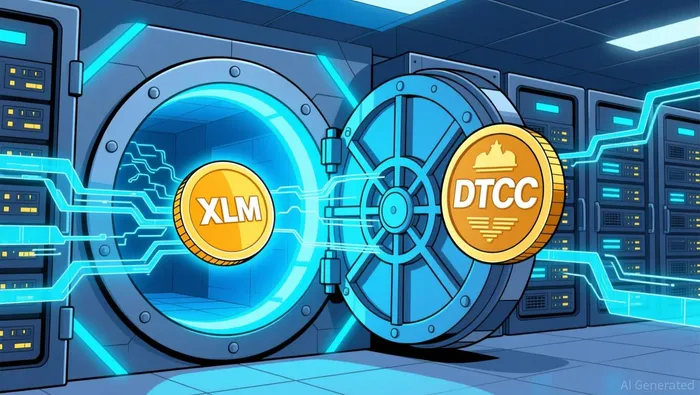
Stellar is gaining institutional credibility, highlighted by a partnership with the DTCC to tokenize assets like U.S. Treasuries by early 2027 . The network currently hosts $3.06 billion in tokenized real-world assets (RWAs), with stablecoin supply surging 38.3% monthly . These developments create structural, non-speculative demand for XLM, as every account and transaction requires lumens . Protocol 27 (Zipper), voting on July 8, 2026, introduces delegated authentication to enhance scalability . The 2026 roadmap also highlights privacy features utilizing ZK-proofs and the expansion of Soroban smart contracts .

Blending traditional trading wisdom with cutting-edge cryptocurrency insights.
Latest Articles
Stay ahead of the market.
Get curated U.S. market news, insights and key dates delivered to your inbox.


AInvest
PRO
AInvest
PRO




Comments
No comments yet