
Stellar News Today: As XLM Plummets, U.S. Bank Stakes Stablecoin Claim on Stellar


 Aime Summary
U.S. BankBANK-- has begun testing a stablecoin on the StellarXLM-- blockchain, joining a growing list of traditional financial institutions exploring blockchain-based payment solutions. The Minneapolis-based bank, in collaboration with the Stellar Development Foundation and PwC, is evaluating the use case of a dollar-backed stablecoin to enhance cross-border transactions and digital asset custody according to reports. Mike Villano, senior vice president of digital asset products at U.S. Bank, emphasized the platform's ability to freeze assets and unwind transactions at the protocol level, a feature critical for compliance with banking regulations according to reports.
The initiative aligns with a broader industry shift as major banks, including CitiC--, Goldman SachsGS--, and Bank of AmericaBAC--, increasingly experiment with stablecoins. This trend has gained momentum following the introduction of the GENIUS Act, which provides regulatory clarity for stablecoin issuance. U.S. Bank's move also builds on its recent role as custodian for Anchorage Digital's stablecoin reserves, signaling a strategic pivot toward tokenized money movementMOVE-- according to reports.
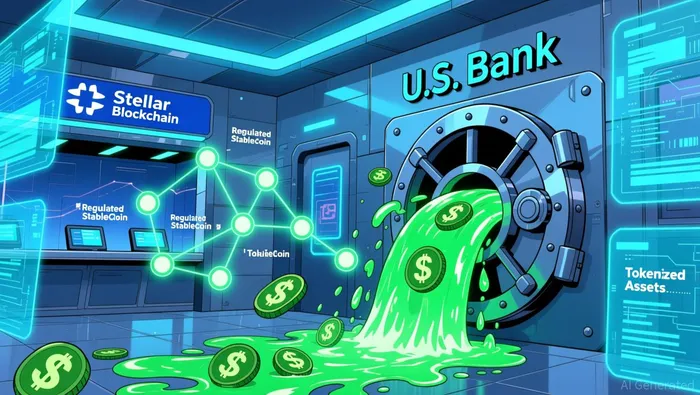 Stellar's blockchain, designed for financial services, has attracted institutional interest due to its operational reliability and compliance-ready architecture. The network processed $32 billion in payments in 2024 and hosts 9.8 million unique addresses, with Circle's USDCUSDC-- dominating 94% of its stablecoin volume according to reports. Jose Fernandez da Ponte, president of the Stellar Development Foundation, noted that institutions are prioritizing platforms offering long-term stability and open infrastructure over competitor-driven ecosystems.
The test underscores the growing demand for programmable money-digital representations of U.S. dollars that enable instant settlements and reduce transaction friction. Dominic Venturo, U.S. Bancorp's chief digital officer, highlighted that clients are seeking clarity on how tokenized assets can optimize treasury operations and deposit management. While retail stablecoins like USDTUSDT-- and USDC dominate trading pairs, bank-issued alternatives could cater to institutional needs for identity verification and fraud reversal mechanisms according to reports.
Market analysts suggest that U.S. Bank's pilot could reshape the stablecoin landscape by introducing regulated, bank-backed alternatives. If expanded, the project might compete with fintech-issued stablecoins while addressing concerns around liquidity and compliance. Meanwhile, Stellar's native token, XLMXLM--, has faced volatility, trading at $0.25-a 72% decline from its all-time high-reflecting broader crypto market challenges.
The experiment is part of U.S. Bank's broader digital asset strategy, which includes expanding revenue from custody services, tokenized instruments, and blockchain-based payments according to reports. As traditional banks formalize their entry into the stablecoin arena, the distinction between tokenized dollars and conventional deposits continues to blur, signaling a transformative phase for financial infrastructure according to Bloomberg.

Stay ahead of the market.
Get curated U.S. market news, insights and key dates delivered to your inbox.
AInvest
PRO
AInvest
PRO



Comments
No comments yet