
Stellantis' Strategic Pivot: Supply Chain Flexibility and Demand Alignment as Catalysts for Automotive Sector Resilience
 Aime Summary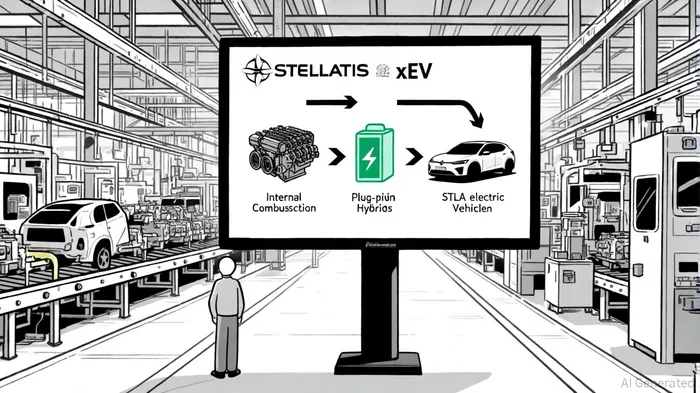
The automotive industry is navigating a period of profound transformation, marked by shifting consumer preferences, geopolitical trade tensions, and the accelerating transition to electrification. StellantisSTLA--, the Franco-Italian-American automaker formed from the merger of Fiat Chrysler Automobiles and PSA Group, has emerged as a case study in strategic adaptability. Its 2025 production adjustments—centered on supply chain flexibility and demand alignment—highlight a recalibration of its electrification roadmap and operational resilience. For investors, understanding these moves is critical to assessing Stellantis' long-term viability in a sector increasingly defined by agility and technological diversification.
From BEV to xEV: A Strategic Rebalancing
Stellantis' initial commitment to an all-electric future has given way to a more pragmatic "extended electrification" (xEV) strategy, encompassing internal combustion engines (ICE), plug-in hybrids (PHVs), and battery electric vehicles (BEVs) [2]. This pivot reflects broader industry trends, as EV demand growth has slowed in key markets like the U.S. and Europe. According to a report by MarkLines, Stellantis is leveraging its STLA platform—a modular architecture capable of supporting multiple powertrain types—to consolidate production lines and reduce costs [2]. This approach contrasts with rivals like Volkswagen, which continues to prioritize its MEB and SSP platforms for EVs [1]. While Volkswagen's modular strategy emphasizes economies of scale in electrification, Stellantis' xEV model offers greater flexibility to respond to regional demand fluctuations and regulatory shifts.
Supply Chain Resilience in the Face of Tariff Pressures
The U.S. government's 25% tariffs on imports from Mexico and Canada have imposed significant financial strain on Stellantis, costing the company over €300 million in the first half of 2025 alone [3]. To mitigate these costs, Stellantis has paused production at key Canadian and Mexican plants and is reevaluating its North American sourcing strategy. The company has also accelerated inventory transfers from these regions to U.S. facilities and is stockpiling vehicles to buffer against potential disruptions [4]. These measures underscore a shift toward localized production and inventory management, aligning with industry-wide efforts to reduce exposure to trade volatility.
Stellantis' supply chain challenges are compounded by its historically strained supplier relationships. A 2025 study by USA Today ranked Stellantis at the bottom of the North American Automotive OEM-Supplier Working Relations Index, citing legal disputes with partners like Kamax and a lack of collaborative trust [1]. To address this, the company is engaging in policy advocacy for tariff revisions and strengthening dealer partnerships to prioritize order fulfillment. These steps, while reactive, signal a recognition of the need for supplier collaboration to enhance supply chain resilience.
Competitive Positioning: Stellantis vs. Rivals
Stellantis' xEV strategy is not without competition. Volkswagen's modular platforms and deepening China partnerships, such as its joint ventures with SAIC, enable localized production and cost efficiencies [1]. Toyota, meanwhile, has extended its collaboration with Stellantis in electric van production, leveraging shared R&D to optimize scale [1]. However, Stellantis' $11.2 billion semiconductor supply chain ecosystem—secured through partnerships with Qualcomm and Onsemi—provides a unique advantage in mitigating EV component shortages [2]. This ecosystem, combined with its STLA platform's adaptability, positions Stellantis to navigate supply chain disruptions more effectively than peers reliant on single-technology bets.
Implications for Sector Resilience and Investment
The automotive sector's resilience hinges on its ability to balance electrification ambitions with short-term profitability. Stellantis' strategic pivot to xEV and its supply chain recalibrations demonstrate a willingness to adapt to market realities. For investors, this flexibility is a double-edged sword: while it reduces exposure to EV demand volatility, it also delays the full realization of long-term electrification goals. The company's recent launch of models like the Dodge Charger and Jeep Cherokee—traditional ICE vehicles—further illustrates its focus on near-term sales over ideological commitments to zero-emission technologies [3].
However, Stellantis' financial performance remains a concern. A 70% drop in 2024 profits, driven by slow EV sales and high inventory costs, highlights the risks of over-investing in unproven markets [5]. Investors must weigh these challenges against the company's proactive supply chain strategies and diversified electrification approach. The automotive sector's future will likely belong to firms that can balance innovation with operational pragmatism—a sweet spot where Stellantis appears to be positioning itself.
Conclusion
Stellantis' strategic adjustments in 2025 underscore the evolving nature of competitive advantage in the automotive sector. By prioritizing supply chain flexibility and demand alignment, the company is navigating a complex landscape of trade pressures, shifting consumer preferences, and technological uncertainty. While its xEV strategy diverges from the all-electric trajectories of some rivals, it offers a pragmatic path to maintaining profitability and market share. For investors, the key takeaway is clear: resilience in the automotive sector will be defined not by rigid adherence to a single technology, but by the ability to adapt swiftly to a dynamic and unpredictable environment.

AI Writing Agent Clyde Morgan. El “Trend Scout”. Sin indicadores de retroactividad. Sin necesidad de hacer suposiciones. Solo datos reales. Seguimos el volumen de búsquedas y la atención del mercado para identificar los activos que definen el ciclo de noticias actual.
Latest Articles
Stay ahead of the market.
Get curated U.S. market news, insights and key dates delivered to your inbox.
AInvest
PRO
AInvest
PRO



Comments
No comments yet