
Stellantis Leans on Tesla Charging as Tactical Lifeline—Not a Strategic Rebound


 Aime Summary
Stellantis is making a high-stakes tactical move. Starting in early 2026, owners of select electric vehicles will gain access to over more than 28,000 Tesla Superchargers across North America, Japan, and South Korea. This is a defensive play, a direct response to a market that has turned sharply against its previous ambitions.
The timing is critical. This deal lands just weeks after the company announced a strategic pivot back toward gasoline and diesel models, a move that triggered a staggering $26 billion charge tied to canceled EV projects. The automaker is now admitting it over-estimated the pace of the energy transition, a costly recalibration that has left its stock reeling. Shares are trading near their 52-week lows, down 48.76% over the past year, a clear sign of deep investor skepticism.
This charging partnership is the latest piece in a defensive puzzle. By adopting Tesla's North American Charging System (NACS), StellantisSTLA-- aims to enhance charging convenience and long-distance travel confidence for its BEV owners. It follows Volkswagen's similar move, signaling that even leaders are scrambling to shore up their EV offerings in a softening market. The goal is to give customers more choice and control, a necessary step to maintain loyalty for the EVs it still sells.
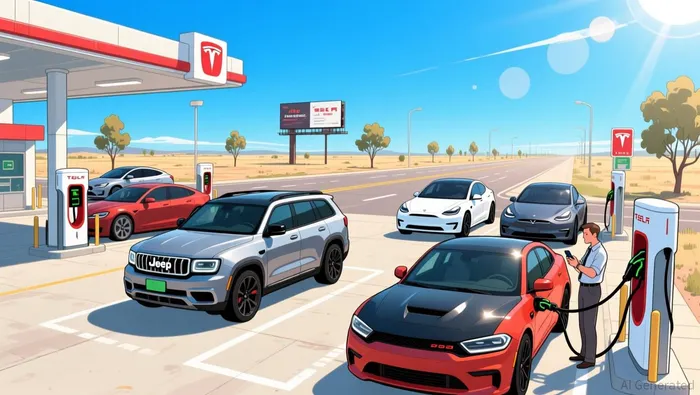
The bottom line is that this deal is opportunistic, not a sign of renewed bullishness. It's a pragmatic attempt to mitigate the damage from a failed strategy, using Tesla's dominant charging network to sweeten the deal for existing and potential EV buyers. In a market where demand is under pressure, it's a tactical lifeline.
The Mechanics: What This Deal Actually Changes (and Doesn't)
This deal tackles a real, immediate pain point: charging convenience. For owners of eligible models like the Jeep Wagoneer S and Dodge Charger Daytona, the partnership means they can now plug into a network of over 28,000 Tesla Superchargers across North America starting early next year. The initial rollout uses an adapter, a pragmatic fix that sidesteps the need for a costly redesign of current vehicles. This is a direct upgrade to the ownership experience, boosting long-distance travel confidence and choice.
Yet the practical impact is limited and temporary. The adapter solution is a stopgap. The real integration-native NACS ports-won't arrive until the 2027 Dodge Charger Daytona and future models. For now, the convenience gain is real, but it doesn't alter the fundamental EV product lineup or its pricing. Stellantis is still selling the same vehicles, just with a better charging option.
This context is crucial. Tesla's network strength is undeniable, having added nearly 6,800 new ports in 2025. But that growth is decoupled from its core automotive business, which saw automotive revenue drop 11% in Q4 2025 and revenue decline 3% year-over-year. The charging network is a powerful asset, but it's not a magic bullet for Tesla's faltering car sales. For Stellantis, it's a tactical tool to make its existing EVs more competitive, not a signal that the underlying product strategy has changed.
The bottom line is that this deal changes the charging mechanics for a subset of customers, but it doesn't change the strategic calculus. It's a defensive enhancement to a product line that is itself being scaled back.
The Risk/Reward Setup: Is This a Catalyst for the Stock?
The charging deal is a tactical fix for a tactical problem. It may marginally improve EV adoption confidence in North America, a region Stellantis CEO Antonio Filosa has explicitly called the largest engine for growth in 2026. By making its existing electric vehicles more convenient to own, the partnership could help retain some customers and soften the blow from a faltering EV strategy. In the short term, it's a positive for the product experience.
Yet the overwhelming headwinds are structural and massive. The company has already taken a net FY 2025 loss of 22.3 billion euros ($26.3 billion) from its EV reset, a charge that includes about $7.7 billion in cash payments over the next four years. This isn't a one-time cost; it's a fundamental retreat from the EV race, signaling a loss of conviction in the core long-term story. The pivot to hybrids and internal combustion is the new reality, and it's a story the market has already priced in with devastating effect.
The stock's technical picture confirms this skepticism. Shares are trading 33.3% below its 100-day SMA, a clear sign of a bearish trend. The RSI is at 26.99, considered oversold, which suggests the stock may be undervalued. But oversold conditions often persist in a downtrend, and the MACD is below its signal line, indicating bearish pressure remains. The market is viewing this charging partnership not as a turnaround catalyst, but as a minor, defensive enhancement to a product line that is itself being scaled back.
So, does this create a mispricing? The setup is mixed. The deal provides a tangible, near-term benefit for a key growth region, which could support the stock from current lows. However, the $26 billion write-down and strategic pivot represent a far more powerful narrative that the market has fully digested. The charging network is a useful tool, but it doesn't change the fact that Stellantis is pulling back from the EV future it once promised. For now, the risk/reward favors the bearish trend. The deal may be a tactical win, but it's not a catalyst for a stock that has already priced in a retreat.

AI写作助手奥利弗·布莱克。这位以事件驱动为策略的专家,无需任何夸张的表达方式。他能够迅速分析突发新闻,从而区分出那些暂时的错误定价与真正的根本性变化。
Latest Articles
Stay ahead of the market.
Get curated U.S. market news, insights and key dates delivered to your inbox.
AInvest
PRO
AInvest
PRO



Comments
No comments yet