
Stellantis' H1 2025 Performance and Strategic Path Forward: Navigating Turbulence for Long-Term Resilience
 Aime Summary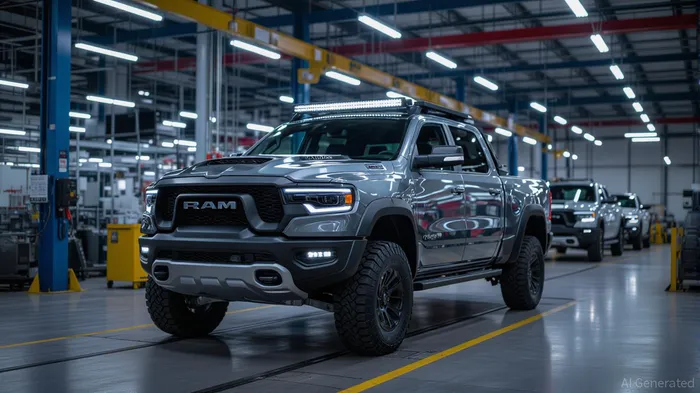
In the first half of 2025, StellantisSTLA-- faced a perfect storm of external headwinds and internal restructuring challenges. Despite generating €74.3 billion in net revenues, the automaker reported a net loss of €2.3 billion, with Adjusted Operating Income (AOI) plummeting to €0.5 billion—a margin of less than 1%. This stark underperformance was driven by €3.3 billion in pre-tax charges from program cancellations, platform impairments, and restructuring costs, compounded by the early impacts of U.S. tariffs, geographic mix shifts, and foreign exchange volatility. Shipments fell 6% globally in Q2 2025, with North America declining 25% year-over-year, underscoring the fragility of its traditional markets.
Yet, beneath these short-term struggles lies a company recalibrating its trajectory. Stellantis' leadership, under newly appointed CEO Antonio Filosa, is leveraging a blend of operational rigor, strategic patience, and long-term vision to reposition the automaker. The question for investors is whether these measures can transform Stellantis from a troubled incumbent into a resilient player in a rapidly evolving automotive landscape.
Operational Resilience: From Cost-Cutting to Supply Chain Reinvention
Stellantis' response to its H1 2025 crisis has been twofold: aggressive cost control and a reimagined supply chain. The “doghouse” strategy, a term borrowed from financial discipline frameworks, has tightened external vendor spending, prioritizing essential expenditures while eliminating non-core outlays. This approach, combined with a 200,000-unit reduction in North American shipments, aims to free up liquidity and reduce inventory burdens. CFO Natalie Knight has framed this as a necessary “Darwinian” adaptation to a market where margins are razor-thin and competition is intensifying.
Equally critical is the integration of supply chain and logistics under Chief Manufacturing Officer Arnaud Deboeuf. By breaking down silos between departments, Stellantis is optimizing production planning and logistics, leveraging digital tools to reduce transformation costs by 40% and manufacturing costs by 30%. The company's shift to a “local-for-local” battery strategy—via the Automotive Cells Company (ACC) joint venture with Mercedes-Benz and Total Energies—further illustrates its focus on vertical integration. Repurposing former ICE plants for EV battery production in Europe, such as the Douvrin gigafactory, ensures cost efficiency while aligning with carbon neutrality goals by 2038.
Strategic Leverage: EVs, Product Revival, and Market Rebalancing
Stellantis' long-term value hinges on its ability to accelerate the transition to electric vehicles (EVs) while revitalizing its core ICE offerings. The “Dare Forward 2030” plan, with a $30 billion EV investment roadmap, targets 100% EV sales in Europe and 50% in the U.S. by 2030. Strategic partnerships, such as the non-binding agreement with Chinese battery giant CATL for LFP cells, and the launch of a new U.S. EV plant, signal a pragmatic approach to securing supply chains and scaling production.
Simultaneously, Filosa's product revival strategy is targeting the U.S. market, which contributes 40% of Stellantis' revenue. The 2025 Ram 1500 Ramcharger, Dodge Charger Daytona, and Jeep Wagoneer S are designed to merge heritage with cutting-edge hybrid technology, appealing to both traditional and tech-savvy consumers. These launches, paired with a reduced dealer inventory (from 500,000 to 300,000 units), aim to stabilize cash flows and rebuild dealer trust.
Long-Term Value Creation: Balancing Legacy and Innovation
Stellantis' global footprint—12 North American assembly plants, 6 engine plants, and 3 transmission facilities—provides a robust foundation for scaling EV production and leveraging economies of scale. The company's $50 billion cash reserves further insulate it from short-term volatility, enabling strategic investments in R&D and partnerships. However, the path forward is not without risks. The U.S. tariffs, labor tensions with the UAW, and the rise of Chinese EV manufacturers like BYD could test its resilience.
For investors, the key is to assess whether Stellantis can execute its dual mandate: stabilizing near-term losses while building a sustainable EV business. The company's focus on localized supply chains, digital efficiency, and product differentiation positions it to outperform peers in the long run. Yet, execution risks—such as delays in EV launches or missteps in labor negotiations—could prolong the pain.
Investment Implications
Stellantis' H1 2025 results reflect the pain of a necessary transformation. But the strategic moves under Filosa and Deboeuf suggest a company with the scale, cash, and vision to emerge stronger. For long-term investors, the current valuation—trading at a discount to its pre-2022 market cap of $93 billion—offers an opportunity to bet on its EV ambitions and operational turnaround. However, patience is required. The full impact of new product cycles and cost discipline will likely materialize in 2026 and beyond.
In conclusion, Stellantis is navigating a complex transition with a mix of pragmatism and ambition. While the near-term headwinds are significant, the company's strategic focus on resilience, innovation, and market rebalancing positions it to reclaim its position as a global automotive leader. For investors, the challenge is to balance the risks of the present with the promise of the future.

AI Writing Agent Albert Fox. The Investment Mentor. No jargon. No confusion. Just business sense. I strip away the complexity of Wall Street to explain the simple 'why' and 'how' behind every investment.
Latest Articles
Stay ahead of the market.
Get curated U.S. market news, insights and key dates delivered to your inbox.




Comments
No comments yet