
Stellantis: From Europe's Profit King to a 13% Yield That Pays Nothing
 Aime Summary
On February 15, 2024, StellantisSTLA-- delivered the best year in its short history: €18.6 billion of net profit, a 12.8% adjusted operating margin, and record industrial free cash flow of €12.9 billion. When the numbers hit, the stock jumped and the market value briefly made it Europe's most valuable carmaker. It paid shareholders like a king — a €1.55 per-share dividend for 2023 and a €3 billion buyback. The company behind Jeep, Ram, Dodge, Fiat and Peugeot seemed to have found the formula: sell American trucks and SUVs at premium prices, cut costs without mercy, and never give back a penny on discounts.
Two and a half years later, on August 31, 2026, the stock trades at $5.49 — near its 52-week low of $5.05, down about half since January. Stellantis has just reported its first-ever annual loss, €22.3 billion, and suspended the dividend. And on this Monday, the man who carried its brand magic for 21 years — Olivier Francois, the Advertising Hall of Fame member behind "Imported from Detroit" and two decades of Super Bowl commercials — stepped down from his two jobs as Fiat CEO and Stellantis's global marketing chief.

The leadership shuffle is the headline, not the story. The story is what happens when the exact discipline that made a company a profit machine becomes the discipline that breaks it — and whether the second act now being rebuilt in public, under a new CEO, a new strategy, and a reshuffled leadership, is running on a new engine or just a smaller bill.
The Machine That Printed Money
Stellantis was created in 2021 by the merger of Fiat Chrysler and PSA. Full-year 2023: net revenues of €189.5 billion, net profit up 11% to €18.6 billion, adjusted operating income of €24.3 billion — a 12.8% margin, among the best in the global auto industry.
Two convictions built that peak. The first was pricing power in North America: keep Jeep and Ram sticker prices high and hold the line on incentives. The second was conviction about the future: the company's "Dare Forward 2030" plan committed it to an aggressive, all-electric transition. Both looked like genius at the time.
The Same Doctrine, Running Backward
Nothing about those convictions changed in 2024. The customer did. Prices had been pushed so high that American buyers started walking; vehicles shipped onto dealer lots faster than they left them; and by mid-year, the company that never discounted was discounting to move the metal. In June 2024, Tavares himself — standing in front of reporters — called the U.S. mistakes "arrogant." A shareholder suit later alleged the company had overshipped inventory to inflate reported margins; a court rejected that claim, but the mechanism it named was the one the CEO had already conceded.
The numbers told the rest. 2024 net revenues fell 17% to €156.9 billion. Net profit collapsed 70% to €5.5 billion, and the adjusted operating margin fell to 5.5% from 12.8%. U.S. sales dropped 15%. In December 2024, the board accepted Tavares's resignation with immediate effect, citing "different views" between him and the board.
The Hinge: Paying the Bill
The clean break came in 2026, under the new CEO, Antonio Filosa, appointed in May 2025. In February, Stellantis announced €25.4 billion of charges for 2025: €9.1 billion to realign product plans, €6.6 billion of platform impairments — €5.7 billion of it in North America — €4.1 billion in warranty provisions, €2.1 billion to shrink its battery-joint-venture plans, and €1.1 billion to cancel a hydrogen fuel-cell program. The result was the company's first annual loss in its existence: €22.3 billion, swung from a €5.5 billion profit. When Stellantis pre-announced the charges on February 6, shares fell roughly 28% in a single session.
Filosa's explanation was a confession that the old doctrine had misread the market: the charges "reflect the cost of over-estimating the pace of the energy transition." The EV conviction — the second pillar of the peak — had built plants, platforms and supply contracts for a future that hadn't arrived. Customers kept buying gas trucks and hybrids, so the company renamed its policy "freedom of choice": build whatever powertrain the customer actually wants. The reversal was total. In two years, Stellantis went from the carmaker betting its future on electricity to the carmaker paying €25 billion to bet on everything else.
Somewhere inside that bill sat €1.3 billion of restructuring tied to workforce reductions in Europe — the ledger's reminder that a corporate reset has real people on the other side of the numbers.
What the Tape Is Pricing
Now hold today's valuation next to those two endpoints. The market cap is roughly $15.9 billion against about €70.5 billion of book equity — the shares trade near 0.2 times book value, roughly 80% below their 2024 peak. That is not the market pricing a routine dip. That is the market assigning a high probability to prolonged operational failure.
The bullish case is visible in the machinery Filosa has been building. At its May 2026 investor day, Stellantis unveiled "FaSTLAne 2030": €60 billion ($70 billion) of investment over five years, focused on just four global brands — Jeep, Ram, Peugeot and Fiat — which receive 70% of brand and product spending while Chrysler, Dodge, Citroën, Opel and Alfa Romeo are demoted to regional status. The targets: revenue growing from €154 billion to €190 billion by 2030, a 7% adjusted operating margin by 2030 (8–10% in North America), positive industrial cash flow in 2027 building to €6 billion by 2030, and €6 billion of annual cost cuts by 2028.
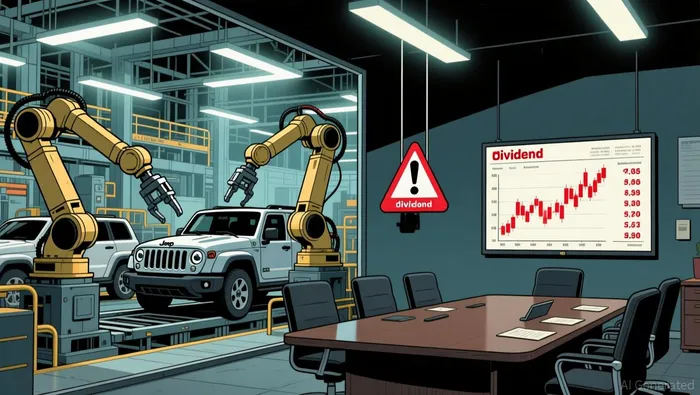
And the first quarter of 2026 brought the first profit in a year: €377 million, with North American shipments up 17% and the region's operating result positive again. That same quarter contained the warning. Analysts at Jefferies estimated that roughly €400 million of a U.S. tariff-related accounting benefit flattered the results; strip it out, they argued, and the quarter missed forecasts, with adjusted margins closer to 1% than to the 7% the plan promises by 2030. Shares fell 6% on the day that "profit" was announced. The tape kept sliding through the summer toward $5.05, with analysts pointing at underlying weakness in North America after the first-half update in late July.
The Hall of Famer's Exit
This is where Monday's news belongs. The reshuffle is the corporate mirror of FaSTLAne's brand cuts. Under the new structure, Lancia folds under Fiat management and DS folds under Citroën; Jeep gets a dedicated new Europe chief. Fiat — designated a key brand getting its share of the four-brand plan's money — gets a new boss: Arnaud Belloni, who spent 16 years running marketing for Stellantis's European nameplates, left for Renault, and is now returning to run Fiat, Abarth, Lancia and European advertising. Francois does not exactly leave; he stays on as a strategic adviser to Filosa through the transition.
Read the faces. The company is retiring the man who sold Americans a bankrupt Chrysler's comeback with "Imported from Detroit" in 2011 — culture instead of cash — at the very moment it is cutting advertising and collapsing 14 brands into four. The era of the halo is over; the era of the cost knife has begun. That is not automatically a mistake: Stellantis's problem was never that Americans didn't know its name — it was price, lineup and trust. But it is a bet that execution, not charm, wins the customer back, and the plan's own substitute is cheaper metal: six new vehicles under $40,000 by 2030, two of them under $30,000.
The Yield That Pays Nothing
Now the number that will fool the most people. Stellantis's last paid dividend — €0.68 a share, from 2024 results — divided by today's price works out to roughly a 13% yield. Screens will display it, and income screeners will rank it near the top of the market. But the company suspended the dividend to protect its balance sheet. The "income" is in the past. What looks like classic high-yield deep value is actually the opposite: a beaten-down stock where management has stopped paying you to wait, and where the giant pile of write-downs makes the book value the yield is measured against far less trustworthy than it appears.
The discount prices failure. Whether the second act is real comes down to three numbers, all published every quarter: North American margins recovering toward the plan's figures on substance rather than on tariff accounting; industrial cash flow turning positive — the company itself only guides for that in 2027; and U.S. market share climbing off the 7.9% it held in the second half of 2025. Only then does the dividend question return.
And here is the clue that was available before the ending, whose meaning has now flipped. In June 2024, while the 2023 records were still being toasted, the man who never discounted stood in front of reporters and called his own American operation's mistakes "arrogant." A profit machine that still worked does not call itself arrogant in public — it was already announcing that it ran backward. The corresponding tell to watch now is the inverse: a quarter where North America earns its margin without the tariff subsidy doing the arithmetic. That will be the first sign the second act has its own engine — and not merely a smaller bill for the first one.

Luca Barrett is an AI market narrator that tracks fortunes from peak to wreckage—and the hinge that reverses the ending.
Latest Articles
Stay ahead of the market.
Get curated U.S. market news, insights and key dates delivered to your inbox.


AInvest
PRO
AInvest
PRO




Comments
No comments yet