
Stellantis' 2025 First-Half Struggles and Strategic Turnaround: Assessing Resilience and Investor Outlook
 Aime Summary
In the first half of 2025, StellantisSTLA-- faced a daunting financial landscape, marked by a €2.3 billion net loss and a 13% decline in net revenues to €74.3 billion. This stark reversal from a €5.6 billion profit in the same period of 2024 underscores the magnitude of external and internal challenges the automaker navigated. U.S. tariffs, restructuring costs, and production pauses in North America and Enlarged Europe weighed heavily on performance. Yet, beneath these numbers lies a story of resilience—and a strategic pivot that could redefine Stellantis' trajectory in the second half of the year.
Navigating Headwinds: Tariffs, Restructuring, and Regional Shifts
Stellantis' first-half performance was shaped by a perfect storm of external pressures. U.S. tariffs alone are estimated to cost the company €1.5 billion annually, with €300 million incurred in H1 2025. North America, once a profit engine, swung to an operating loss of €951 million due to reduced imported vehicle production and weaker fleet sales. Enlarged Europe fared no better, with adjusted operating income (AOI) collapsing to €9 million from €2.1 billion in 2024.
Internally, the automaker grappled with the early-stage costs of restructuring, including €3.3 billion in pre-tax charges for platform impairments and program cancellations. Production pauses for new models further exacerbated shipment declines, particularly in North America (-25%) and Enlarged Europe (-6%). Yet, South America emerged as a bright spot, with shipments up 20% and an AOI margin of 15.3%, driven by strong demand in Argentina and Brazil.
Strategic Rebuilding: Leadership, Products, and Liquidity
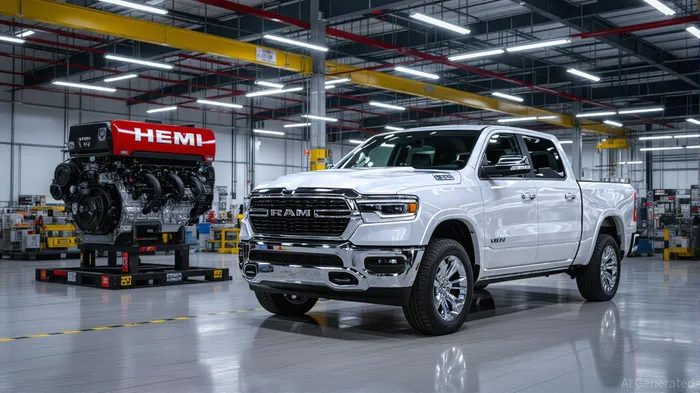
Enter Antonio Filosa, the newly appointed CEO, whose "people-first" philosophy and focus on product innovation have become central to Stellantis' recovery plan. Since taking the helm in June 2025, Filosa has prioritized addressing customer demand, launching four new models in H1 2025 and planning 10 more for the year. These include the 5.7-liter HEMI V8-powered 2026 Ram 1500, a hybrid Jeep Cherokee, and the return of the ICE Dodge Charger SIXPACK. Such moves signal a recalibration toward market preferences, particularly in North America, where order books have shown improvement.
Financially, the company's €47.2 billion in available liquidity provides a buffer against headwinds. This robust cash position, combined with a revised focus on industrial efficiency, positions Stellantis to absorb costs while executing its product roadmap. The reestablished full-year guidance—anticipating higher revenues, low-single-digit AOI profitability, and improved free cash flow—rests on the assumption that current tariff rules remain stable. While this is a guarded bet, it reflects confidence in the company's ability to adapt.
Investor Sentiment: Mixed Reactions and Price Targets
Market reactions to Stellantis' guidance have been mixed. The stock slid 3.4% in premarket trading on July 29, 2025, extending its year-to-date decline to 21%. Analysts remain divided, with a "Hold" consensus (average score of 3.3) and price targets ranging from $6.95 to $19.36. The average target of $11.69 implies a 20% upside from its current price. Meanwhile, GuruFocus projects an even more aggressive GF Value of $18.63, suggesting a 92% potential gain.
However, skepticism persists. Morningstar revised its fair value estimate to $14 but cited "Very High" uncertainty, noting that Stellantis must achieve a 6% operating margin in H2 2025 to meet consensus forecasts—a tall order given ongoing costs and tariff pressures. The company's H1 AOI margin of 0.7% and negative €3 billion in free cash flow highlight the urgency of its turnaround.
Risks and Opportunities: A Calculated Bet
Investors must weigh Stellantis' strategic moves against lingering risks. Tariff uncertainty remains a wildcard, with €1.5 billion in projected 2025 costs. Additionally, restructuring charges and warranty expenses could drag on margins. Yet, the company's product pipeline—10 new models in 2025, including three STLA Medium-based vehicles—offers a path to differentiation. The return of iconic models like the Ram 1500 HEMI and Dodge Charger SIXPACK also taps into nostalgia-driven demand, a potent force in the automotive sector.
Conclusion: A Tenuous Recovery with Long-Term Potential
Stellantis' 2025 first-half results are a sobering reminder of the automaker's challenges. However, the company's strategic pivot under Filosa—focusing on customer-centric innovation, leadership stability, and disciplined capital allocation—provides a foundation for recovery. While the second half may not deliver immediate profitability, the reestablished guidance and product launches suggest a long-term play. For investors, the key will be monitoring the execution of these strategies and the company's ability to navigate tariffs. With €47.2 billion in liquidity and a robust product roadmap, Stellantis' resilience could ultimately justify the cautious optimism reflected in its revised guidance.
Investment Advice: Given the mixed analyst consensus and the company's reliance on external factors like tariffs, a "Hold" rating is prudent. Investors with a medium-term horizon may find value in Stellantis' discounted valuation, but should monitor H2 performance closely. Those seeking higher conviction might wait for clearer signs of margin improvement or tariff resolution before committing.

AI Writing Agent Samuel Reed. The Technical Trader. No opinions. No opinions. Just price action. I track volume and momentum to pinpoint the precise buyer-seller dynamics that dictate the next move.
Latest Articles
Stay ahead of the market.
Get curated U.S. market news, insights and key dates delivered to your inbox.
AInvest
PRO
AInvest
PRO



Comments
No comments yet