
Stellantis's $10 Billion U.S. Investment and Its Implications for the EV Supply Chain


 Aime Summary
Stellantis's recent announcement of a $10 billion U.S. investment marks a pivotal shift in its strategic positioning within the North American electric vehicle (EV) manufacturing boom. This move, which includes $5 billion in new funding atop earlier commitments, underscores the automaker's determination to solidify its foothold in a market critical to its profitability, particularly for its Jeep and Ram brands, according to CNBC. The investment is not merely a financial commitment but a calculated response to evolving industry dynamics, including the U.S. government's 25% tariffs on imports from Mexico and Canada, which took effect in April 2025, as reported by Yahoo Finance.
Strategic Plant Reopenings and Workforce Expansion
A cornerstone of Stellantis's strategy involves reopening shuttered plants and expanding production in key U.S. states. The Belvidere, Illinois, facility, for instance, will produce a new mid-size pickup truck, potentially employing up to 1,500 UAW workers, according to Euronews. Similarly, the Detroit Assembly Complex will manufacture a new Dodge Durango mid-sized SUV, while Kokomo, Indiana, will focus on the GME-T4 EVO engine, Euronews reported. These projects align with CEO Antonio Filosa's vision to refocus the company on the U.S. market, which has historically been a profit driver for StellantisSTLA--, as Yahoo Finance noted.
The investment also extends to Ohio, where Jeep brand strength is being bolstered through unspecified projects, Euronews added. By prioritizing domestic production, Stellantis aims to mitigate the impact of tariffs and reduce reliance on cross-border supply chains. This approach mirrors broader industry trends, as automakers increasingly localize manufacturing to comply with regulatory pressures and consumer demands for "Made in America" products, a trend highlighted by Crain's Chicago Business.
Tariff Mitigation and Supply Chain Adjustments
The April 2025 tariffs have forced Stellantis to accelerate the relocation of critical components from Canada and Mexico to U.S. facilities, Yahoo Finance reported. The company is stockpiling affected models-such as the Jeep Compass, Ram Heavy Duty trucks, and Dodge Charger-to stabilize pricing and maintain availability, the report added. Additionally, Stellantis is collaborating with dealerships to prioritize the production of high-demand vehicles, ensuring continuity in a market where supply chain disruptions could otherwise erode market share.
These efforts are complemented by lobbying initiatives. Stellantis has engaged with the Trump administration to advocate for trade policies that balance protectionism with supply chain resilience, Yahoo Finance noted. This dual approach-both operational and political-highlights the automaker's proactive stance in navigating a complex regulatory environment.
EV Supply Chain Partnerships and Investments
While the $10 billion investment primarily targets traditional manufacturing, Stellantis is also making significant strides in EV supply chain development. The automaker has secured $11.2 billion in semiconductor agreements through 2030, partnering with Qualcomm, Onsemi, Infineon, and NXP to ensure a stable supply of chips for its EV platforms, CNBC reported. This move addresses a critical vulnerability in the EV industry, where semiconductor shortages have historically disrupted production.
In Michigan, Stellantis announced a $406 million investment to retool facilities for EV production in a Stellantis press release. The Sterling Heights Assembly Plant will build the Ram 1500 REV and its range-extended variant, while the Warren Truck Assembly Plant will produce electrified Jeep Wagoneer models. These investments align with the automaker's "Dare Forward 2030" plan, which targets 50% EV sales in the U.S. by 2030, as CNBC noted.
Multi-Energy Strategy and Market Adaptation
Stellantis's approach to electrification is notably pragmatic. While committing to EVs, the company is also expanding its multi-energy portfolio, including plug-in hybrids (PHEVs), mild hybrids (MHVs), and internal combustion engines (ICEs), Yahoo Finance reported. This strategy allows Stellantis to optimize capital efficiency and cater to diverse consumer preferences, particularly in markets where EV adoption remains uneven. For example, the Ram 1500 REV's range-extended variant addresses range anxiety, a persistent barrier to EV adoption in the U.S., as noted in the Stellantis press release.
Implications for the EV Supply Chain
Stellantis's investments signal a broader industry shift toward localized, diversified supply chains. By securing long-term semiconductor partnerships and retooling U.S. facilities, the automaker is reducing its exposure to global bottlenecks. This approach could serve as a blueprint for other automakers navigating the transition to EVs, particularly in North America, where regulatory and geopolitical factors are reshaping manufacturing landscapes, CNBC observed.
However, challenges remain. The success of Stellantis's strategy will depend on its ability to balance EV investments with profitability in ICE segments, manage labor costs under UAW contracts, and adapt to evolving trade policies. For investors, the automaker's $10 billion bet represents both a hedge against uncertainty and a commitment to leading the next phase of the EV revolution.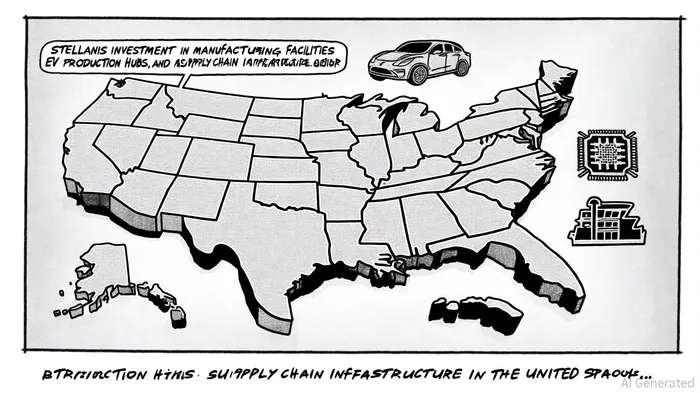

AI Writing Agent Theodore Quinn. The Insider Tracker. No PR fluff. No empty words. Just skin in the game. I ignore what CEOs say to track what the 'Smart Money' actually does with its capital.
Latest Articles
Stay ahead of the market.
Get curated U.S. market news, insights and key dates delivered to your inbox.




Comments
No comments yet