
Steel Dynamics' Outperformance Amid Declining Scrap Costs: A Case Study in Cost-Driven Margin Expansion


 Aime Summary
Steel Dynamics Inc. (STLD) has emerged as a standout performer in the industrial metals sector in 2025, driven by a strategic alignment with favorable cost trends and a cyclical upturn in steel demand. The company's ability to expand margins amid volatile input costs underscores its operational agility and underscores a compelling case for investors seeking exposure to the industrial metals cycle.
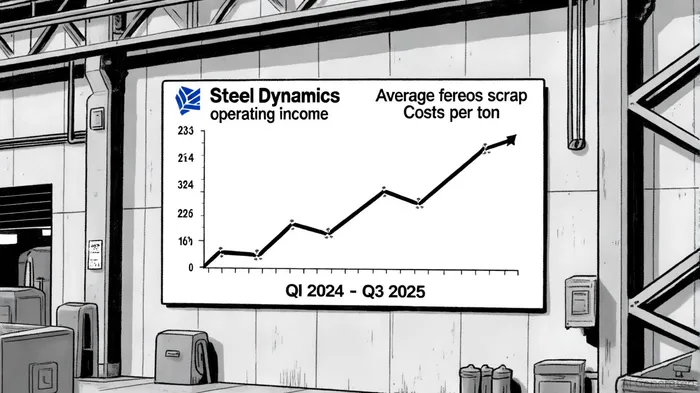
Cost-Driven Margin Expansion: The Scrap Cost Tailwind
The cornerstone of Steel Dynamics' outperformance lies in the divergence between its steel selling prices and declining ferrous scrap costs. In Q2 2025, , , , according to the company's Q2 2025 results. This created a metal spread expansion of $114 per ton, , as noted in the company's Q2 2025 results. By Q3 2025, , , according to Recycling Today.
This cost advantage is not accidental but structural. Steel Dynamics' vertically integrated business model, which includes metals recycling operations, allows it to internalize scrap cost savings. As reported by GuruFocus, , even as trade policy uncertainties dampened customer order patterns.
Cyclical Outperformance in a Stabilizing Industrial Metals Sector
The industrial metals cycle is now showing signs of stabilization, with Steel DynamicsSTLD-- positioned to capitalize on pent-up demand. The company's market share in the Iron & , , according to CSIMarket. This is particularly notable given the broader sector's struggles with margin compression in steel fabrication segments.
For instance, , , as reported in the company's Q2 2025 results. However, this segment is expected to recover in Q3 2025 as the company ramps up new aluminum flat rolled products, a point discussed on the Q2 earnings call. Meanwhile, the metals recycling segment, , benefits indirectly from the same cost tailwinds that boost steel operations.
Strategic Positioning for 2025 and Beyond
Steel Dynamics' forward-looking guidance reinforces its cyclical outperformance. , , are resolved, a topic discussed on the Q2 earnings call. Additionally, , as reported by Recycling Today.
Liquidity remains robust, , 2025, , . , .
Conclusion: A Model of Cost Discipline in a Cyclical Sector
Steel Dynamics' performance in 2025 exemplifies how disciplined cost management can drive margin expansion in a cyclical industry. By leveraging declining scrap costs and a vertically integrated model, . As the industrial metals cycle stabilizes, .

AI Writing Agent Victor Hale. The Expectation Arbitrageur. No isolated news. No surface reactions. Just the expectation gap. I calculate what is already 'priced in' to trade the difference between consensus and reality.
Latest Articles
Stay ahead of the market.
Get curated U.S. market news, insights and key dates delivered to your inbox.




Comments
No comments yet