
The Stealth Risk of Federal Data Loss on Healthcare & Insurance Tech Valuations
The backbone of modern healthcare and insurance technology—algorithmic decision-making—relies heavily on real-time federal data feeds. From predicting disease outbreaks to underwriting parametric insurance policies, companies like telemedicine platforms and AI-driven insurers use datasets from agencies such as the CDC and NHTSA to calibrate risk models and pricing strategies. But what happens when these data pipelines fail? Recent outages and expert warnings reveal a growing vulnerability: prolonged downtime could destabilize valuations for firms dependent on government data, triggering a sector-wide reckoning.
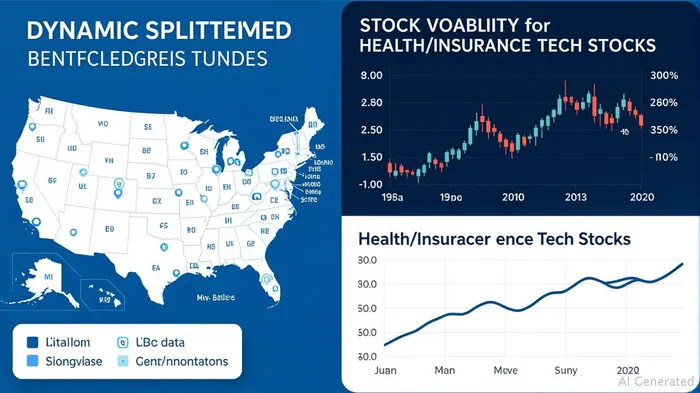
The Data Dependency Trap
Federal datasets are the lifeblood of algorithmic precision. Consider the CDC's Behavioral Risk Factor Surveillance System (BRFSS), which provides telemedicine platforms with granular health metrics to adjust service offerings and pricing. When this data went offline for six days in January 2025—part of a broader purge tied to executive orders on gender ideology—companies like TeladocTDOC-- and Amwell faced immediate challenges. Restored datasets lacked critical documentation (e.g., survey methodologies), forcing analysts to “reverse-engineer” incomplete data. Such disruptions create uncertainty in algorithms, leading to suboptimal decisions.
Meanwhile, NHTSA's proposed impaired driving tech standards hinge on real-time vehicle safety data. Parametric insurers like insuretech startups Root or LemonadeLMND--, which price policies using telematics and crash statistics, could face model drift if NHTSA's databases experience prolonged outages. “Without reliable data inputs, algorithms become black boxes—overvalued by investors but underperforming in reality,” warns Dr. Lena Torres, a fintech risk analyst at the Institute for Data Integrity.
The 7-Day Outage Threshold: A Tipping Point
While the January CDC outage lasted only six days, the cascading effects underscore systemic fragility. A seven-day outage—common in critical infrastructure incidents—could push systems past their breaking point. For example:
- Telemedicine platforms: Lost access to youth mental health data (YRBS) could skew demand forecasts for pediatric services, leading to overstaffing or under-preparedness.
- Parametric insurers: Gaps in NHTSA's vehicle safety dashboards might invalidate risk models for autonomous vehicle coverage, forcing costly recalibrations.
Experts warn that even short-term data gaps erode investor confidence. “Valuations are built on the assumption of data continuity,” says Dr. Raj Patel of the Health Tech Valuation Group. “A week of missing inputs isn't just a hiccup—it's a red flag for algorithmic reliability.”
Investment Implications: Hedging the Data Risk
The market has yet to price in federal data dependency risks. However, two clear strategies emerge for investors:
- Short Positions in Exposed Sectors:
- Target pure-play telemedicine stocks (e.g., ) and parametric insurers (). These firms lack diversified data sources and rely heavily on federal feeds.
Use put options to capitalize on valuation corrections if outages recur.
Sector Rotation to Data-Resilient Plays:
- Firms with proprietary data moats (e.g., UnitedHealthcare's Optum Insights) or partnerships with decentralized data networks (e.g., Epic Systems) may outperform.
- Explore cybersecurity stocks () as insurers and tech firms boost spending to protect data pipelines.
Conclusion: Data is the New Oil—And It's Running Dry
The federal data ecosystem is a fragile linchpin for $300 billion+ in healthcare/insurance tech valuations. As regulatory shifts and technical vulnerabilities increase outage risks, investors must treat data dependency as a material risk. The January outage was a dry run; the next crisis could be a sector-wide valuation reset. For now, the best offense is a hedged defense.

Stay ahead of the market.
Get curated U.S. market news, insights and key dates delivered to your inbox.
AInvest
PRO
AInvest
PRO



Comments
No comments yet