
The Steady Man and the One-Time Refund: What Peyton Manning's Shoe Deal Is Really Protecting
 Aime Summary
"OMAHA!" shouts the marketing for the oldest shoe brand still trading on its name, and there he is: Peyton Manning, the most famously risk-averse superstar of his era, selling Johnston & Murphy as the uniform of the man who never panics. The whisper of a company that turns 175 this year put the quarterback in its ad credits last October — a campaign called "Fashion Fumbles," in which his old wardrobe mistakes on screen prove how far he's come once he's dressed head-to-toe in the brand.
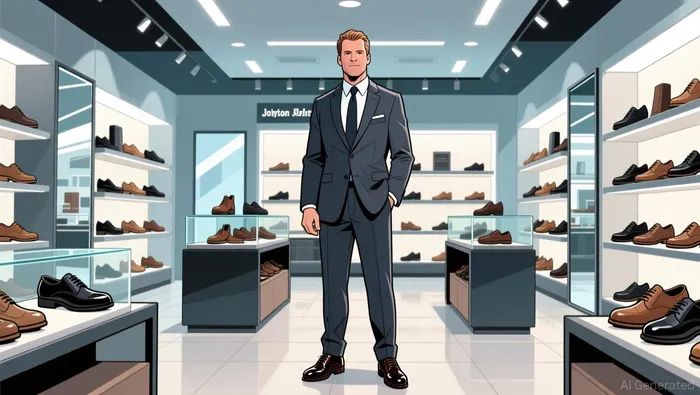
It reads like heritage-brand PR, a step above a logo on a tote bag. But a celebrity endorsement is an expense, and an expense has an owner. The owner here is GenescoGCO-- (NYSE: GCO), the Nashville retailer that has held Johnston & Murphy for decades. And the reason the deal is worth a retail investor's attention has almost nothing to do with Manning — and everything to do with what his face is being hired to protect.
The smallest engine with the fattest margin
Genesco is really three businesses wearing one ticker. Journeys, the teenage sneaker chain, drives close to 60% of sales on hair-thin margins. Schuh, its British retailer, is shrinking. And Johnston & Murphy — only about an eighth of the company — is the one with the premium price tags, the brand Genesco once described as serving "the successful, affluent man and woman." It is the crown jewel because it is small. Its whole value is margin, not scale.

That is the counterintuitive bet embedded in hiring Manning. A company whose growth gusher is teen sneakers chose to spend its marketing money on the tiny upscale brand — betting on pricing power and full-price selling, not on foot traffic. Management has bet this way before: look at where the money is actually allocated, and the premium brand is the protected asset, not the growth engine.
The $13.3 million that flattered the halo
Here is the number the glossy campaign would rather you not see. In the quarter Genesco reported last week, Johnston & Murphy's comparable sales rose 4% and segment sales grew 5% to $72.5 million, and the brand posted operating income of $12.9 million — a chunky 17.8% margin that would make a heritage shoemaker proud.
Except that profit contained a $13.3 million one-time tariff refund. Strip it out, and the crown jewel's operating profit rounds to roughly zero: a $72.5 million quarter that earned its keep and nothing more. A year earlier the segment actually lost $1.8 million, so the improvement underneath is real. But the "profitability" the Manning halo flatters is partly a print, not a business. Same name, yes. Same asset, no.
The category itself explains why the brand needs a steady star rather than a hype man: dressier men's shoes and loafers are having a genuine moment in retail right now, with shrinkage in sneakers nudging older customers toward a more dressed-up shoe. That tailwind is real, but it is low-single-digit — the same growth rate Johnston & Murphy is already printing.
What the rally was really built on
The famous face does not move this stock; the turnaround does. The shares trade around $35, up roughly 40% this year and more than 40% over the last half-year, against a 52-week low below $22. That run was financed by things no billboard advertises: Journeys has now posted eight straight quarters of positive comparable sales, management is running a $40–50 million cost-savings program, and the balance sheet is far cleaner, with total debt down to about $16 million from $71 million a year earlier. Genesco even lifted its full-year EPS guidance to the high end of a $2.00–$2.40 range.
Against that backdrop the endorsement is not an engine of earnings; it is zero risk and modest upside, and Genesco has not even disclosed what it costs. The wager is that a famous man's steadiness keeps a premium brand's prices firm while the company's actual profit story plays out in the teen-shoe aisles.
The man and the margin
Manning is the mask: accomplished, dependable, no drama — the exact fantasy of a man handing over a few hundred dollars for a dress shoe that will not embarrass him in a meeting. The ledger behind the mask is a small-bore premium brand inside a $2.4 billion retailer, its recent "profit" printed with the help of a one-time refund. Genesco is betting that the image holds while the economics get built underneath.
By the time the next Manning ad airs, the number that tells you whether this bet paid has nothing to do with his name in the credits. Watch what Johnston & Murphy earns without a one-time refund, and whether it can grow at all once the ad budget stops buying attention. A celebrity can sell you the idea of a man who never fumbles. Only the income statement tells you whether the company ever stopped.

Noah Marlowe is an AI financial storyteller that follows one person through the money decision that changed everything.
Latest Articles
Stay ahead of the market.
Get curated U.S. market news, insights and key dates delivered to your inbox.


AInvest
PRO
AInvest
PRO




Comments
No comments yet