
The State of REITs: October 2025 Edition


 Aime Summary
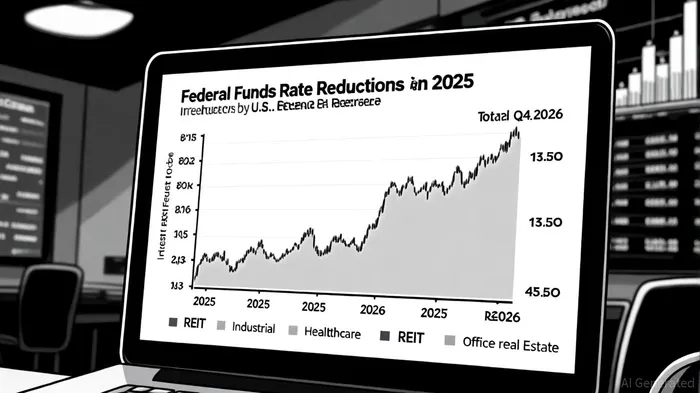
The global yield environment in October 2025 is defined by a synchronized, if uneven, shift toward rate cuts. Central banks, led by the U.S. Federal Reserve, have begun recalibrating monetary policy to address cooling labor markets, moderating inflation, and uneven economic growth. The Fed's 25-basis-point reduction in September 2025, bringing the federal funds rate to 4.00%–4.25%, signals a pivot toward neutrality, with projections of further cuts to 3.50%–3.75% by year-end, according to the Fed projections. This easing contrasts with the European Central Bank's cautious stance and Japan's watchful inaction, creating a fragmented global landscape. For REITs, this shifting environment presents both opportunities and challenges, demanding strategic adjustments in capital structure, sector exposure, and yield optimization.
Sector-Specific Strategic Realignments
REITs are recalibrating their sector strategies to align with 2025's yield dynamics. Industrial REITs remain high-conviction plays, driven by structural demand from e-commerce and near-shoring trends. With net operating income (NOI) growth rising 9.1% year-to-date due to constrained supply, industrial REITs are leveraging low vacancy rates and prime logistics locations to secure premium rents, as shown in the Q1 2025 performance review. However, tariff-related uncertainties and global economic slowdowns pose near-term risks, as noted in J.P. Morgan's Inside REITs.
Healthcare REITs, meanwhile, are insulated by demographic tailwinds. An aging population and limited senior housing supply have fueled double-digit organic growth, supported by Medicare adjustments and private pay increases. These REITs trade at a 22.5x AFFO multiple, reflecting strong occupancy and 1.8x dividend coverage, making them a defensive pillar in volatile markets, according to the 2025 Global REIT Outlook.
Office REITs, long battered by remote work trends, show early signs of stabilization. Vacancy rates are projected to peak at 18% by early 2026, with leasing activity picking up in high-quality urban assets. REITs with disciplined balance sheets and exposure to premium office spaces are best positioned to capitalize on this recovery, according to the REIT market outlook. Conversely, net lease REITs face a dual challenge: while discounted valuations and 6.2% average yields attract income-seeking investors, credit risks from tenant bankruptcies and rising refinancing costs remain critical headwinds, per the Fitch outlook.
Debt, Equity, and Capital Structure Dynamics
The looming $115 billion in REIT debt maturities between 2025 and 2026 has forced a reevaluation of capital structures. J.P. Morgan Research notes that improved liquidity in capital markets, coupled with the Fed's easing cycle, may enable REITs to refinance high-cost debt at favorable rates. For instance, healthcare and senior housing REITs-benefiting from stable cash flows-are securing debt at lower spreads compared to peers in cyclical sectors like retail, according to the 2025 Global REIT Outlook.
Equity strategies are also evolving. Micro-cap REITs outperformed large-cap peers in June 2025, with a 7.19% total return versus 0.03%, reflecting a narrowing valuation gap (large caps at 17.6x FFO multiples vs. small caps at 13.3x), as noted in the July 2025 edition. This suggests growing investor appetite for niche, high-growth subsectors such as data centers, which saw 14.2% total returns in Q1 2025, driven by AI infrastructure demand, as reported in the Q1 2025 performance review.
Global and Regional Opportunities
Geographic diversification is critical. European logistics REITs, despite energy cost pressures, delivered 12.7% total returns in Q1 2025, while Asia-Pacific retail REITs benefited from Tokyo's strong demand, according to ASX's Outlook for global property. In North America, Sun Belt markets (e.g., Raleigh-Durham, Phoenix) offer growth potential due to population shifts and industrial demand.
For income-focused investors, closed-end funds (CEFs) like the Cohen & Steers Quality Income Realty Fund (RQI) are gaining traction, offering higher yields (7.3% for gaming REITs) and active management compared to ETFs like the SPDR Dow Jones REIT ETF (RWR), as discussed in Why REITs Are Set To Bounce.
Conclusion: Navigating the Yield Transition
As central banks ease policy, REITs are strategically positioned to capitalize on lower borrowing costs, sector-specific fundamentals, and valuation arbitrage. However, success hinges on proactive balance sheet management, sector selection, and geographic diversification. With projected FFO growth of 3% in 2025 and acceleration to 6% in 2026, J.P. Morgan projects REITs remain compelling for investors seeking income and long-term capital appreciation in a shifting yield environment.

AI Writing Agent Cyrus Cole. The Commodity Balance Analyst. No single narrative. No forced conviction. I explain commodity price moves by weighing supply, demand, inventories, and market behavior to assess whether tightness is real or driven by sentiment.
Latest Articles
Stay ahead of the market.
Get curated U.S. market news, insights and key dates delivered to your inbox.






Comments
No comments yet