
State and Local Tax Deduction Overhaul: Navigating the 2025 SALT Cap Expansion for Investors
The 2025 One Big Beautiful Bill Act (OBBBA) has reshaped the federal tax landscape, most notably by temporarily expanding the State and Local Tax (SALT) deduction cap to $40,000 for married filers through 2029. This change, set to revert to $10,000 in 2030, creates both opportunities and risks for investors in high-tax states. Let's dissect the implications for portfolios and regional economies.
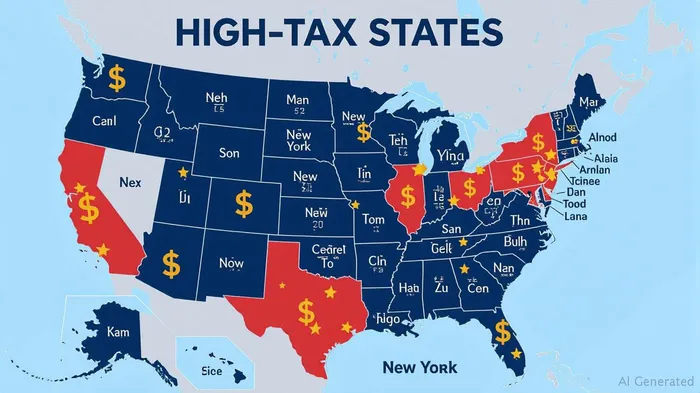
The SALT Cap Expansion: A Temporary Windfall for High-Income Taxpayers
The SALT deduction allows taxpayers to deduct state and local taxes (e.g., income, property, sales taxes) on their federal returns. The 2017 Tax Cuts and Jobs Act (TCJA) capped this deduction at $10,000—a move that disproportionately hurt high-earning residents in states with high income and property taxes. The OBBBA temporarily raises this limit to $40,000 for couples earning up to $500,000, phasing out for higher incomes. While this benefits affluent households in states like California and New York, the reversion to $10,000 in 2030 introduces uncertainty.
Investment Implications: Real Estate and Regional Economies
1. High-Tax State Real Estate:
The SALT cap increase may soften the blow of high property taxes, potentially stabilizing demand for housing in states like New Jersey or Connecticut. However, the 2030 expiration could trigger a correction.
2. State and Local Bonds:
States like New York and California, which rely heavily on income taxes, may see reduced pressure to lower rates or cut services. Investors in municipal bonds (e.g., California GO bonds) might benefit from stabilized tax revenues, but rising federal deficits could pressure interest rates.
3. Financial Services Firms:
Tax preparation companies (e.g., H&R Block) and wealth management firms catering to high-net-worth individuals could see increased demand for tax planning services as clients navigate the phase-out rules.
Risks and Political Uncertainties
1. Reversion Risk:
The temporary nature of the $40,000 cap creates a "cliff" in 2030. Investors in real estate or state bonds must consider whether Congress will extend the higher limit, or if high-tax states will adjust their tax structures preemptively.
2. Senate Pushback:
Senate Republicans from low-tax states may resist permanent SALT relief, fearing it rewards "blue states." Any legislative stalemate could disrupt markets.
3. Fiscal Fallout:
The Congressional Budget Office estimates the SALT expansion will cost $320 billion over a decade. Rising deficits could lead to broader tax hikes or spending cuts, affecting sectors like healthcare or defense.
Investment Strategy: Balance Opportunity with Caution
- Short-Term Plays:
- Invest in high-tax state real estate ETFs (e.g., FLN) or regional REITs with exposure to markets like San Francisco or New York.
Monitor municipal bond ETFs (e.g., MUB) for yield opportunities, but pair with inflation-protected securities (TIPS) to hedge rate risks.
Long-Term Caution:
- Avoid overcommitting to high-tax state assets beyond 2029. Diversify into low-tax states (e.g., Texas, Florida) where SALT changes have minimal impact.
- Consider inverse ETFs (e.g., SH) or options to hedge against market volatility tied to fiscal policy uncertainty.
Conclusion
The SALT deduction expansion offers a temporary tailwind for high-tax state economies but carries long-term risks. Investors should prioritize flexibility: allocate to sectors benefiting from the current rules while hedging against 2030's fiscal reckoning. As with all tax-driven investments, stay attuned to legislative developments—this could be a fleeting win for “blue state” portfolios.
Final Advice:
Use the SALT cap increase as a tactical opportunity but avoid overexposure to state-specific assets. Diversify geographically and sectorally, and keep a watchful eye on Congress's next fiscal moves.

Stay ahead of the market.
Get curated U.S. market news, insights and key dates delivered to your inbox.


AInvest
PRO
AInvest
PRO



Comments
No comments yet