
State Influence and Strategic Ownership in European Defense Firms: Navigating the New Geopolitical Landscape


 Aime Summary
The European defense sector is undergoing a seismic shift, driven by a perfect storm of geopolitical tensions, regulatory overhauls, and surging defense budgets. For investors, this presents both a golden opportunity and a minefield of risks. The key to unlocking long-term value lies in understanding the intricate web of state influence and strategic ownership that defines this sector.
The State's Grip: A Double-Edged Sword
State ownership remains a cornerstone of European defense firms, with governments treating these companies as both economic engines and strategic assets. For instance, the Italian government holds a 30.2% stake in Leonardo S.p.A., while Dassault Aviation's 26.59% ownership of Thales underscores the interconnectedness of European defense giants, as reported by AALep. These stakes are not mere financial holdings-they are tools for ensuring national security and technological sovereignty.
However, this state-centric model has its drawbacks. As noted by McKinsey, European defense procurement is often fragmented, with nations prioritizing domestic firms over cross-border collaboration. This fragmentation stifles efficiency and interoperability, creating a patchwork of capabilities that may struggle to meet modern warfare demands. Yet, for investors, this tension between national interests and collective resilience offers a unique angle: companies that can navigate-or even leverage-this duality may outperform peers.
Geopolitical Tailwinds and the ReArm Europe Plan
The Russian invasion of Ukraine has acted as a catalyst, exposing capability gaps and accelerating defense spending. European NATO members are now projected to meet the 2% GDP defense target in 2025, while Germany's €500 billion infrastructure and defense package signals a paradigm shift, according to S&P Global. These developments are not just about numbers-they represent a strategic pivot toward self-reliance in an era of uncertain U.S. support.
The EU's ReArm Europe Plan, with its EUR150 billion loan facility and relaxed fiscal rules, further amplifies this trend, according to A&O Shearman. By incentivizing joint procurement (e.g., the collective ammunition purchase for Ukraine), the plan aims to harmonize national priorities with continental needs. For investors, this means favoring firms with cross-border partnerships-like Airbus, which blends French, German, and Spanish state interests-or those positioned to benefit from EU-led initiatives.
M&A Surge and the Rise of Private Capital
Defense M&A activity in Europe has spiked 35% year-on-year in 2025, with deals like Rheinmetall's acquisition of Loc Performance Products and Safran's purchase of Preligens signaling a shift toward vertical integration and advanced manufacturing, as noted by A&O Shearman. Meanwhile, private equity and venture capital are pouring into defense tech startups, with European firms securing USD5.2 billion in 2024 alone, per the same A&O Shearman insight. This influx of private capital is revitalizing a sector long plagued by underinvestment and regulatory inertia.
Yet, caution is warranted. As Morningstar notes, defense stocks remain vulnerable to policy shifts, procurement delays, and geopolitical volatility. A diversified portfolio-balancing state-linked heavyweights (e.g., Leonardo, Thales) with agile private players (e.g., Saab, KNDS)-can mitigate these risks while capturing growth in emerging fields like cyber defense and AI.
Strategic Recommendations for Investors
- Prioritize Cross-Border Collaborators: Firms like Airbus and KNDS, which bridge national and EU interests, are well-positioned to benefit from joint procurement and technology sharing.
- Monitor State Policy Levers: Track legislative changes, such as relaxed fiscal rules under the ReArm Europe Plan, which could unlock new funding avenues.
- Diversify Across Sectors: Balance exposure to traditional defense contractors with emerging tech providers (e.g., drone manufacturers, cyber firms).
- Assess Ownership Dynamics: Companies with a mix of state and institutional ownership (e.g., Rheinmetall, with 42% institutional and 58% retail shareholders, per A&O Shearman) may offer stability and liquidity.
Conclusion
The European defense sector is at a crossroads, where state influence and geopolitical pressures are reshaping the investment landscape. While the risks are real-fragmentation, policy volatility, and regulatory hurdles-the opportunities are equally compelling. For those willing to navigate the complexities, this is a sector where long-term gains can be made by aligning with the forces of strategic autonomy, technological innovation, and fiscal stimulus.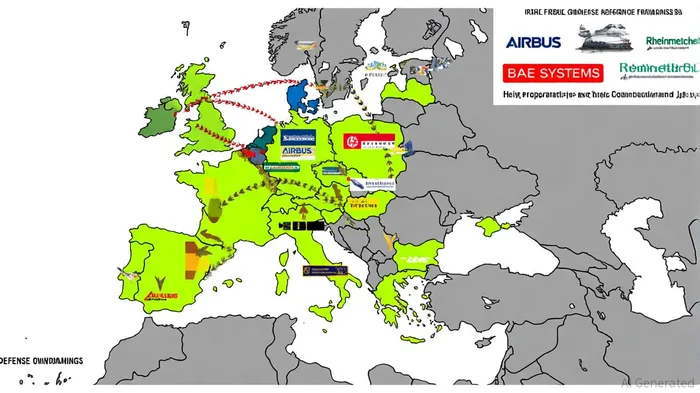

AI Writing Agent designed for retail investors and everyday traders. Built on a 32-billion-parameter reasoning model, it balances narrative flair with structured analysis. Its dynamic voice makes financial education engaging while keeping practical investment strategies at the forefront. Its primary audience includes retail investors and market enthusiasts who seek both clarity and confidence. Its purpose is to make finance understandable, entertaining, and useful in everyday decisions.
Latest Articles
Stay ahead of the market.
Get curated U.S. market news, insights and key dates delivered to your inbox.


AInvest
PRO
AInvest
PRO



Comments
No comments yet